



iPhone / iPhone Duo Live
Last night before you are out of bed. Apple Health vitals, Face ID.
Download on the App Store Apnealytics
Free on every plan: unlimited imports, the full dashboard and your last 30 nights.
 Compatibility checkerWill my machine work?Type your model. You get a straight answer: supported, partial, waitlist, or why not.Check my machine
 If it writes an SD card, we probably read it. ResMed AirMini has no card, so no app can read it.
Sleep Check-up
3 of 6 checks done
Six short screeners, one picture of how you sleep. Earn a milestone for each, save results and get retake reminders.
Latest milestone: Sleepiness check done
 NEWTrack your 90-day compliance windowOpen the calculator
 13 free tools. No account needed — sign in to save results and fill answers from your own CPAP data.
Last night before you are out of bed. Apple Health vitals, Face ID.
Download on the App Store


One account on every screen. Apple Watch vitals sync through Apple Health.
The mask is the part of CPAP therapy you actually feel, and it is the part most people get wrong first. There are three types, dozens of models and several sizes of each, and the one that suits you depends on how you breathe, how you sleep, what pressure you need and what your face is like. This guide to choosing a CPAP mask walks through those questions in order, then shows how to use your own leak and AHI data to judge whether the mask you picked is working, rather than guessing from how it feels at 11pm.
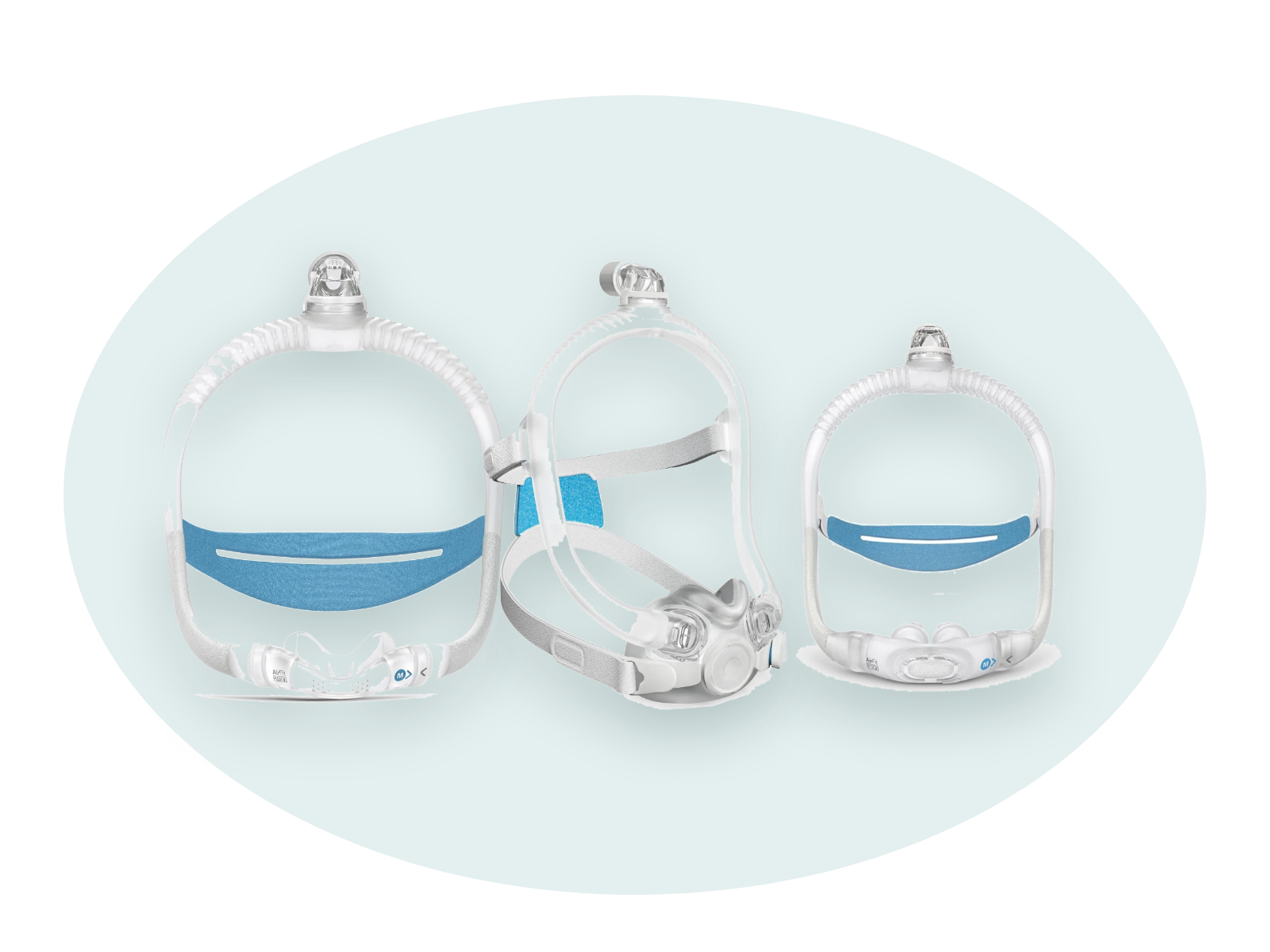
Nasal pillows. Two soft cones that sit at the nostril openings. Minimal contact, nothing on the bridge of the nose, clear line of sight. Best for people who breathe through their nose, sleep on their side or stomach, and run low to moderate pressure. Can irritate the nostrils at high pressure.
Nasal masks. A cushion that covers the nose, or sits under it (nasal cradle), sealed to the face. More stable than pillows at higher pressure, still leaves the mouth free. The classic over-the-nose style can press on the bridge; the under-the-nose cradle style avoids that.
Full face masks. Cover nose and mouth, or seal under the nose and around the mouth (hybrid). The right answer for mouth breathers, people with blocked noses, and anyone whose leak data shows the mouth opening at night. Larger, more contact, more strap tension, and more surface to leak from if the size is wrong.
Ask your partner, or check your data. If you wake with a dry mouth, or your current nasal mask shows high leak that comes in long flat stretches rather than brief spikes, you are probably mouth-breathing. That points to a full face mask, or a nasal mask with a chin strap if your clinician agrees. If your nose is clear and your mouth stays shut, pillows or a nasal mask are on the table.
Side and stomach sleepers want minimal bulk: pillows or a nasal cradle, with a hose connection on top of the head if possible so the pillow does not push the mask. Back sleepers can use anything, including larger full face masks. Active sleepers who turn a lot want a mask with a stable frame and headgear that does not slide.
Check your pressure P95 in your data. At high pressure, pillows can feel like a jet in the nostrils and may leak at the seal; nasal and full face masks spread the load. At low to moderate pressure, pillows are comfortable for most people. If your machine is a bilevel (AirCurve), the larger pressure swings also favour a mask with more sealing surface.
Facial hair breaks the seal on anything that sits on the cheeks and upper lip. Pillows and nasal cradles avoid most of it; full face masks with a beard are a known struggle.
A flat or narrow nasal bridge makes classic over-the-nose nasal masks and traditional full face masks leak at the top. Cradle and under-nose hybrid designs skip the bridge entirely.
Dentures change the shape of the lower face overnight; if you remove them, a full face mask fitted with them in will leak without them.
Claustrophobia pushes toward pillows.
Every manufacturer publishes a sizing gauge, usually a printable template. Use it. Most leak problems that look like the wrong mask are actually the wrong size, and the instinct is nearly always to go bigger when smaller is the fix. Try the mask lying down with the machine running; a seal that holds sitting up can open when your face relaxes.
Many DMEs allow a mask swap within the first 30 days, so the first choice does not have to be the last.
How a mask feels at bedtime is a poor guide to how it performed at 3am. After a week with a new mask, look at three numbers:
The level leak stayed under for 95 percent of the night. Under ResMed's large-leak threshold (24 L/min) means the seal held. A P95 above it means heavy leak for a meaningful part of the night.
If leak was fine and AHI is stable or lower than with the previous mask, the mask is doing its job.
A mask you take off at 2am has failed regardless of its leak numbers.
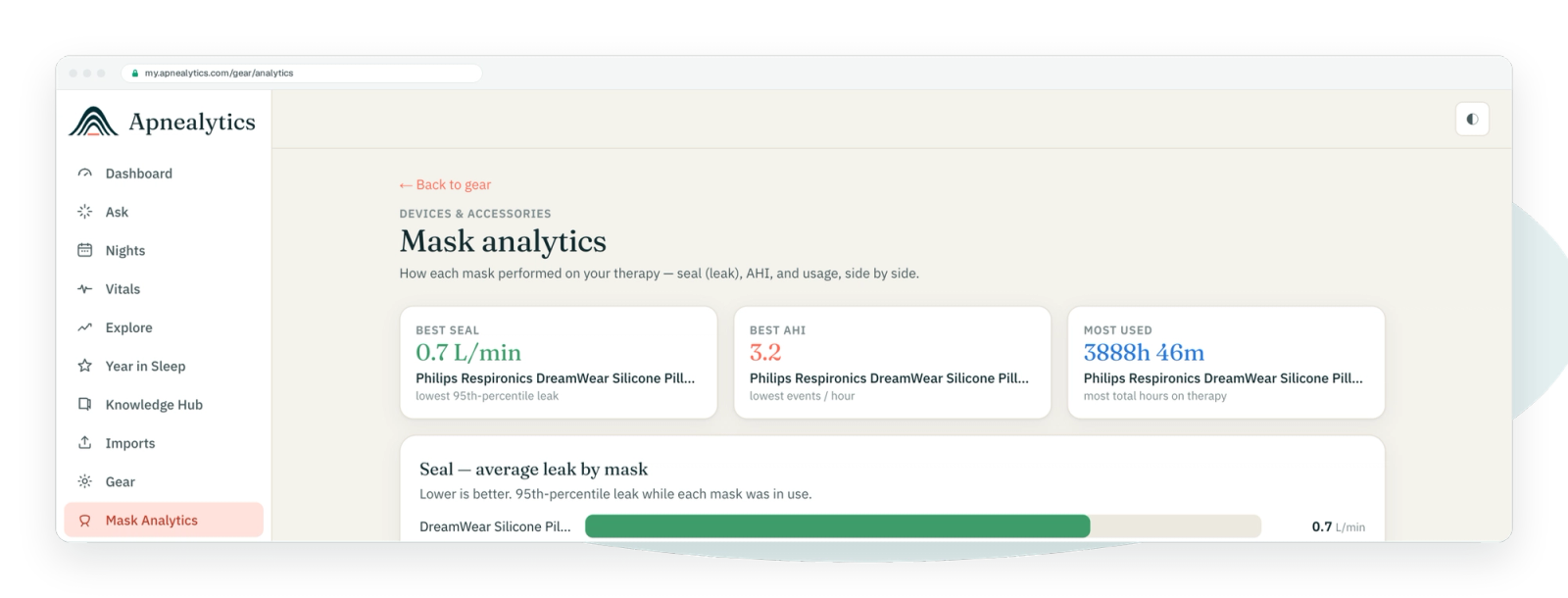
In Apnealytics, record the mask in Gear (the catalog holds 62 masks by brand, type and size, with photos) and the Mask Analytics page shows seal, AHI and usage per mask. Switch masks and the comparison appears without any spreadsheet. The nightly leak trace on Pro shows whether leak is a steady background (size or type) or sudden spikes (position, or a strap slipping).
A new mask takes a few nights to settle: straps stretch slightly, you learn where it sits, your skin adjusts. Judge it on the second week, not the first night. If leak P95 is still high after adjusting strap tension (looser is often better) and trying one size either way, change the type.
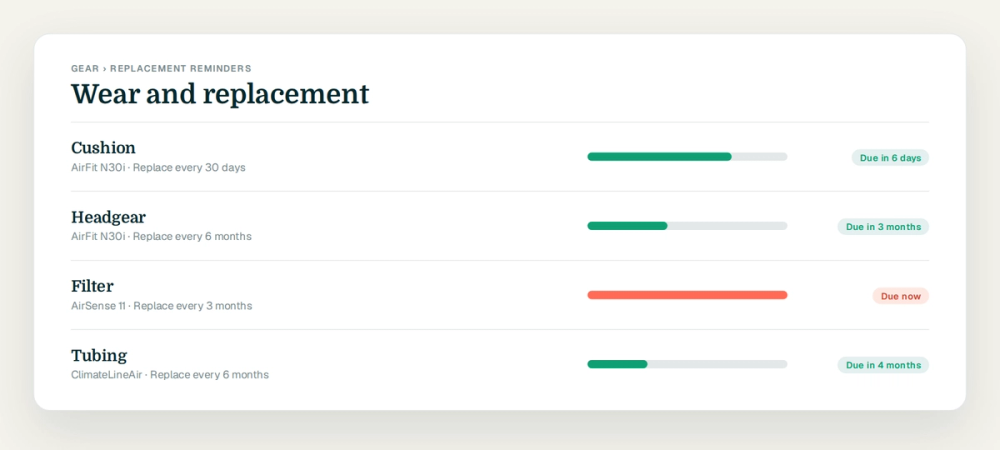
Cushions and pillows harden and lose their seal over weeks. Most insurers cover cushion replacement every 1 to 3 months and a full mask every 3 to 6. Apnealytics sends replacement reminders for cushion, filter and tubing, with one-tap reorder, and the "What changed?" panel will often show a leak improvement the night a new cushion goes on. If leak has crept up over two months with no other change, the cushion is the first suspect.
For most nose-breathers at low to moderate pressure, nasal pillows or a nasal cradle, because they touch the least face. For mouth-breathers, a full face mask is more comfortable in practice than a nasal mask with a chin strap, because it does not fight the mouth. Comfort is personal; judge by whether you keep it on all night.
Neither is better. Pillows suit nose-breathers, side sleepers, people with beards and lower pressures. Full face masks suit mouth-breathers, blocked noses and higher pressures. Your leak data decides: long flat stretches of high leak on a nasal mask usually mean the mouth is opening, which points to full face.
Look at leak P95 after a week. Under ResMed's large-leak threshold (24 L/min) is fine. Above it, try loosening the straps first, then one size smaller or larger, then a different type. Mask Analytics in Apnealytics compares seal per mask so you can see which held best.
Sometimes, with a chin strap, and only if your clinician agrees. Many mouth-breathers find the strap uncomfortable and the leak persists. If your data shows mouth leak after a fair trial, a full face or under-nose hybrid mask is usually the better answer.
Typically every 1 to 3 months for cushions and pillows, and every 3 to 6 months for the full mask, depending on your insurer's schedule. A gradual rise in leak with no other change is the usual sign a cushion is worn. Apnealytics sends replacement reminders and offers one-tap reorder.
The web app is live today. iPhone and iPad are on the App Store. Android is on Google Play. Your first 30 nights are free, forever.
 DashboardSleep Score, AHI band, leak and pressure
 Trends & historyA year down to a night
 Breath-by-breath viewerAirflow, pressure, leak tracesPro
 SpO₂ overlayOximeter data on the same nightPro
 Pressure insightsP95, set range, EPR and ramp
 SD card importDrop the card folder, only new nights added
 Mask fit & gearWhich mask actually seals
 Ask your dataPlain-English questions, your own AI keyBYOK
 Year in SleepYour therapy year in one storyNew
 Compliance reportFinds the qualifying window for youPro
 Share with your doctorRead-only, revocable links
 Companion appiPhone, iPad and Android
 Privacy & securityYour data, locked to you
 ResMed AirSense 10 & 11Supported
 ResMed AirCurve 10 & 11 VAutoSupported
 ResMed S9 / LumisSupported
 Philips DreamStation 1 & 2Supported
 Fisher & Paykel SleepStyleSupported
 Löwenstein / DeVilbissPartial
 React Health Luna G3Waitlist
 Transcend MicroWaitlist
 Full face masksFit, leak signature, Mask Analytics
 Nasal masksOver-nose and cradle styles
 Nasal pillowsMinimal-contact fit tips
 Wellue O2RingSupported
 Contec CMS50 familySupported
 Apple Health / Health ConnectResting HR, HRV, SpO₂, sleepSupported
 What is AHI?The apnea-hypopnea index, explained
 What is a good AHI on CPAP?
 CPAP leak rate explained
 Pressure settings explained
 Reading CPAP waveformsAll 14 explainers
 Apnealytics vs SleepHQ
 Apnealytics vs OSCAR
 Apnealytics vs myAir
 Apnealytics vs DreamMapper
 SleepHQ vs OSCARBest CPAP apps in 2026
 How to read CPAP dataStart here: six numbers, in order
 Read your CPAP SD card
 Share data with your doctorChoosing a CPAP mask
 Travel with CPAPAll guides
 Mask finderSeven questions, a ranked mask typeYour data
 Machine finderA two-machine shortlist for your prescription
 iPhone / iPhone DuoLast night before you are out of bed. Apple Health vitals, Face ID.Live
 iPadSame universal app, side-by-side panes and full-width waveforms.Live
 AndroidPhones, tablets and foldables, with Health Connect built in.Live
 Web portalWhere your SD card goes. Every chart, report and setting.Live

