



iPhone / iPhone Duo Live
Last night before you are out of bed. Apple Health vitals, Face ID.
Download on the App Store Apnealytics
Free on every plan: unlimited imports, the full dashboard and your last 30 nights.
 Compatibility checkerWill my machine work?Type your model. You get a straight answer: supported, partial, waitlist, or why not.Check my machine
 If it writes an SD card, we probably read it. ResMed AirMini has no card, so no app can read it.
Sleep Check-up
3 of 6 checks done
Six short screeners, one picture of how you sleep. Earn a milestone for each, save results and get retake reminders.
Latest milestone: Sleepiness check done
 NEWTrack your 90-day compliance windowOpen the calculator
 13 free tools. No account needed — sign in to save results and fill answers from your own CPAP data.
Last night before you are out of bed. Apple Health vitals, Face ID.
Download on the App Store


One account on every screen. Apple Watch vitals sync through Apple Health.
Travelling with CPAP is two problems. The first is the machine: getting it there, powering it, keeping it clean. The second, which almost nobody mentions, is the data: whether the nights away are recorded, where they end up, and whether your history has a hole in it when you get home. This guide to travel with CPAP covers both, with a straight answer on the AirMini, which solves the first problem and creates the second.
Your everyday machine (AirSense 10 or 11, AirCurve). Heavier and larger, but it records full data to the SD card, uses your usual mask, and your therapy continues exactly as at home. For a week away, most people take it. It fits a carry-on, it does not count against your bag allowance on most US airlines as a medical device, and the data is complete.
A travel machine. Smaller, lighter, often with a battery option. The trade-off is data.
If complete data matters to you, take the main machine. If size matters more, take the travel machine and accept a gap.
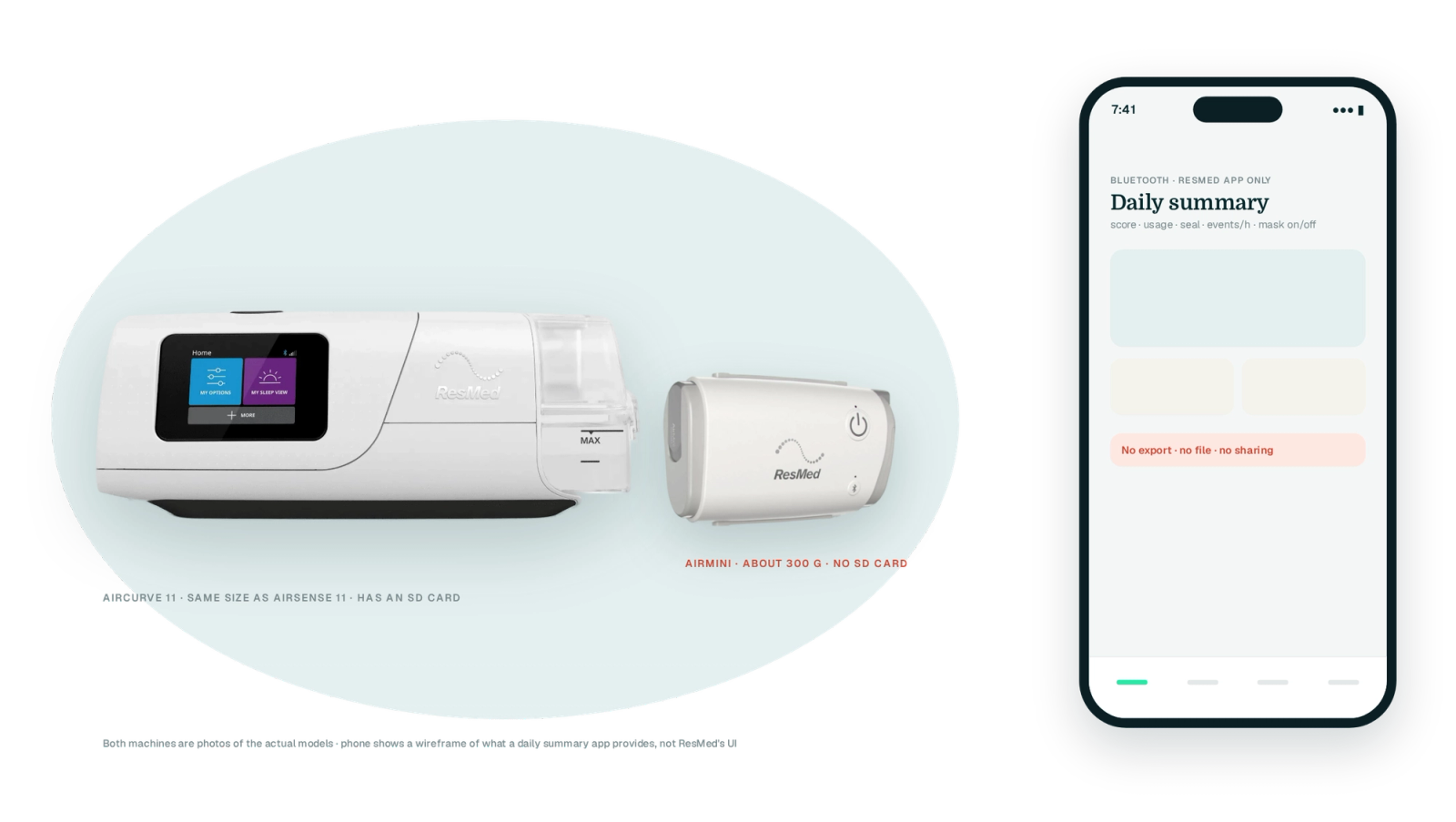
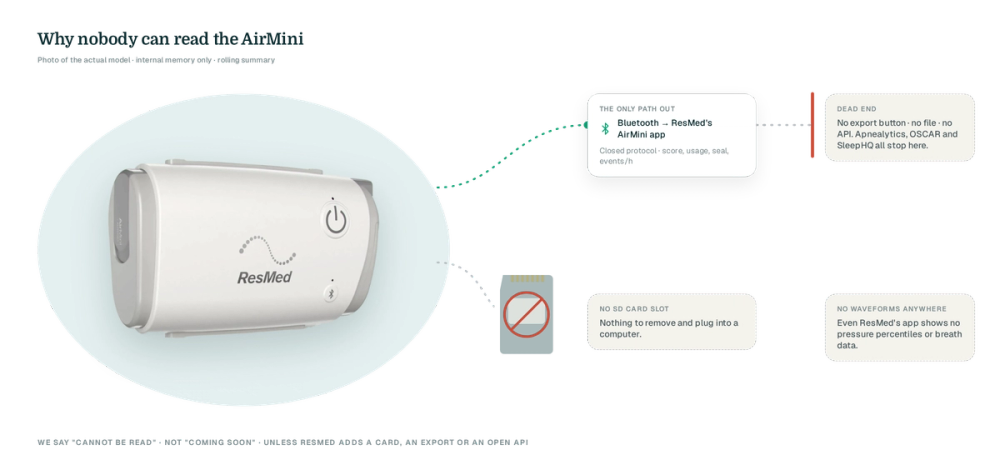
The AirMini is a good travel machine and an honest page has to say what it costs you in data terms.
You will see a nightly myAir score and its four components. That is all.
Apnealytics cannot import those nights. Your Nights list will show the dates as missing.
Your import streak and any usage goal that counts machine data will break for the trip.
If you are inside your first 90 days and need compliance data, AirMini nights still count with the DME through myAir and AirView, but they will not appear in a card-based compliance report.
Two ways to soften it:
Power. Check the voltage range on your power brick; ResMed bricks handle 100–240 V, so you need only a plug adapter, not a converter. For camping or long flights, a dedicated CPAP battery is the only safe option; do not improvise with a general-purpose power bank unless it is rated for the machine. Turn off the humidifier and heated tube to extend battery life.
Water. Distilled water is not always available. Bottled water for a few nights is fine for most machines; empty and dry the chamber each morning.
Mask and spares. A spare cushion weighs nothing and saves a trip.
Documentation. A copy of your prescription and a letter of medical necessity. Some security checkpoints ask; most do not.
The SD card. Leave it in the machine. Do not take it out for the trip "to keep it safe"; the machine will record nothing in detail without it.
CPAP machines are medical devices and do not count toward your carry-on limit on most US airlines. Carry it on; never check it. At security, you may be asked to remove it from its bag for screening, as with a laptop. Keep the hose and mask in a clear bag so they are not handled directly. On the plane, you can use it if your seat has power or you have a battery, but tell the crew.
Use the machine as at home. If you are on the main machine, the SD card records every night as usual and there is nothing to do. Altitude and dry air can change how a night feels; the machine compensates for altitude automatically on current ResMed models, and a bump in leak or AHI for a night or two is common and usually settles.
If you took your main machine:
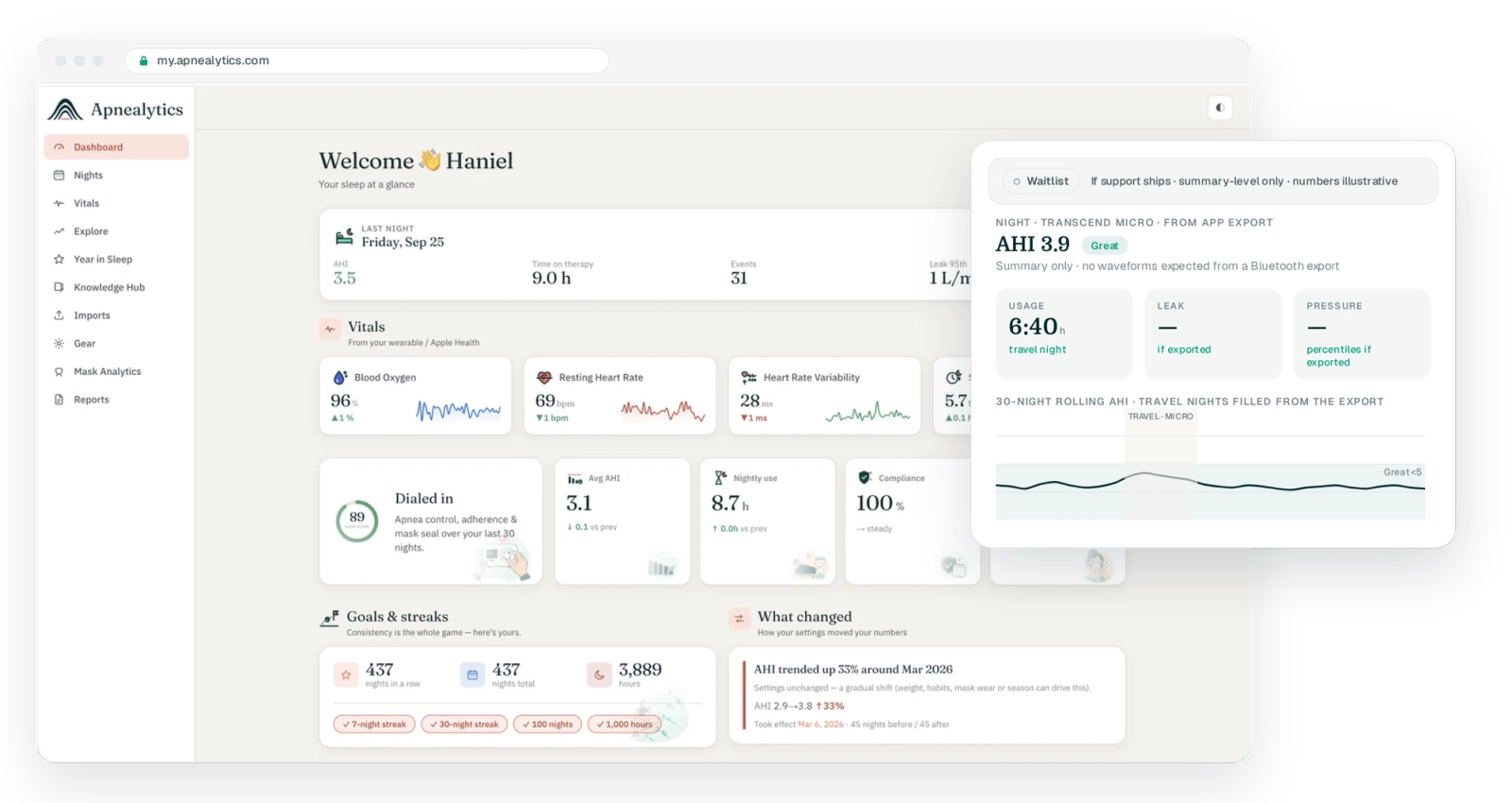
Take the SD card out as usual and upload it on the web portal at my.apnealytics.com.
The upload is incremental. Every night away is added; nights already imported are skipped.
Your streak counts the nights, and the trip appears in Trends with no gap.
If you took an AirMini or another unsupported travel machine:
For a month or more away with your main machine, you can upload the card from any computer with a reader. Sign in to the web portal from a laptop, upload, and put the card back. Card import is web-only, so a phone alone cannot do it; a borrowed laptop can. If you have no computer at all, the card holds many months, so the data waits for you.
Yes. CPAP machines are medical devices and on most US airlines do not count toward your carry-on allowance. Carry it on, never check it. At security it may need to come out of its bag like a laptop. Bring a copy of your prescription in case anyone asks, though most checkpoints do not.
Only summary data, sent to the myAir app over Bluetooth. The AirMini has no SD card, so there is no detailed record and no file for Apnealytics, OSCAR or SleepHQ to read. If you travel with an AirMini, those nights will not appear in your Apnealytics history; a trigger-journal note explains the gap.
Not if you take your main machine and upload the card when you return; the upload is incremental and adds every night away. If you use an AirMini or another unsupported travel machine, the streak pauses for those nights, because there is no card data to import.
Distilled is best for the humidifier chamber, but bottled water for a few nights is acceptable for most machines if you empty and dry the chamber each morning. Mineral build-up is a long-term problem, not a one-week one. You can also run without humidification for short trips.
Yes, from any computer with a card reader and a browser: sign in at my.apnealytics.com and upload as at home. The upload goes directly to your private storage and is resumable if the hotel connection drops. Card import is web-only, so a phone alone cannot do it.
The web app is live today. iPhone and iPad are on the App Store. Android is on Google Play. Your first 30 nights are free, forever.
 DashboardSleep Score, AHI band, leak and pressure
 Trends & historyA year down to a night
 Breath-by-breath viewerAirflow, pressure, leak tracesPro
 SpO₂ overlayOximeter data on the same nightPro
 Pressure insightsP95, set range, EPR and ramp
 SD card importDrop the card folder, only new nights added
 Mask fit & gearWhich mask actually seals
 Ask your dataPlain-English questions, your own AI keyBYOK
 Year in SleepYour therapy year in one storyNew
 Compliance reportFinds the qualifying window for youPro
 Share with your doctorRead-only, revocable links
 Companion appiPhone, iPad and Android
 Privacy & securityYour data, locked to you
 ResMed AirSense 10 & 11Supported
 ResMed AirCurve 10 & 11 VAutoSupported
 ResMed S9 / LumisSupported
 Philips DreamStation 1 & 2Supported
 Fisher & Paykel SleepStyleSupported
 Löwenstein / DeVilbissPartial
 React Health Luna G3Waitlist
 Transcend MicroWaitlist
 Full face masksFit, leak signature, Mask Analytics
 Nasal masksOver-nose and cradle styles
 Nasal pillowsMinimal-contact fit tips
 Wellue O2RingSupported
 Contec CMS50 familySupported
 Apple Health / Health ConnectResting HR, HRV, SpO₂, sleepSupported
 What is AHI?The apnea-hypopnea index, explained
 What is a good AHI on CPAP?
 CPAP leak rate explained
 Pressure settings explained
 Reading CPAP waveformsAll 14 explainers
 Apnealytics vs SleepHQ
 Apnealytics vs OSCAR
 Apnealytics vs myAir
 Apnealytics vs DreamMapper
 SleepHQ vs OSCARBest CPAP apps in 2026
 How to read CPAP dataStart here: six numbers, in order
 Read your CPAP SD card
 Share data with your doctorChoosing a CPAP mask
 Travel with CPAPAll guides
 Mask finderSeven questions, a ranked mask typeYour data
 Machine finderA two-machine shortlist for your prescription
 iPhone / iPhone DuoLast night before you are out of bed. Apple Health vitals, Face ID.Live
 iPadSame universal app, side-by-side panes and full-width waveforms.Live
 AndroidPhones, tablets and foldables, with Health Connect built in.Live
 Web portalWhere your SD card goes. Every chart, report and setting.Live

