



iPhone / iPhone Duo Live
Last night before you are out of bed. Apple Health vitals, Face ID.
Download on the App Store Apnealytics
Free on every plan: unlimited imports, the full dashboard and your last 30 nights.
 Compatibility checkerWill my machine work?Type your model. You get a straight answer: supported, partial, waitlist, or why not.Check my machine
 If it writes an SD card, we probably read it. ResMed AirMini has no card, so no app can read it.
Sleep Check-up
3 of 6 checks done
Six short screeners, one picture of how you sleep. Earn a milestone for each, save results and get retake reminders.
Latest milestone: Sleepiness check done
 NEWTrack your 90-day compliance windowOpen the calculator
 13 free tools. No account needed — sign in to save results and fill answers from your own CPAP data.
Last night before you are out of bed. Apple Health vitals, Face ID.
Download on the App Store


One account on every screen. Apple Watch vitals sync through Apple Health.
Your machine records how well your mask sealed every night, but it does not know which mask you wore. Apnealytics does. Pick your mask from a catalog of 62, and CPAP mask tracking turns your leak data into Mask Analytics: seal, AHI and usage per mask, so you can see which one actually works for you, and when its cushion is due.
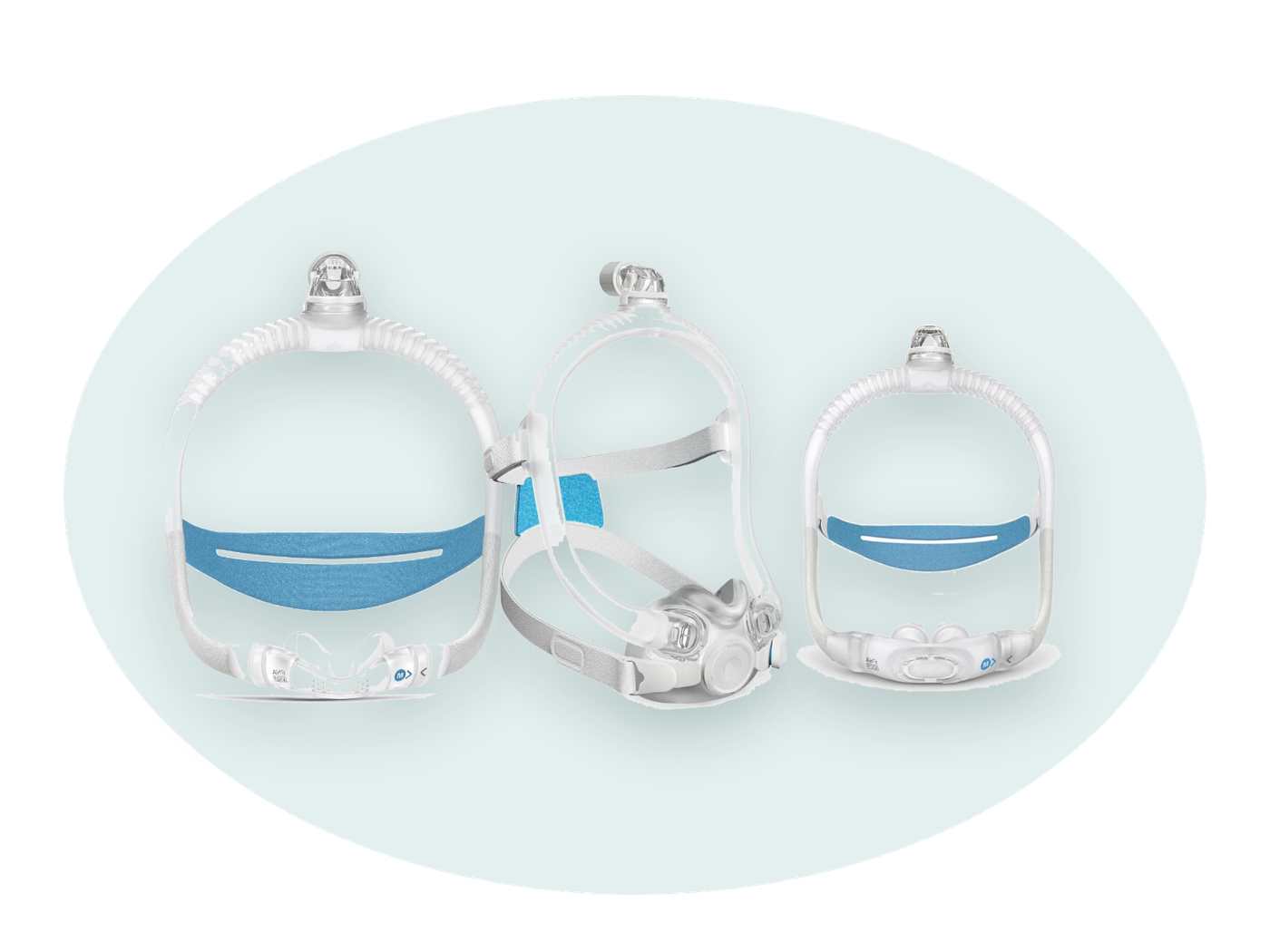
Browse the Gear catalog by brand, then type, then size, or search by name. Each mask has a photo and a detail page. If yours is not listed, add it with your own photo.
Every night from that date is attributed to that mask until you switch.
Your machine's leak and AHI data lands on each night as always; Apnealytics joins it to the mask you had on.
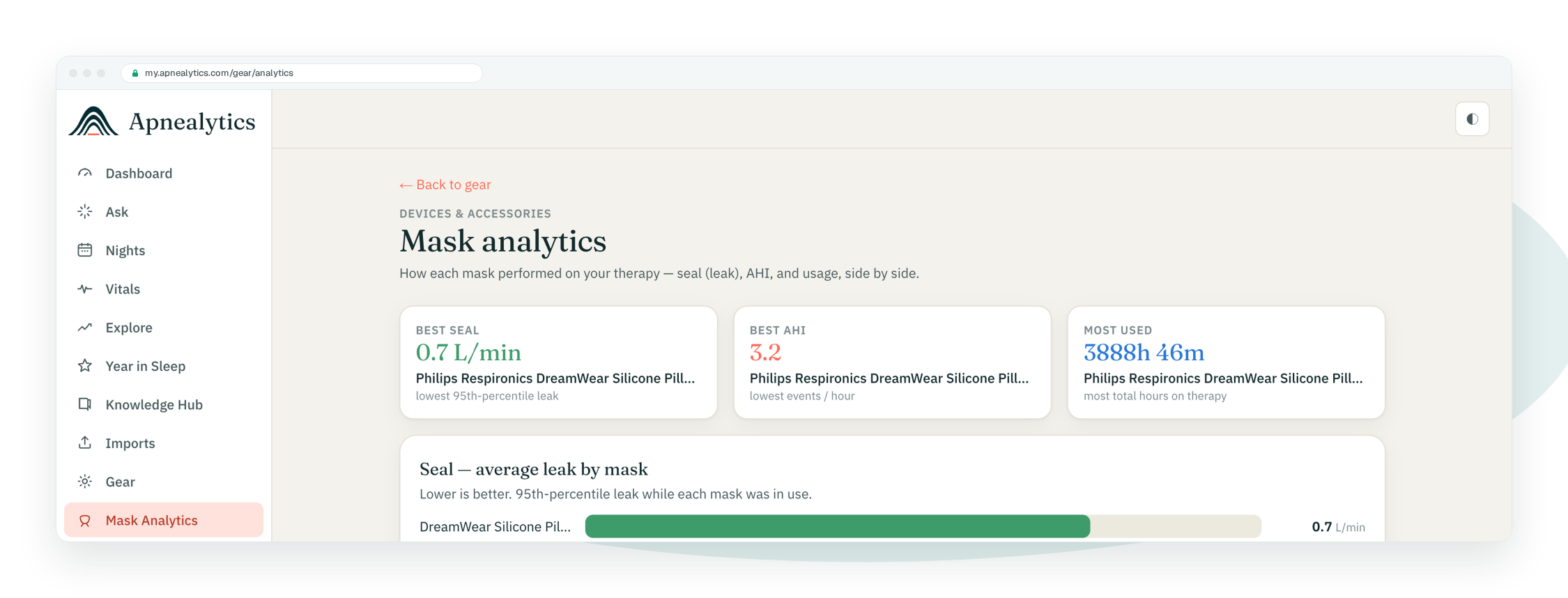
For each mask you have used, you see its seal score, average AHI and average usage, side by side.
Built from leak P95, the 95th-percentile leak across the night. Leak P95 tells you how bad leak got during a sustained stretch, which is more useful than an average that a good first half can hide. A mask with a lower leak P95 across many nights has a better seal for your face.
Average machine-estimated AHI across the nights you wore each mask. A mask that lets your mouth fall open may show a higher AHI even with a good-looking seal number.
Average hours per night. A mask you take off at 3 a.m. shows up here, and it is often the most honest comfort measure you have.
How many nights each mask has, and over what dates, so you know whether a comparison rests on three nights or three hundred.
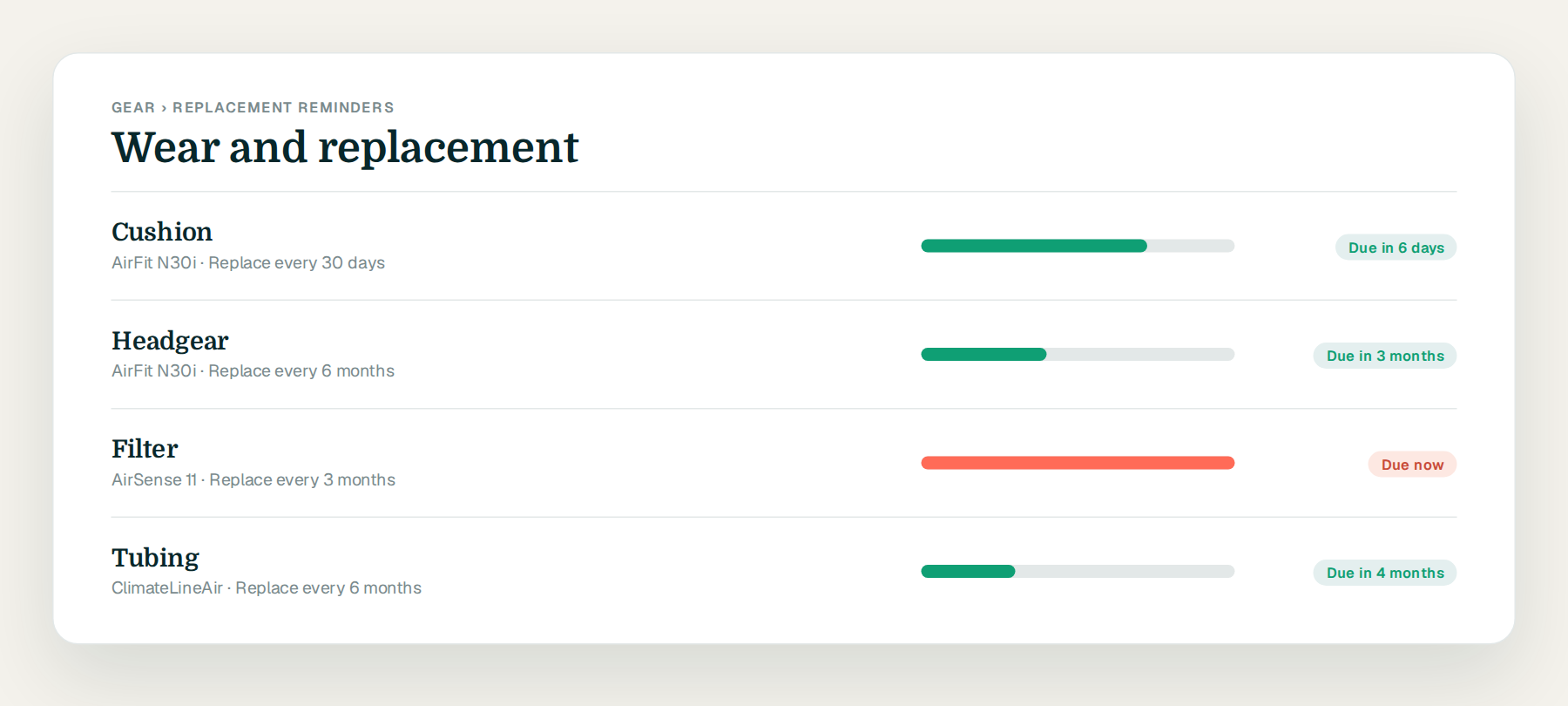
Cushions, pillows, filters and tubing wear out on a schedule, and a worn cushion is one of the most common reasons leak creeps up. Set a replacement interval for each part when you add it, and Apnealytics reminds you when it is due. Push notifications on the phone apps never show health numbers on the lock screen. One-tap reorder links to your supplier of choice.
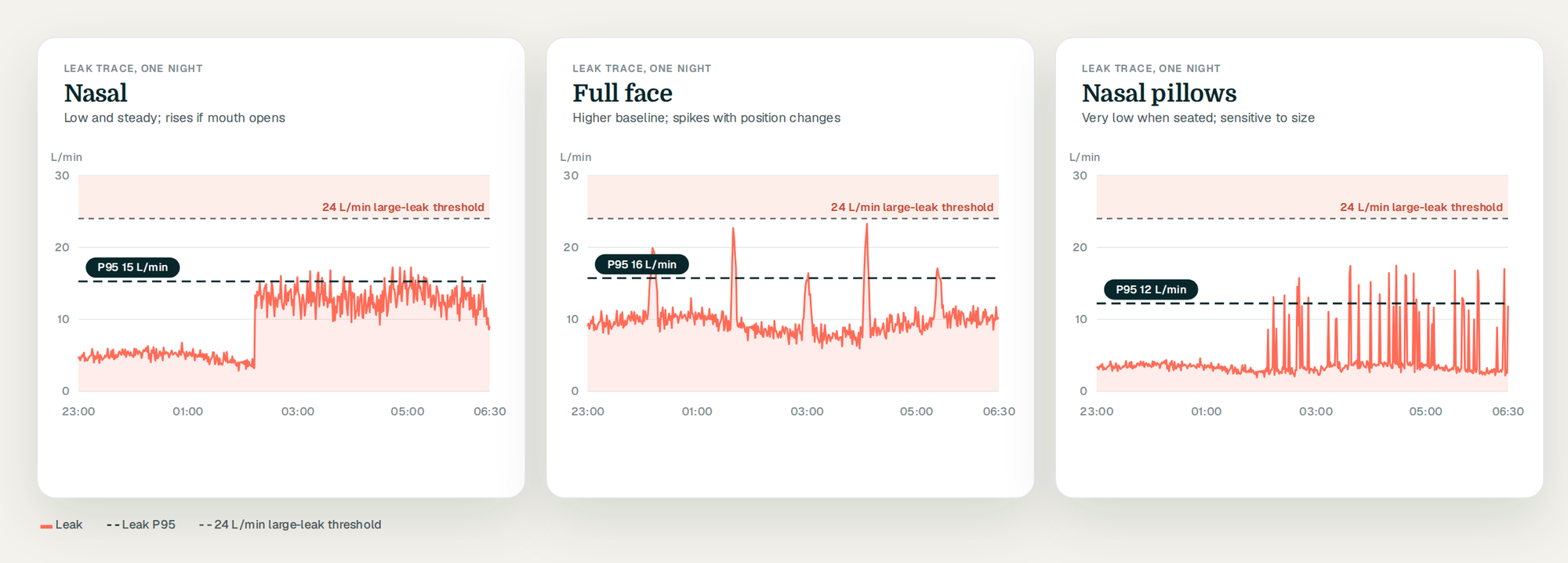
Each type page explains who it suits, fit tips, popular models and what Mask Analytics shows.
| Type | Covers | Suits | Typical leak signature |
|---|---|---|---|
| Nasal | Nose only, cushion or cradle | Nose breathers, side sleepers | Low and steady; rises if mouth opens |
| Full face | Nose and mouth | Mouth breathers, higher pressures, congestion | Higher baseline; spikes with position changes |
| Nasal pillows | Seals at the nostrils | Minimal contact, glasses wearers, facial hair | Very low when seated; sensitive to pillow size |
The catalog includes current models from ResMed (AirFit N30i, N20, F20, F30i, P30i, P10 and others), Philips Respironics (DreamWear in nasal, pillows and full face), Fisher & Paykel (Evora, Eson 2, Vitera, Brevida), and others, 62 in all with photos and part lists. Masks work with any machine that has a standard 22 mm tube connection; AirMini-specific versions are listed separately. Mask tracking does not depend on your machine being supported: a DreamStation owner can track masks today and the seal data fills in from the nights you import.
ResMed machines ask you to set the mask type (Pillows, Nasal, Full Face) because it changes how leak is calculated and what counts as normal. When you switch mask type in Apnealytics, the "What changed?" panel marks the switch so a step in leak P95 is explained rather than alarming. Read more in mask seal and leak explained.
You tell it once. Add the mask from the catalog of 62, set the start date, and every night from then on is attributed to that mask. When you switch, add the new one and the attribution changes from that date. Your machine's leak and AHI data is then compared per mask in Mask Analytics.
Leak P95 is the leak level that 95 percent of the night stayed below, so it reflects your worst sustained stretch rather than an average. It is the standard measure for judging mask seal because a good average can hide an hour of heavy leak. Apnealytics shows it on every night and per mask.
Yes for the catalog, replacement reminders and gear history. Seal, AHI and usage per mask need nightly data, so they fill in from the nights you import, on any supported machine. Owners of machines on the waitlist can set up their gear now.
Follow your supplier's guidance; a common pattern is cushions and pillows monthly, filters monthly or fortnightly, and frames and tubing every few months, but it varies by product and insurer. Apnealytics lets you set your own interval per part and reminds you when it is due.
It shows you what happened with each mask you have actually worn: seal, AHI, usage, over how many nights. That is strong evidence for a conversation with your equipment supplier or clinician. It is not a recommendation engine, and we do not take payment from mask manufacturers.
The web app is live today. iPhone and iPad are on the App Store. Android is on Google Play. Your first 30 nights are free, forever.
 DashboardSleep Score, AHI band, leak and pressure
 Trends & historyA year down to a night
 Breath-by-breath viewerAirflow, pressure, leak tracesPro
 SpO₂ overlayOximeter data on the same nightPro
 Pressure insightsP95, set range, EPR and ramp
 SD card importDrop the card folder, only new nights added
 Mask fit & gearWhich mask actually seals
 Ask your dataPlain-English questions, your own AI keyBYOK
 Year in SleepYour therapy year in one storyNew
 Compliance reportFinds the qualifying window for youPro
 Share with your doctorRead-only, revocable links
 Companion appiPhone, iPad and Android
 Privacy & securityYour data, locked to you
 ResMed AirSense 10 & 11Supported
 ResMed AirCurve 10 & 11 VAutoSupported
 ResMed S9 / LumisSupported
 Philips DreamStation 1 & 2Supported
 Fisher & Paykel SleepStyleSupported
 Löwenstein / DeVilbissPartial
 React Health Luna G3Waitlist
 Transcend MicroWaitlist
 Full face masksFit, leak signature, Mask Analytics
 Nasal masksOver-nose and cradle styles
 Nasal pillowsMinimal-contact fit tips
 Wellue O2RingSupported
 Contec CMS50 familySupported
 Apple Health / Health ConnectResting HR, HRV, SpO₂, sleepSupported
 What is AHI?The apnea-hypopnea index, explained
 What is a good AHI on CPAP?
 CPAP leak rate explained
 Pressure settings explained
 Reading CPAP waveformsAll 14 explainers
 Apnealytics vs SleepHQ
 Apnealytics vs OSCAR
 Apnealytics vs myAir
 Apnealytics vs DreamMapper
 SleepHQ vs OSCARBest CPAP apps in 2026
 How to read CPAP dataStart here: six numbers, in order
 Read your CPAP SD card
 Share data with your doctorChoosing a CPAP mask
 Travel with CPAPAll guides
 Mask finderSeven questions, a ranked mask typeYour data
 Machine finderA two-machine shortlist for your prescription
 iPhone / iPhone DuoLast night before you are out of bed. Apple Health vitals, Face ID.Live
 iPadSame universal app, side-by-side panes and full-width waveforms.Live
 AndroidPhones, tablets and foldables, with Health Connect built in.Live
 Web portalWhere your SD card goes. Every chart, report and setting.Live

