



iPhone / iPhone Duo Live
Last night before you are out of bed. Apple Health vitals, Face ID.
Download on the App Store Apnealytics
Free on every plan: unlimited imports, the full dashboard and your last 30 nights.
 Compatibility checkerWill my machine work?Type your model. You get a straight answer: supported, partial, waitlist, or why not.Check my machine
 If it writes an SD card, we probably read it. ResMed AirMini has no card, so no app can read it.
Sleep Check-up
3 of 6 checks done
Six short screeners, one picture of how you sleep. Earn a milestone for each, save results and get retake reminders.
Latest milestone: Sleepiness check done
 NEWTrack your 90-day compliance windowOpen the calculator
 13 free tools. No account needed — sign in to save results and fill answers from your own CPAP data.
Last night before you are out of bed. Apple Health vitals, Face ID.
Download on the App Store


One account on every screen. Apple Watch vitals sync through Apple Health.
A good AHI on CPAP is generally one under 5 events per hour, which is the same cut-off used to call breathing normal in a sleep study. Many people on well-set therapy sit between 1 and 3. But the number only tells part of the story, and how you feel still counts.
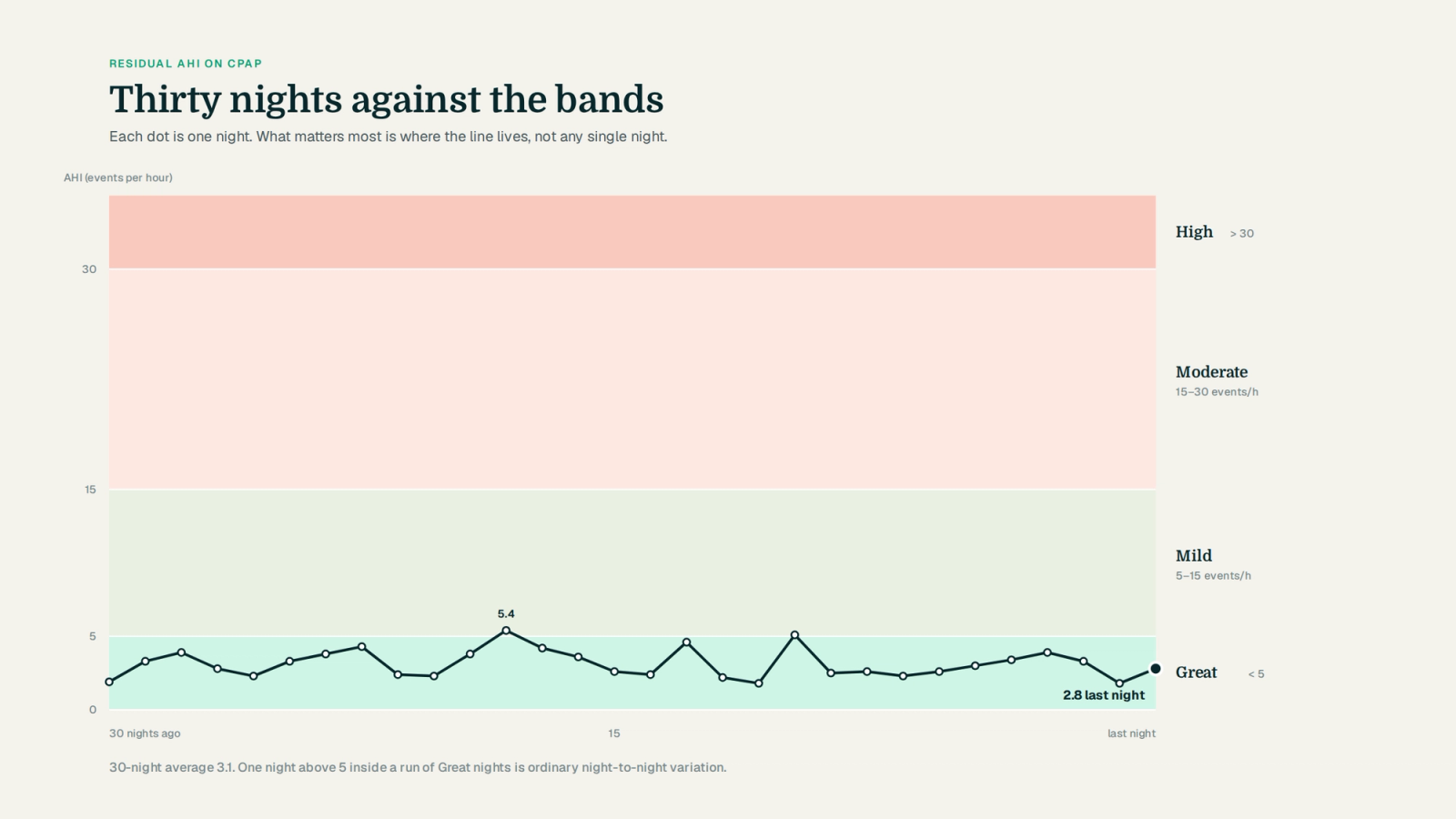
If your residual AHI is below 5 most nights, your therapy is doing what it was prescribed to do by the usual clinical measure. If it is consistently above 5, that is worth a conversation with your clinician. If it is above 10 or climbing, do not wait for your next appointment to mention it.
That is the short answer. The longer answer is that "good" depends on where you started, what kind of events remain, how much leak there is, and whether you wake up feeling rested.
Before you start therapy, a sleep study gives you a diagnostic AHI. For adults the bands are under 5 normal, 5 to 15 mild, 15 to 30 moderate, and over 30 severe. That number describes your untreated apnea.
Once you are on CPAP, the number you see every morning is your residual AHI: the events that still slipped through while the machine was running. These are different quantities. Someone with a diagnostic AHI of 60 who now runs a residual of 4 has had a dramatic improvement; someone with a diagnostic AHI of 8 who runs a residual of 4 has had a modest one. Both are "under 5."
The AHI explainer covers how the machine arrives at its estimate and why it is not the same as a lab measurement.
There is no single universal target written into every guideline, but a residual AHI under 5 is the most common threshold used in clinical practice and in research to say that CPAP is controlling the apnea. Some clinicians, and many engaged patients, aim lower, on the view that fewer events means fewer arousals and better sleep quality. Others are comfortable with a residual in the 5 to 10 range if symptoms are controlled and the remaining events are mostly hypopneas.
Your own target is something to settle with your clinician. It will depend on your diagnosis, your symptoms, any heart or lung conditions, and what is realistic with your mask and comfort settings.
A good AHI on CPAP is necessary but not sufficient. Four other things sit beside it.
Leak. When unintentional leak is high, the machine's ability to detect events drops. A low AHI on a high-leak night may simply mean the machine could not see well. Always read AHI and leak together. See CPAP leak rate explained.
Event type. Five obstructive events and five central events are both "AHI 5" but call for different thinking. If your residual AHI is made up mostly of central (clear airway) events, raising pressure will not help and may make it worse. See central vs obstructive apnea on CPAP.
Flow limitation. The machine only counts events that cross a threshold. Breaths that are restricted but not restricted enough to score do not appear in AHI, yet they can still fragment sleep. See flow limitation explained.
Usage. An AHI of 2 across three hours is not a good night. The index is per hour of use, and the hours you spend without the mask are untreated. See CPAP usage hours and adherence.
And beyond the data: if your AHI is 1.5 and you still feel exhausted, something else may be going on, from poor sleep hygiene to a different sleep disorder. A good number does not close the file.
AHI bounces. A person whose 30-night average is 3 will routinely see nights at 1 and nights at 6. Alcohol, a cold, a late meal, sleeping on your back, a cushion that has gone soft, or a new pillow can each move the number for a night or a week. One high night means very little. A rising 30-night trend means a lot more.
This is why Apnealytics compares your night to your own baseline rather than only to the fixed bands. A Heads up alert that says "AHI 8.5 — 2.9× your usual ~3.0" is more useful than a tile that just says "Mild."
Mask and leak. The most common fixable cause of a creeping AHI. A worn cushion, a loose strap or a change in sleeping position can all raise leak and therefore events.
Pressure range. On an auto-adjusting machine, a maximum pressure set too low leaves obstructive events untreated. A machine whose 95th-percentile pressure sits at the ceiling night after night may want more room. This is a clinical setting; see CPAP pressure settings explained and talk to your clinician.
EPR. Expiratory pressure relief lowers pressure on exhale. For some people a higher EPR level is associated with more residual events; for others it makes no difference. See EPR and Flex explained.
Weight change, medication, alcohol. All of these affect airway tone.
Position. Supine sleep worsens obstruction for most people.
Mouth breathing. With a nasal mask or pillows, mouth leak lets pressure escape and can let events return.
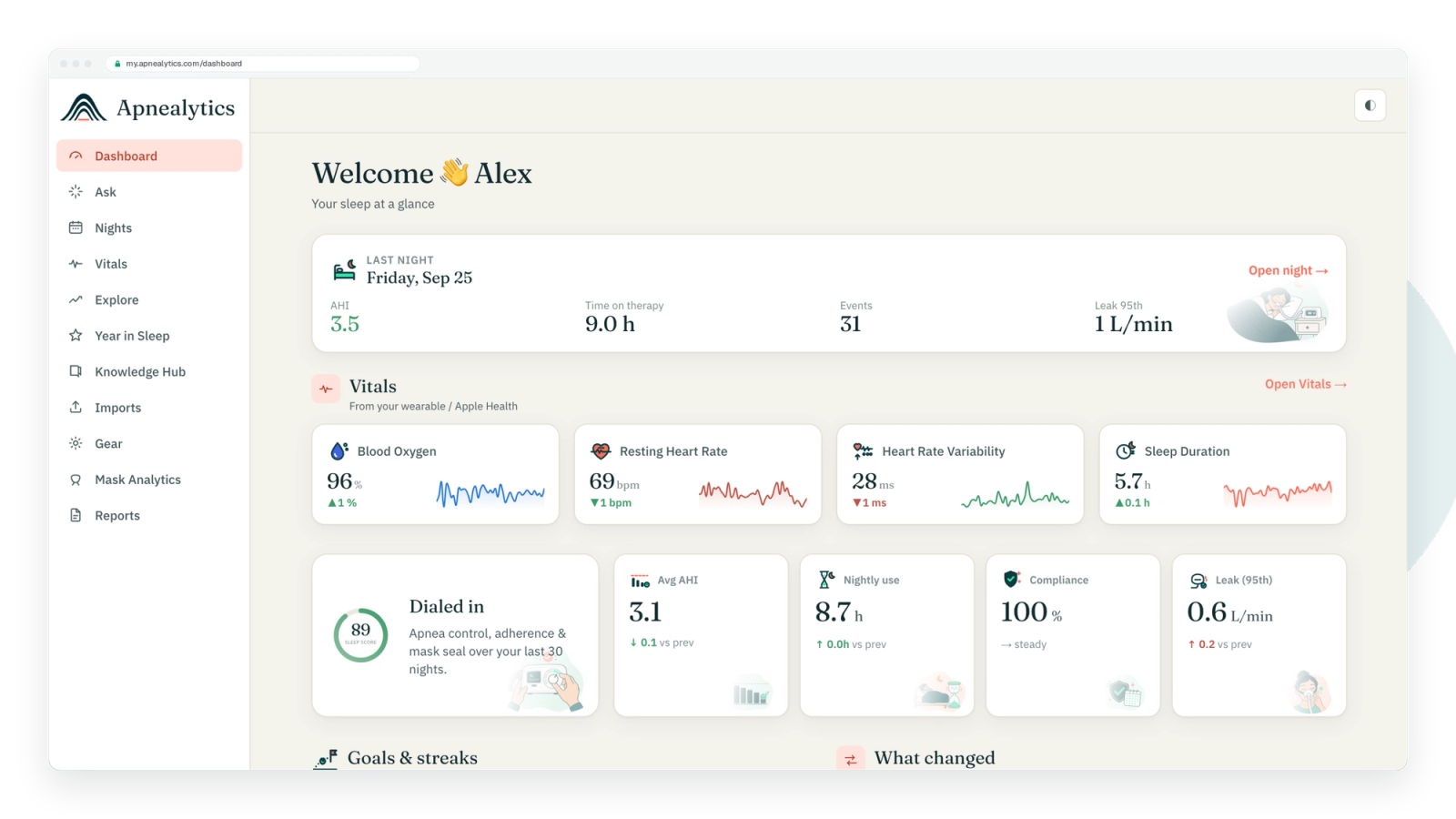
The dashboard shows last-night AHI with a band label (Great, Mild, Moderate, High) and the event composition ring beneath it. The 30-night rolling trend sits beside the tile, so a single night is always shown in context.
Open Trends to view AHI over 90 nights, a year or all time, and switch on leak and pressure P95 as overlays. Period-over-period comparison lets you put the 30 nights after a mask change beside the 30 nights before it. The "What changed?" panel marks settings changes on the same timeline, so if your AHI shifted the week your pressure range did, you will see both.
Pro users can open the breath-by-breath viewer to look at the flagged events on the airflow trace, and the compliance report bundles AHI, leak and usage into a PDF your clinician can read in a minute.
Reasonable triggers, in rough order of urgency:
Residual AHI consistently above 10, or rising week over week.
Residual AHI above 5 with a large share of central events.
A sudden change in AHI with no obvious cause (no new mask, no illness).
Good AHI but persistent daytime sleepiness.
Bring the trend. Apnealytics' share links let you give your clinician a read-only view so they can see the same chart you are describing.
Yes. An AHI under 5 is the most widely used threshold for well-controlled sleep apnea on therapy, and matches the cut-off for "normal" breathing in a sleep study. Many people on well-tuned CPAP run between 1 and 3. Always read it alongside leak and usage; a low AHI on a high-leak or short night is less reassuring than it looks.
The target is the same: a residual AHI under 5 is the usual goal regardless of how high your diagnostic AHI was. Someone who started at 60 and now runs at 4 has had an excellent response. Your clinician may accept a slightly higher residual if symptoms are controlled, or aim lower if you still feel tired.
Night-to-night variation is normal. Alcohol, a cold, sleeping position, a worn mask cushion, late meals and simple chance all move the number. A single high night rarely matters. Look at your 30-night trend instead, and pay attention when the average shifts or when Apnealytics flags a night as well above your usual.
Not in the sense of being harmful. A very low AHI usually means the machine is controlling obstruction well. The one caution is that a low AHI on a night with very high leak may reflect the machine's inability to detect events rather than their absence, so check your leak P95 alongside it.
Tell your clinician. A controlled AHI removes one cause of poor sleep but not all of them. Flow limitation that does not score as events, short usage, insomnia, restless legs, medication effects and other conditions can all leave you tired with a good AHI. Bring your usage hours and leak data as well as the AHI so the picture is complete.
The web app is live today. iPhone and iPad are on the App Store. Android is on Google Play. Your first 30 nights are free, forever.
 DashboardSleep Score, AHI band, leak and pressure
 Trends & historyA year down to a night
 Breath-by-breath viewerAirflow, pressure, leak tracesPro
 SpO₂ overlayOximeter data on the same nightPro
 Pressure insightsP95, set range, EPR and ramp
 SD card importDrop the card folder, only new nights added
 Mask fit & gearWhich mask actually seals
 Ask your dataPlain-English questions, your own AI keyBYOK
 Year in SleepYour therapy year in one storyNew
 Compliance reportFinds the qualifying window for youPro
 Share with your doctorRead-only, revocable links
 Companion appiPhone, iPad and Android
 Privacy & securityYour data, locked to you
 ResMed AirSense 10 & 11Supported
 ResMed AirCurve 10 & 11 VAutoSupported
 ResMed S9 / LumisSupported
 Philips DreamStation 1 & 2Supported
 Fisher & Paykel SleepStyleSupported
 Löwenstein / DeVilbissPartial
 React Health Luna G3Waitlist
 Transcend MicroWaitlist
 Full face masksFit, leak signature, Mask Analytics
 Nasal masksOver-nose and cradle styles
 Nasal pillowsMinimal-contact fit tips
 Wellue O2RingSupported
 Contec CMS50 familySupported
 Apple Health / Health ConnectResting HR, HRV, SpO₂, sleepSupported
 What is AHI?The apnea-hypopnea index, explained
 What is a good AHI on CPAP?
 CPAP leak rate explained
 Pressure settings explained
 Reading CPAP waveformsAll 14 explainers
 Apnealytics vs SleepHQ
 Apnealytics vs OSCAR
 Apnealytics vs myAir
 Apnealytics vs DreamMapper
 SleepHQ vs OSCARBest CPAP apps in 2026
 How to read CPAP dataStart here: six numbers, in order
 Read your CPAP SD card
 Share data with your doctorChoosing a CPAP mask
 Travel with CPAPAll guides
 Mask finderSeven questions, a ranked mask typeYour data
 Machine finderA two-machine shortlist for your prescription
 iPhone / iPhone DuoLast night before you are out of bed. Apple Health vitals, Face ID.Live
 iPadSame universal app, side-by-side panes and full-width waveforms.Live
 AndroidPhones, tablets and foldables, with Health Connect built in.Live
 Web portalWhere your SD card goes. Every chart, report and setting.Live

