



iPhone / iPhone Duo Live
Last night before you are out of bed. Apple Health vitals, Face ID.
Download on the App Store Apnealytics
Free on every plan: unlimited imports, the full dashboard and your last 30 nights.
 Compatibility checkerWill my machine work?Type your model. You get a straight answer: supported, partial, waitlist, or why not.Check my machine
 If it writes an SD card, we probably read it. ResMed AirMini has no card, so no app can read it.
Sleep Check-up
3 of 6 checks done
Six short screeners, one picture of how you sleep. Earn a milestone for each, save results and get retake reminders.
Latest milestone: Sleepiness check done
 NEWTrack your 90-day compliance windowOpen the calculator
 13 free tools. No account needed — sign in to save results and fill answers from your own CPAP data.
Last night before you are out of bed. Apple Health vitals, Face ID.
Download on the App Store


One account on every screen. Apple Watch vitals sync through Apple Health.
Everything your ResMed machine knows about last night is on a small SD card in its side. To read your CPAP SD card you need three things: a minute to take the card out safely, a card reader that fits your computer, and somewhere to upload it. This guide walks through all three for the AirSense 10, AirSense 11 and AirCurve 10 and 11, on Mac and Windows, ending with an upload to Apnealytics. The whole process takes about five minutes the first time and under two after that.
Turn the machine off and let it finish. After you stop therapy, the machine writes the final summary to the card. Wait until the screen is idle, around 30 seconds, before removing the card. Removing it mid-write can corrupt the last night.
Never format the card. Your computer may offer to. Decline. Formatting erases the data and the folder structure the machine expects.
Do not rename or move anything on the card. Read it, upload it, put it back.
With the machine off, look at the left side (as you face the screen). There is a small rubber flap over the SD card slot.
Lift the flap.
Press the card in gently until it clicks, then release. It will pop out a few millimetres.
Pull the card out and set it label-up on a clean surface.
The S9 has an SD slot on the back-left behind a cover; the Lumis follows the same layout as the AirCurve 10.
The ResMed AirMini has no SD card. There is nothing to remove and nothing any third-party tool can read. Its only data path is the myAir app over Bluetooth.
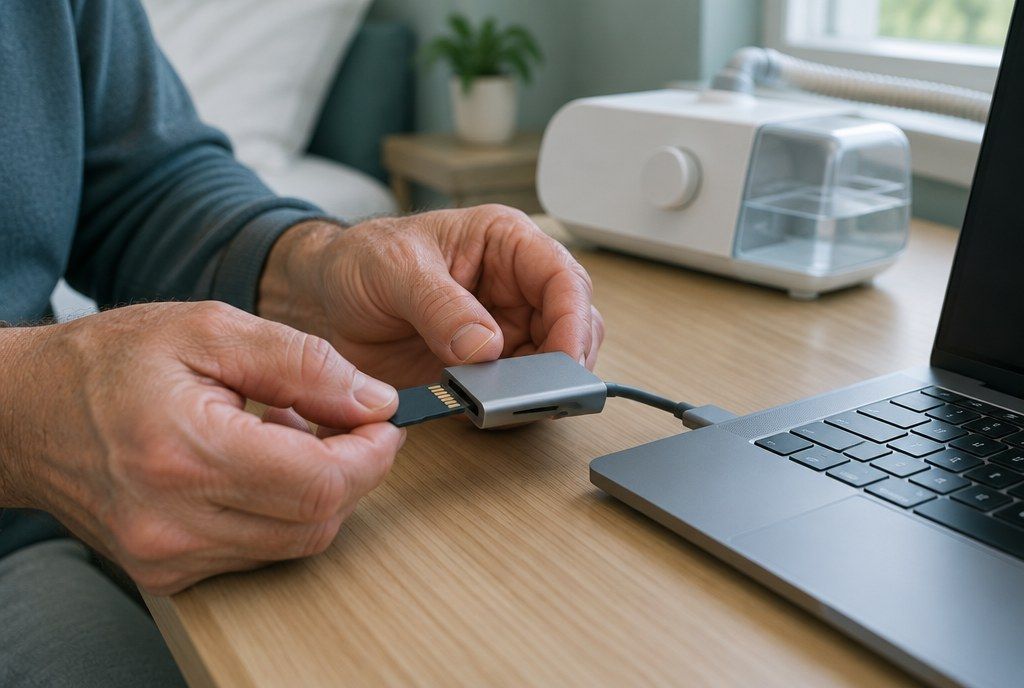
The card is a full-size SD card (not microSD). Most laptops no longer have a built-in slot, so you will likely need a reader. Any basic reader works; speed does not matter.
USB-C only (recent MacBooks, many Windows ultrabooks): buy a USB-C SD card reader that lists "SD / SDHC / SDXC" support. Compact ones with no cable travel well.
USB-A (the rectangular port): buy a USB-A SD card reader. Inexpensive and widely available.
Both ports: either, or a dual-connector reader.
Built-in SD slot: you need nothing. Many older MacBook Pros, iMacs and Windows laptops have one.
Avoid readers that only accept microSD.
Insert the card into the reader and the reader into the Mac.
A drive appears on the desktop or Finder sidebar, possibly named "Untitled" or "NO NAME".
If macOS says the disk was not readable, do not click Initialize. Click Ignore, re-seat the card, and try again; try a different reader before assuming the card is faulty.
Open the drive.
A ResMed card contains a small set of files and one large folder. You do not need to understand them to upload, but it helps to recognise a healthy card.
Identification.json (or.tgt): the machine's serial number and model, which tells Apnealytics which machine the card came from.
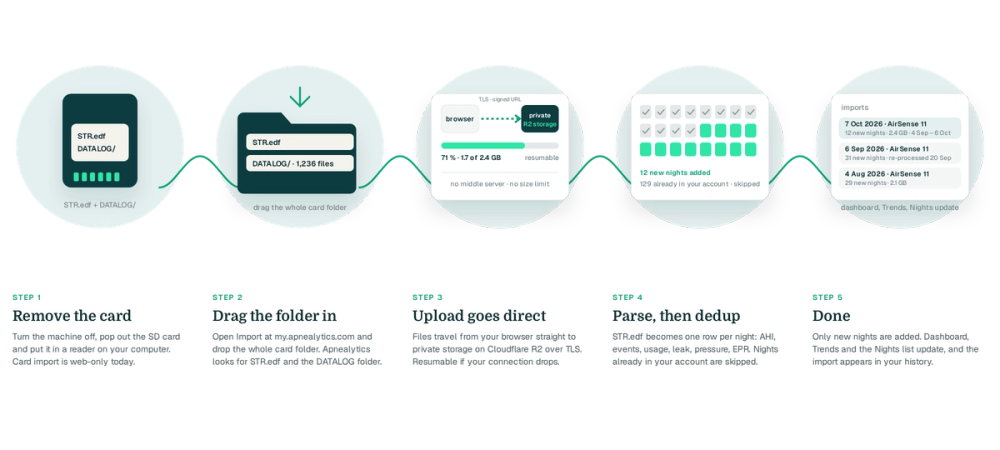
STR.edf: the summary file, one row per night with AHI, usage, leak, pressure and settings. This drives the dashboard.
DATALOG/: one folder per date holding the high-resolution EDF files: airflow, pressure, leak, events and, on some machines, oximetry (SAD.edf). This is where waveforms come from, and why the card runs to gigabytes.
SETTINGS/: settings snapshots.
If DATALOG is empty, the machine may not be set to record detailed data; that is a clinician-side setting on some machines. Ask your DME.
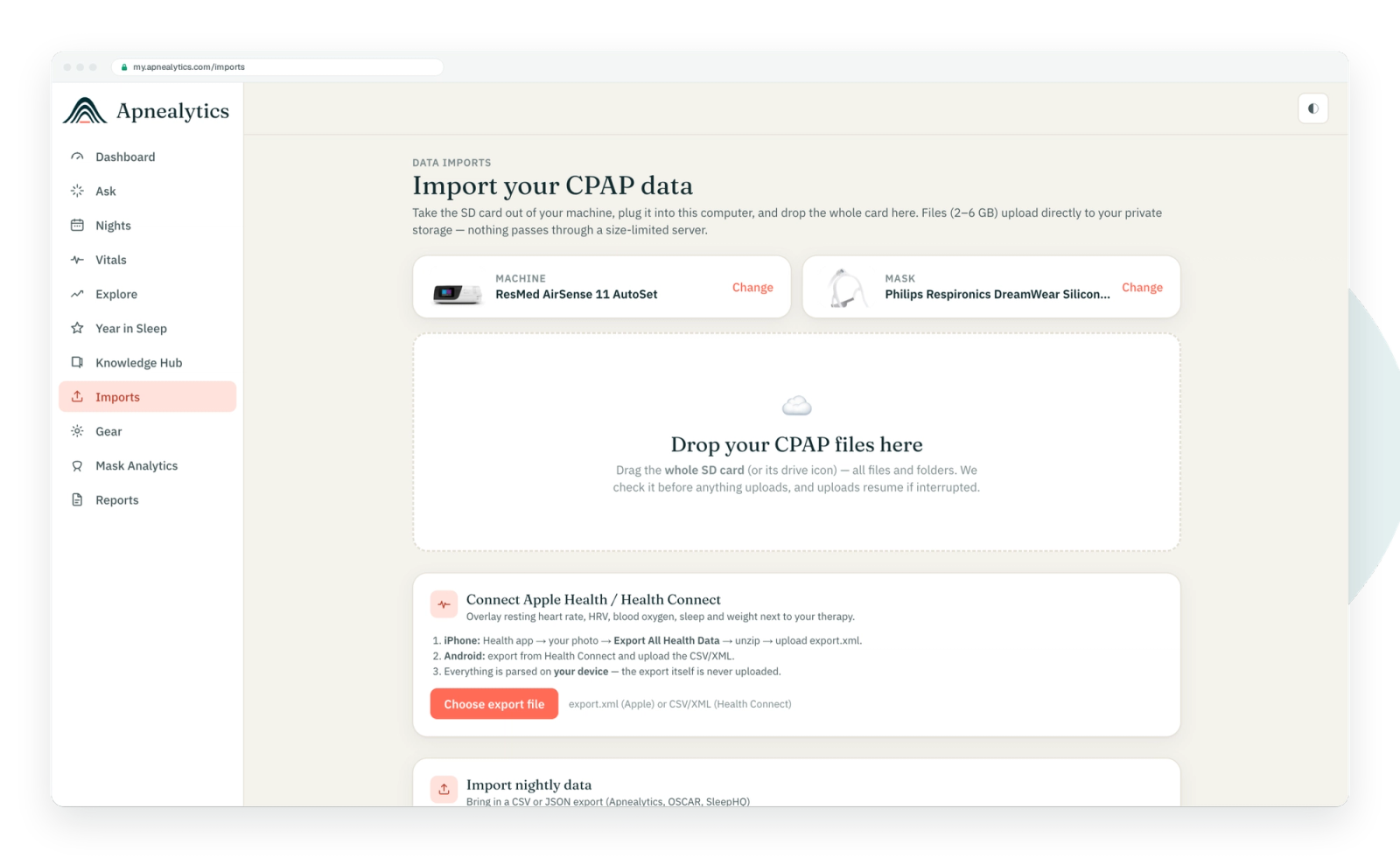
Sign in at my.apnealytics.com in your browser. Card import is web-only today; the phone apps do not read the card.
Go to Import.
Drag the entire card drive onto the upload area, or click to choose it and select the card's root folder. The upload is folder-aware, so it finds STR.edf and DATALOG itself. Do not select individual files.
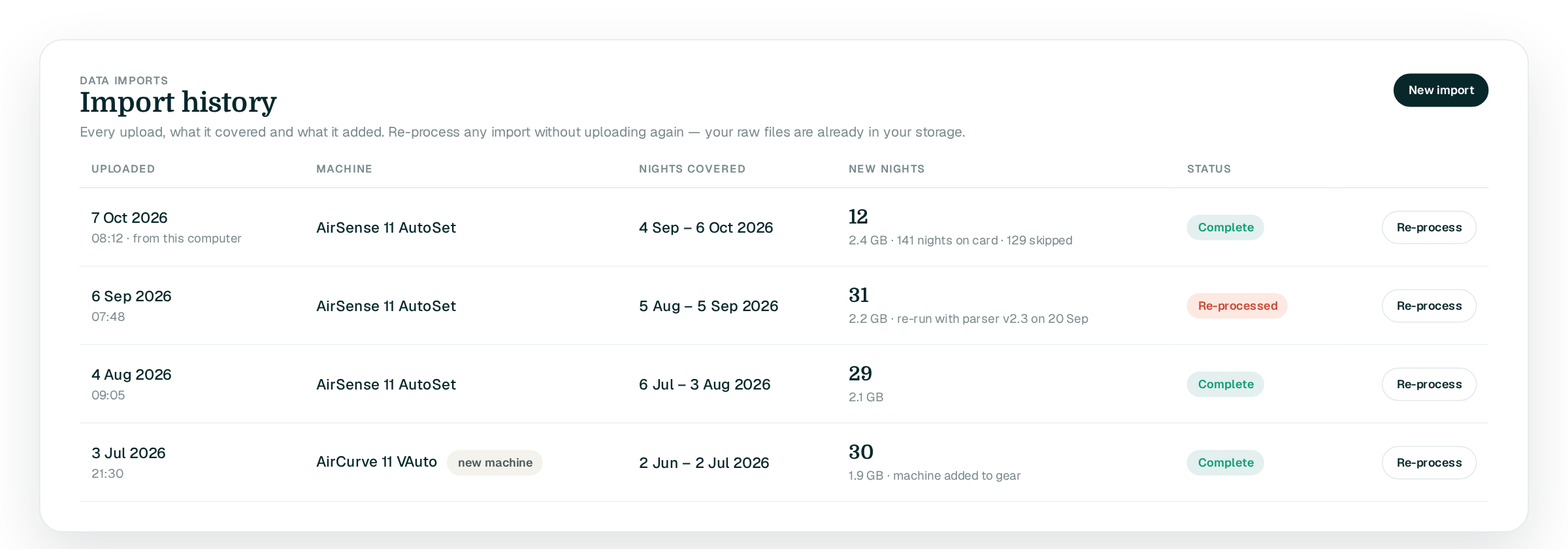
Wait. Cards run from 2 to 6 GB, and the upload goes directly from your browser to your private storage (Cloudflare R2), never through a middle server. It is resumable: if your connection drops, start it again and it picks up where it left off.
When processing finishes, your Nights list and dashboard update. Re-uploading later only adds new nights; existing nights are deduplicated.
Eject the drive (Finder: eject icon; Windows: "Safely Remove Hardware").
Remove the card from the reader.
Slide it back into the machine, label-side as it came out, until it clicks.
Close the flap or cover.
If you forget to put the card back, the machine still records summary data internally, but those nights will have no waveforms.
Monthly suits most people; weekly if you are changing masks or settings. The card holds many months, so missing a cycle costs nothing.
Turn the machine off first and wait about 30 seconds for the screen to go idle. The machine writes to the card at the end of a session, and pulling the card mid-write can corrupt that night. With the machine off and idle, removing the card is safe and routine.
A full-size SD card, not microSD. Your machine shipped with one. If you need a spare, a standard SDHC card in the 4 to 32 GB range works; check with your DME before swapping, since the machine expects its folder structure. Never format the original.
Usually a reader or contact problem, not a damaged card. Click Cancel or Ignore, re-seat the card, try another port or reader. Formatting erases your data. If the card truly is unreadable in two readers, the data on it may be lost, but the machine will write new nights to a replacement card.
Not with Apnealytics today; card import is web-only. Some phones accept SD cards via an adapter and can show the files, but you still need a browser session on a computer to upload. The Apnealytics phone apps sync Apple Health / Health Connect and import CSV/JSON exports instead.
No. The upload reads the files and copies them to your private storage. Nothing is written to the card. Put it back in the machine and it continues exactly as before.
The web app is live today. iPhone and iPad are on the App Store. Android is on Google Play. Your first 30 nights are free, forever.
 DashboardSleep Score, AHI band, leak and pressure
 Trends & historyA year down to a night
 Breath-by-breath viewerAirflow, pressure, leak tracesPro
 SpO₂ overlayOximeter data on the same nightPro
 Pressure insightsP95, set range, EPR and ramp
 SD card importDrop the card folder, only new nights added
 Mask fit & gearWhich mask actually seals
 Ask your dataPlain-English questions, your own AI keyBYOK
 Year in SleepYour therapy year in one storyNew
 Compliance reportFinds the qualifying window for youPro
 Share with your doctorRead-only, revocable links
 Companion appiPhone, iPad and Android
 Privacy & securityYour data, locked to you
 ResMed AirSense 10 & 11Supported
 ResMed AirCurve 10 & 11 VAutoSupported
 ResMed S9 / LumisSupported
 Philips DreamStation 1 & 2Supported
 Fisher & Paykel SleepStyleSupported
 Löwenstein / DeVilbissPartial
 React Health Luna G3Waitlist
 Transcend MicroWaitlist
 Full face masksFit, leak signature, Mask Analytics
 Nasal masksOver-nose and cradle styles
 Nasal pillowsMinimal-contact fit tips
 Wellue O2RingSupported
 Contec CMS50 familySupported
 Apple Health / Health ConnectResting HR, HRV, SpO₂, sleepSupported
 What is AHI?The apnea-hypopnea index, explained
 What is a good AHI on CPAP?
 CPAP leak rate explained
 Pressure settings explained
 Reading CPAP waveformsAll 14 explainers
 Apnealytics vs SleepHQ
 Apnealytics vs OSCAR
 Apnealytics vs myAir
 Apnealytics vs DreamMapper
 SleepHQ vs OSCARBest CPAP apps in 2026
 How to read CPAP dataStart here: six numbers, in order
 Read your CPAP SD card
 Share data with your doctorChoosing a CPAP mask
 Travel with CPAPAll guides
 Mask finderSeven questions, a ranked mask typeYour data
 Machine finderA two-machine shortlist for your prescription
 iPhone / iPhone DuoLast night before you are out of bed. Apple Health vitals, Face ID.Live
 iPadSame universal app, side-by-side panes and full-width waveforms.Live
 AndroidPhones, tablets and foldables, with Health Connect built in.Live
 Web portalWhere your SD card goes. Every chart, report and setting.Live

