



iPhone / iPhone Duo Live
Last night before you are out of bed. Apple Health vitals, Face ID.
Download on the App Store Apnealytics
Free on every plan: unlimited imports, the full dashboard and your last 30 nights.
 Compatibility checkerWill my machine work?Type your model. You get a straight answer: supported, partial, waitlist, or why not.Check my machine
 If it writes an SD card, we probably read it. ResMed AirMini has no card, so no app can read it.
Sleep Check-up
3 of 6 checks done
Six short screeners, one picture of how you sleep. Earn a milestone for each, save results and get retake reminders.
Latest milestone: Sleepiness check done
 NEWTrack your 90-day compliance windowOpen the calculator
 13 free tools. No account needed — sign in to save results and fill answers from your own CPAP data.
Last night before you are out of bed. Apple Health vitals, Face ID.
Download on the App Store


One account on every screen. Apple Watch vitals sync through Apple Health.
Apnealytics is a tracking and coaching tool. It reads the data your CPAP machine, oximeter and phone already record and presents it clearly. It is not a medical device, it does not diagnose sleep apnea or any other condition, and it does not treat, change or recommend therapy settings. This page is the Apnealytics medical disclaimer, written to be understood rather than skimmed.
A way to read the SD card from your ResMed machine and see your nights in plain English.
A place to put your oximeter data, your Apple Health or Health Connect vitals and your gear beside your therapy.
A set of reports and share links that help you have better conversations with your clinician.
A Knowledge Hub that explains the terms your machine uses.
Not a diagnostic tool. Apnealytics does not determine whether you have sleep apnea, how severe it is, or what kind.
Not a treatment. It does not deliver therapy, adjust your machine or tell you which setting to use.
Not a substitute for a sleep study or a clinician. A polysomnogram or home sleep test, read by a qualified professional, is how sleep apnea is diagnosed and staged.
Not an emergency service. If you are unwell, contact your doctor or emergency services, not an app.
Not regulated as a medical device. Apnealytics has not been cleared or approved by the FDA or any other regulator for a medical purpose, and does not claim to be.
Your CPAP machine estimates events from airflow at the mask. It does not measure brain activity, oxygen or effort, and it cannot know whether you were asleep. That means:
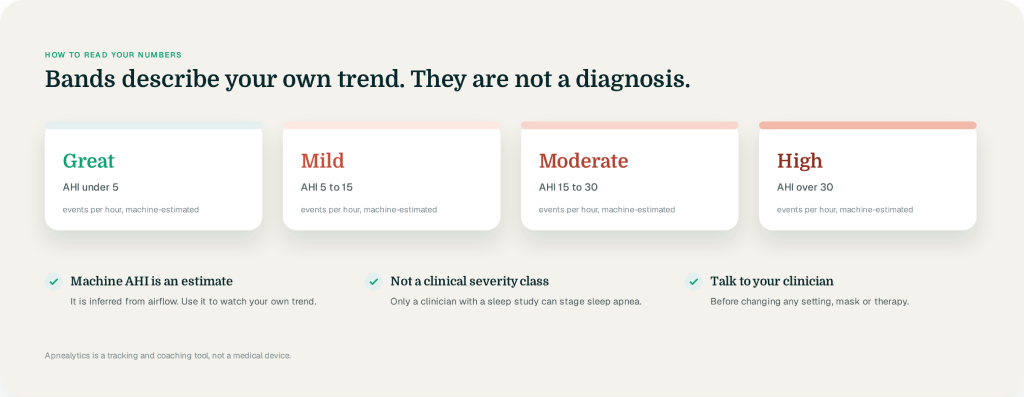
Machine AHI is an estimate. It is useful for watching your own trend over time; it is not the same as the AHI from a sleep study and should not be compared directly to one.
Event types are inferred. Obstructive, central, hypopnea and unclassified labels come from the machine's algorithm, which can misclassify, especially around leak and arousals.
Different machines score differently. A change in machine can change your numbers without any change in you.
Leak affects everything. High leak can cause both missed and spurious events.
Apnealytics shows bands such as Great, Mild, Moderate and High to make your own trend readable. The bands are descriptive labels for your numbers; they are not a clinical severity classification and they are not advice.
The Sleep Score, Heads up alerts, What changed? notes, trigger-journal correlations and Ask your data answers are all derived from the figures above. They describe patterns in your data. They do not establish cause, and they do not replace a clinician's judgement. Oximetry metrics such as ODI₃, ODI₄ and T90 are calculated from your oximeter's export and depend entirely on that device's accuracy and fit.
Talk to your clinician before changing any setting, mask, or part of your therapy, and bring your Apnealytics data to that conversation rather than acting on it alone.
Do not stop therapy because a number looks good, and do not panic because a number looks bad. Ask.
Treat Ask your data as a reading assistant, not a doctor. It is designed to point you back to your clinician for anything that sounds like a medical decision.
Keep your prescription and your clinician's instructions as the authority on your therapy.
Honest framing is part of how Apnealytics is built, not a legal afterthought. Data is only useful if you know what it can and cannot tell you. We would rather you understand the limits of machine-estimated figures and use Apnealytics well than believe it is more than it is.
No. Apnealytics is not a medical device and has not been submitted to, cleared or approved by the FDA or any other regulator. It is a consumer tracking and coaching tool that presents data your own devices already record.
It is a consistent estimate, which makes it good for watching your own trend. It is not a diagnostic measurement. CPAP machines infer events from airflow alone, cannot tell sleep from wakefulness and can misclassify events, particularly when leak is high. Compare your machine AHI with itself over time, and leave comparisons with a sleep study to your clinician.
Apnealytics will show you clearly what happened after any change, but it does not recommend settings and we ask you not to change your prescription without your clinician. Pressure, EPR and mode decisions depend on your diagnosis and history, which your clinician knows and an app does not.
No. The Sleep Score is a 0 to 100 summary of your therapy night built from your machine's figures so you can compare your own nights. It is not a validated clinical instrument and should not be read as one. The underlying figures are always shown beside it.
Not at all. Trend data from your machine is exactly what clinicians look at between visits, and understanding it helps you ask better questions and notice problems such as leak early. The disclaimer is about who makes the medical decisions, not about whether the data matters.
The web app is live today. iPhone and iPad are on the App Store. Android is on Google Play. Your first 30 nights are free, forever.
 DashboardSleep Score, AHI band, leak and pressure
 Trends & historyA year down to a night
 Breath-by-breath viewerAirflow, pressure, leak tracesPro
 SpO₂ overlayOximeter data on the same nightPro
 Pressure insightsP95, set range, EPR and ramp
 SD card importDrop the card folder, only new nights added
 Mask fit & gearWhich mask actually seals
 Ask your dataPlain-English questions, your own AI keyBYOK
 Year in SleepYour therapy year in one storyNew
 Compliance reportFinds the qualifying window for youPro
 Share with your doctorRead-only, revocable links
 Companion appiPhone, iPad and Android
 Privacy & securityYour data, locked to you
 ResMed AirSense 10 & 11Supported
 ResMed AirCurve 10 & 11 VAutoSupported
 ResMed S9 / LumisSupported
 Philips DreamStation 1 & 2Supported
 Fisher & Paykel SleepStyleSupported
 Löwenstein / DeVilbissPartial
 React Health Luna G3Waitlist
 Transcend MicroWaitlist
 Full face masksFit, leak signature, Mask Analytics
 Nasal masksOver-nose and cradle styles
 Nasal pillowsMinimal-contact fit tips
 Wellue O2RingSupported
 Contec CMS50 familySupported
 Apple Health / Health ConnectResting HR, HRV, SpO₂, sleepSupported
 What is AHI?The apnea-hypopnea index, explained
 What is a good AHI on CPAP?
 CPAP leak rate explained
 Pressure settings explained
 Reading CPAP waveformsAll 14 explainers
 Apnealytics vs SleepHQ
 Apnealytics vs OSCAR
 Apnealytics vs myAir
 Apnealytics vs DreamMapper
 SleepHQ vs OSCARBest CPAP apps in 2026
 How to read CPAP dataStart here: six numbers, in order
 Read your CPAP SD card
 Share data with your doctorChoosing a CPAP mask
 Travel with CPAPAll guides
 Mask finderSeven questions, a ranked mask typeYour data
 Machine finderA two-machine shortlist for your prescription
 iPhone / iPhone DuoLast night before you are out of bed. Apple Health vitals, Face ID.Live
 iPadSame universal app, side-by-side panes and full-width waveforms.Live
 AndroidPhones, tablets and foldables, with Health Connect built in.Live
 Web portalWhere your SD card goes. Every chart, report and setting.Live

