



iPhone / iPhone Duo Live
Last night before you are out of bed. Apple Health vitals, Face ID.
Download on the App Store Apnealytics
Free on every plan: unlimited imports, the full dashboard and your last 30 nights.
 Compatibility checkerWill my machine work?Type your model. You get a straight answer: supported, partial, waitlist, or why not.Check my machine
 If it writes an SD card, we probably read it. ResMed AirMini has no card, so no app can read it.
Sleep Check-up
3 of 6 checks done
Six short screeners, one picture of how you sleep. Earn a milestone for each, save results and get retake reminders.
Latest milestone: Sleepiness check done
 NEWTrack your 90-day compliance windowOpen the calculator
 13 free tools. No account needed — sign in to save results and fill answers from your own CPAP data.
Last night before you are out of bed. Apple Health vitals, Face ID.
Download on the App Store


One account on every screen. Apple Watch vitals sync through Apple Health.
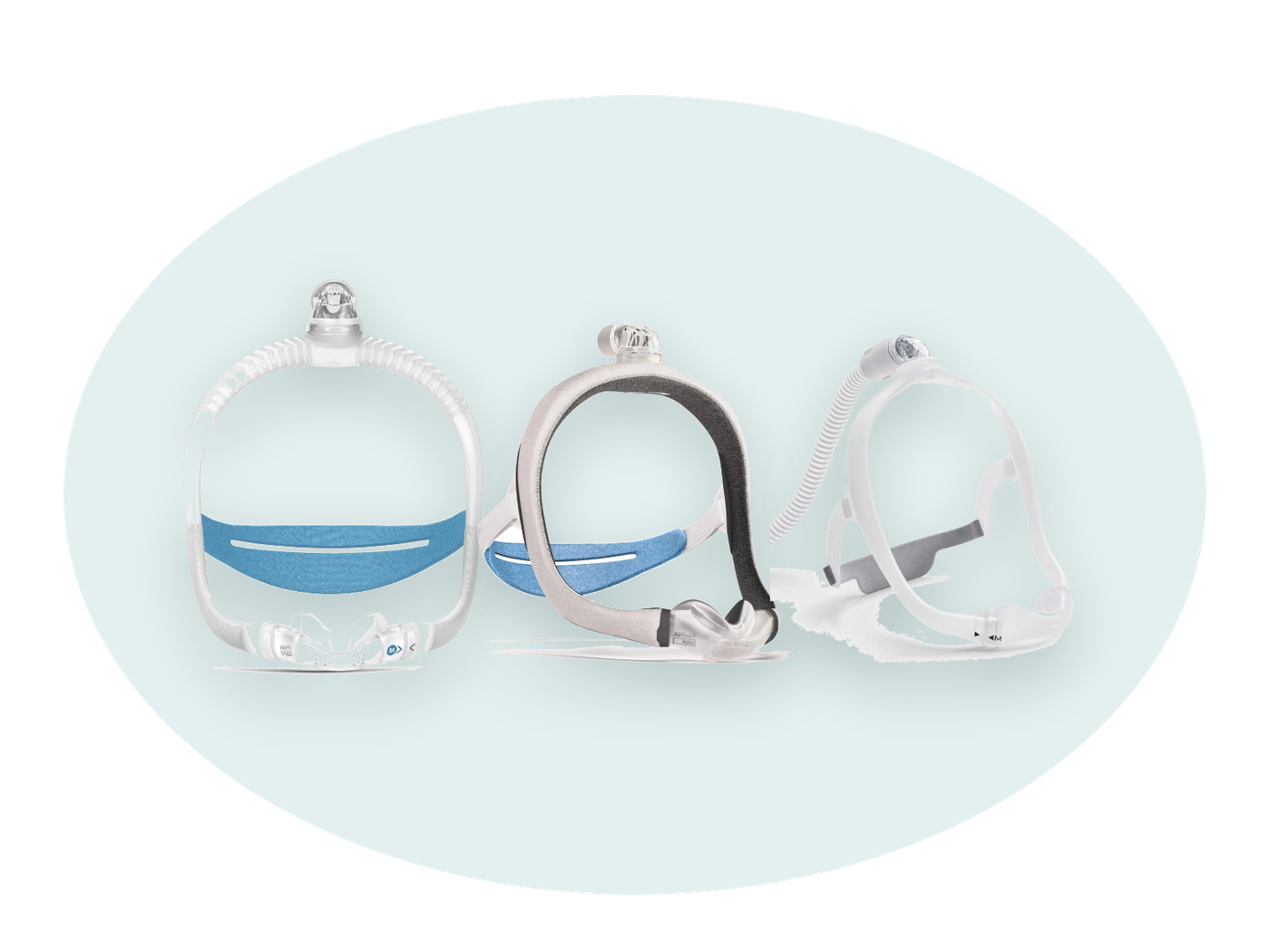
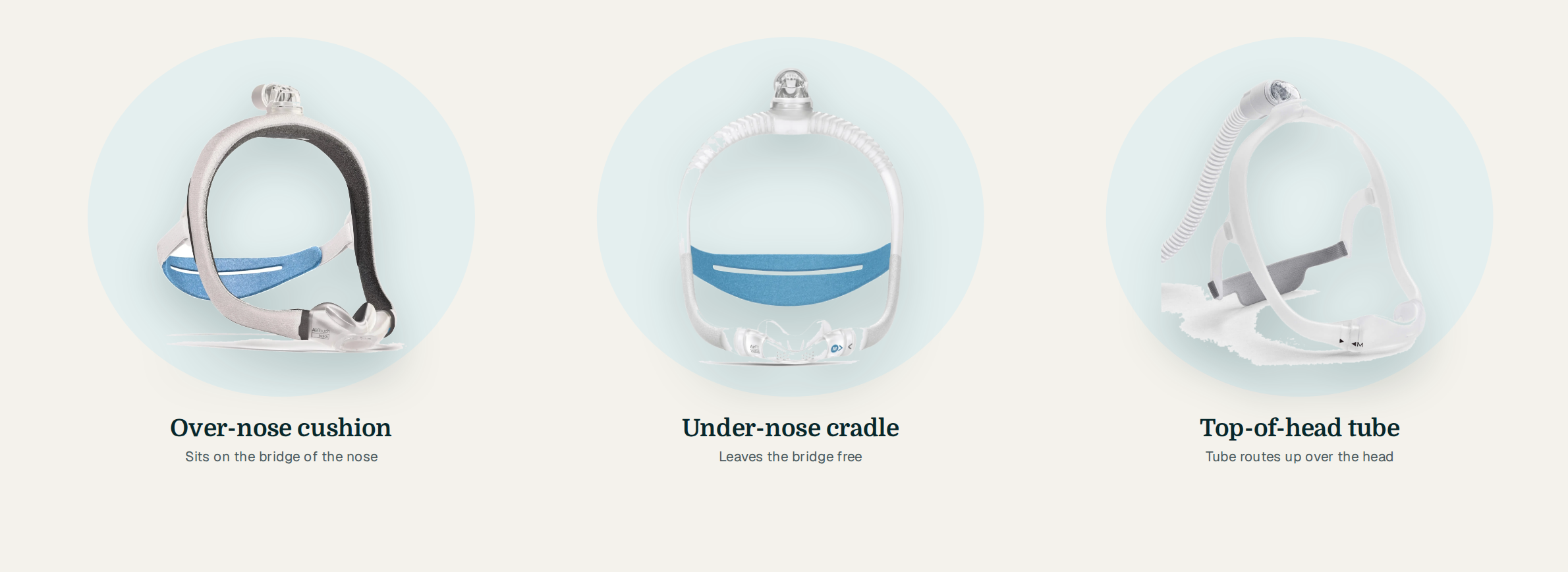
A nasal CPAP mask covers the nose only, with a cushion that sits over it or a cradle that rests under it. It is the middle ground between pillows and a full face mask: more stable than pillows, less bulk than full face. Apnealytics tracks every nasal mask in its catalog and shows you, per mask, how well it sealed, what your AHI was and how long you kept it on.
Nose breathers. If you breathe through your nose asleep, a nasal mask delivers pressure with the least hardware.
Side and stomach sleepers. Cradle-style nasal masks with the tube at the top of the head (N30i, DreamWear) leave the sides of the face free.
People at moderate pressures. Nasal masks seal well up to the mid-teens of cmH₂O for most faces; at higher pressures some people find them harder to keep sealed.
People who felt claustrophobic in a full face mask. A nasal cushion covers far less.
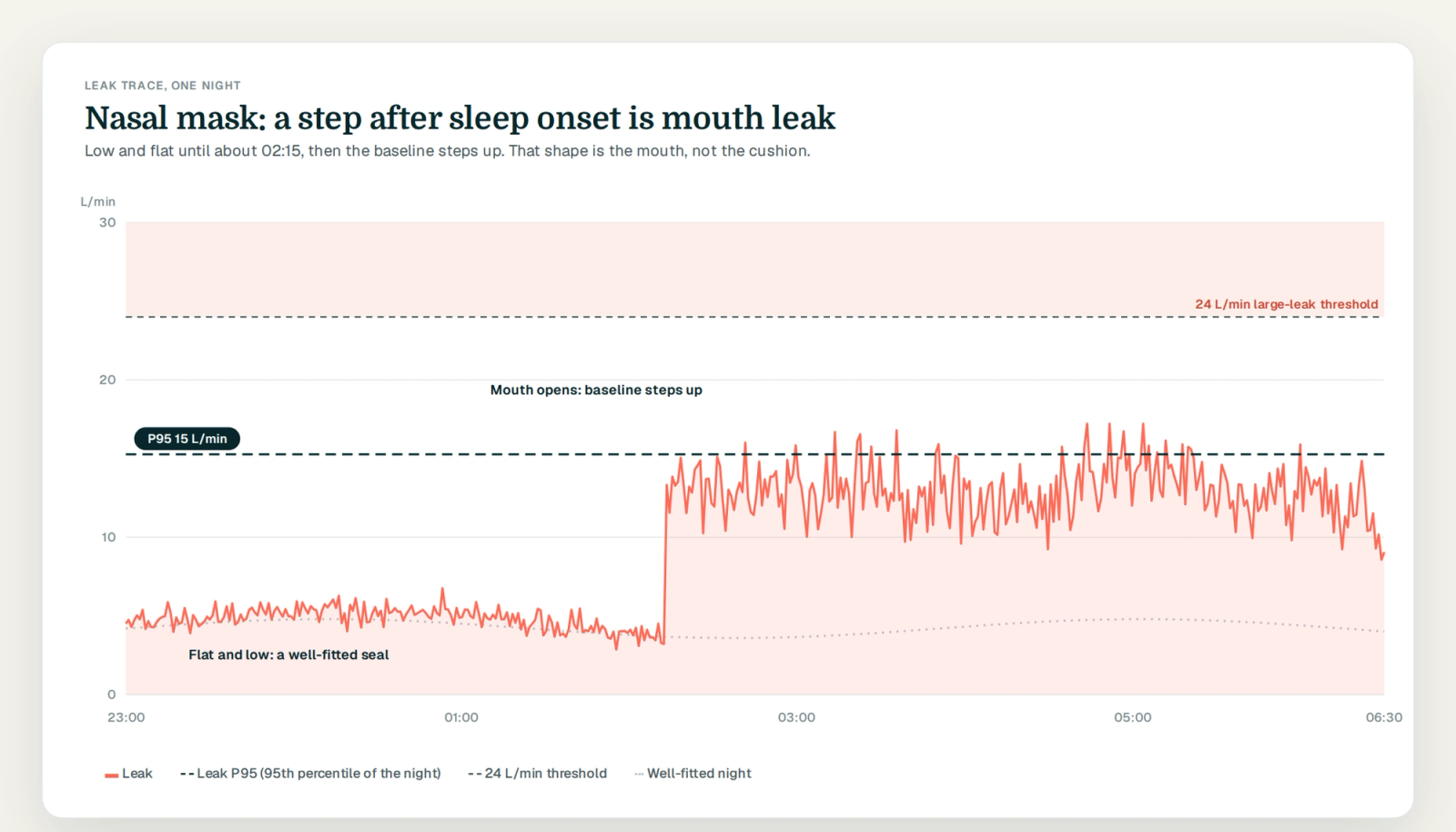
It suits fewer people who breathe through the mouth. If you wake with a dry mouth and your leak P95 climbs after a couple of hours, your mouth may be opening, and a chin strap or full face mask is the usual next conversation with your supplier.
In Apnealytics a well-fitted nasal mask shows a low, flat leak line for most of the night with a modest leak P95. The signature to watch for is a step upward after sleep onset or in the second half of the night: that is the shape of mouth leak, not a cushion problem. Position-related leak shows up as short spikes aligned with movement, visible in the Pro waveform viewer when you zoom in. A slowly rising baseline over weeks, with no change in habits, is a worn cushion.
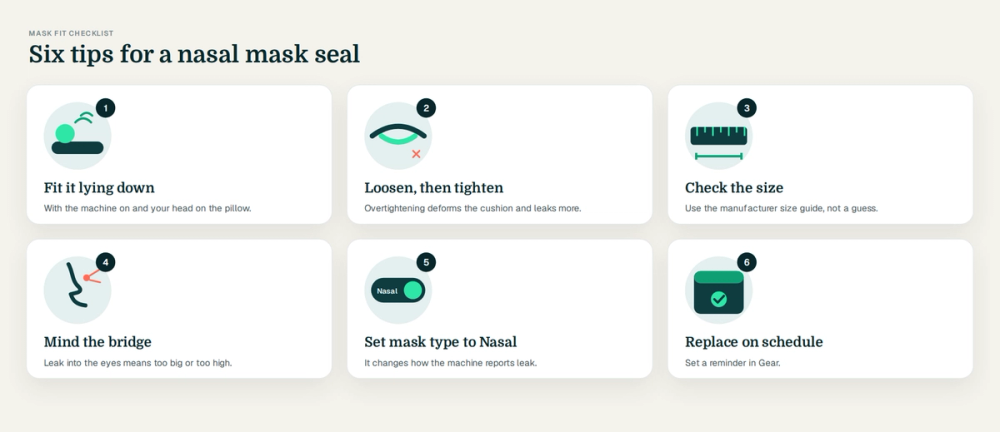
Masks seal differently once pressure is applied and your head is on the pillow.
Overtightening deforms the cushion and leaks more. Start loose and tighten only until the seal holds.
Nasal cushions come in small, medium, large and sometimes wide. A size guide from the manufacturer is more reliable than guessing.
If the top of the cushion leaks into your eyes, the mask is too big or sitting too high. Cradle designs avoid the bridge entirely.
It changes how leak is reported.
Set a reminder in Gear.
ResMed AirFit N20 (over-nose cushion, front tube)
ResMed AirFit N30i (under-nose cradle, top-of-head tube)
ResMed AirFit N30 (under-nose cradle, front tube)
Philips Respironics DreamWear Nasal (under-nose cradle, top-of-head tube)
Fisher & Paykel Evora (compact nasal, under-nose)
Fisher & Paykel Eson 2 (over-nose cushion)
All are in the Apnealytics catalog with photos, sizes and part lists. They fit any machine with a standard 22 mm tube connection. Mask listings describe the mask only; they say nothing about whether your machine's data is supported.
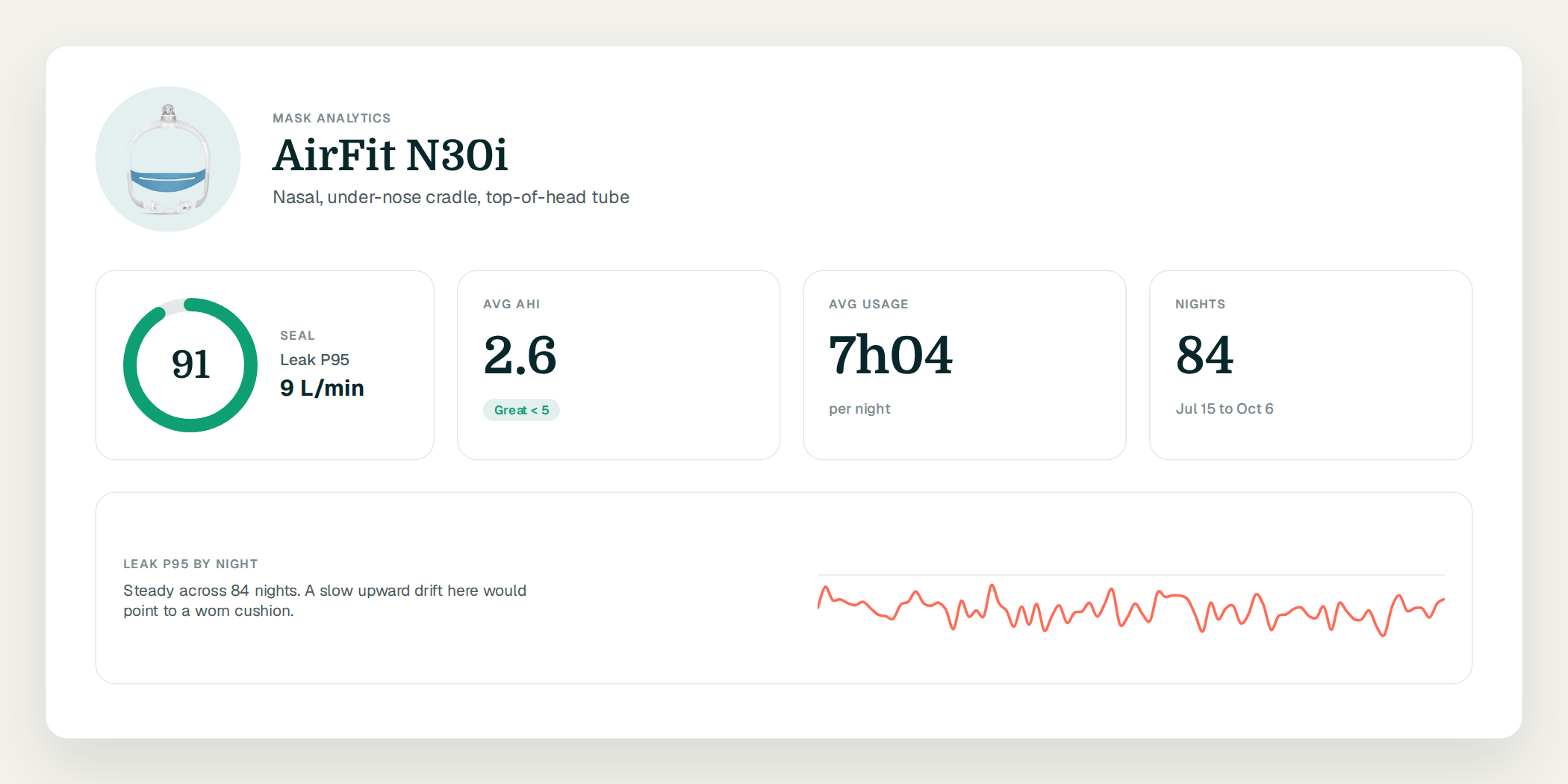
Attach your nasal mask in Gear with a start date and Apnealytics compares it against every other mask you have used:
Seal from leak P95 across the mask's nights
AHI average across those nights, so a mask that lets your mouth open shows its cost
Usage average hours, which is where comfort shows
Nights and span, so you know how much evidence sits behind each figure
If you move from an N20 to an N30i, the "What changed?" panel marks the switch, and Trends shows leak P95 and AHI on either side of it. See mask fit and leak for the product tour.
A nasal mask seals around or under the nose with a cushion or cradle; nasal pillows seal at the nostrils themselves. Nasal masks are a little more stable and tolerate higher pressures; pillows have the least contact. Mask Analytics lets you compare one of each on seal, AHI and usage.
That pattern usually means your mouth is opening as you reach deeper sleep, not that the cushion has failed. Leak P95 rises and AHI often rises with it. Options to discuss with your supplier include a chin strap or a full face mask. The Pro waveform viewer shows exactly when the leak begins.
Cradle-style masks with the tube at the top of the head, such as the AirFit N30i and DreamWear Nasal, keep the sides of the face clear. Whether one seals better on your face is personal; Mask Analytics shows you the answer from your own nights.
Yes. ResMed machines ask for Pillows, Nasal or Full Face because each has a different expected vent flow, and the leak figure is calculated after subtracting it. The wrong setting makes leak look better or worse than it is. Set it to Nasal for a nasal mask.
Follow the manufacturer's or your supplier's interval and set it as a reminder in Gear. In your data, a slowly rising leak P95 over several weeks with no other change is the usual sign of a cushion that has softened or lost its shape.
The web app is live today. iPhone and iPad are on the App Store. Android is on Google Play. Your first 30 nights are free, forever.
 DashboardSleep Score, AHI band, leak and pressure
 Trends & historyA year down to a night
 Breath-by-breath viewerAirflow, pressure, leak tracesPro
 SpO₂ overlayOximeter data on the same nightPro
 Pressure insightsP95, set range, EPR and ramp
 SD card importDrop the card folder, only new nights added
 Mask fit & gearWhich mask actually seals
 Ask your dataPlain-English questions, your own AI keyBYOK
 Year in SleepYour therapy year in one storyNew
 Compliance reportFinds the qualifying window for youPro
 Share with your doctorRead-only, revocable links
 Companion appiPhone, iPad and Android
 Privacy & securityYour data, locked to you
 ResMed AirSense 10 & 11Supported
 ResMed AirCurve 10 & 11 VAutoSupported
 ResMed S9 / LumisSupported
 Philips DreamStation 1 & 2Supported
 Fisher & Paykel SleepStyleSupported
 Löwenstein / DeVilbissPartial
 React Health Luna G3Waitlist
 Transcend MicroWaitlist
 Full face masksFit, leak signature, Mask Analytics
 Nasal masksOver-nose and cradle styles
 Nasal pillowsMinimal-contact fit tips
 Wellue O2RingSupported
 Contec CMS50 familySupported
 Apple Health / Health ConnectResting HR, HRV, SpO₂, sleepSupported
 What is AHI?The apnea-hypopnea index, explained
 What is a good AHI on CPAP?
 CPAP leak rate explained
 Pressure settings explained
 Reading CPAP waveformsAll 14 explainers
 Apnealytics vs SleepHQ
 Apnealytics vs OSCAR
 Apnealytics vs myAir
 Apnealytics vs DreamMapper
 SleepHQ vs OSCARBest CPAP apps in 2026
 How to read CPAP dataStart here: six numbers, in order
 Read your CPAP SD card
 Share data with your doctorChoosing a CPAP mask
 Travel with CPAPAll guides
 Mask finderSeven questions, a ranked mask typeYour data
 Machine finderA two-machine shortlist for your prescription
 iPhone / iPhone DuoLast night before you are out of bed. Apple Health vitals, Face ID.Live
 iPadSame universal app, side-by-side panes and full-width waveforms.Live
 AndroidPhones, tablets and foldables, with Health Connect built in.Live
 Web portalWhere your SD card goes. Every chart, report and setting.Live

