



iPhone / iPhone Duo Live
Last night before you are out of bed. Apple Health vitals, Face ID.
Download on the App Store Apnealytics
Free on every plan: unlimited imports, the full dashboard and your last 30 nights.
 Compatibility checkerWill my machine work?Type your model. You get a straight answer: supported, partial, waitlist, or why not.Check my machine
 If it writes an SD card, we probably read it. ResMed AirMini has no card, so no app can read it.
Sleep Check-up
3 of 6 checks done
Six short screeners, one picture of how you sleep. Earn a milestone for each, save results and get retake reminders.
Latest milestone: Sleepiness check done
 NEWTrack your 90-day compliance windowOpen the calculator
 13 free tools. No account needed — sign in to save results and fill answers from your own CPAP data.
Last night before you are out of bed. Apple Health vitals, Face ID.
Download on the App Store


One account on every screen. Apple Watch vitals sync through Apple Health.
There are five CPAP apps and tools most people end up choosing between: the two manufacturer apps (myAir and DreamMapper), the free desktop analyser (OSCAR), and two cloud platforms (SleepHQ and Apnealytics). This guide to the best CPAP apps in 2026 lays each one out with the same questions: what does it cost, what machines does it read, is it on your phone, how deep does it go, and what can you hand to a doctor. We make Apnealytics, so we have put ourselves in the list where the facts put us, and we have said plainly where we are behind.
By how many people a tool is right for. The manufacturer apps come first because they are free, automatic and the baseline. The cloud and desktop tools follow, with the one that reads the most machines ahead of the one that reads the fewest.
What it is: ResMed's free companion app for AirSense 10, AirSense 11 and compatible AirCurve machines, plus the AirMini over Bluetooth. One 0–100 score per night, delivered automatically over the machine's modem.
Pros
Cons
Best for: every ResMed user as a baseline. If your therapy is stable and your clinician is happy, it may be all you need.
What it is: Philips' free companion app for DreamStation machines. A nightly summary of usage, mask fit and AHI with goal tracking. Philips only.
Pros
Free, automatic.
Encourages adherence with goals and reminders.
Cons
Best for: every DreamStation user as a baseline.
What it is: Free, open-source desktop software for Windows, Mac and Linux. Import the SD card and see every channel the machine records, zoomable to the breath. Reads ResMed, Philips, Fisher & Paykel, Löwenstein and others.
Pros
Free.
The widest brand coverage of any tool.
Unmatched depth: flow, pressure, leak, flow limitation, snore, minute ventilation, tidal volume, respiratory rate and more, as continuous traces.
Entirely local; nothing leaves your computer.
Cons
Best for: anyone who wants depth at no cost and is willing to learn, and anyone whose machine brand the cloud tools do not read yet.
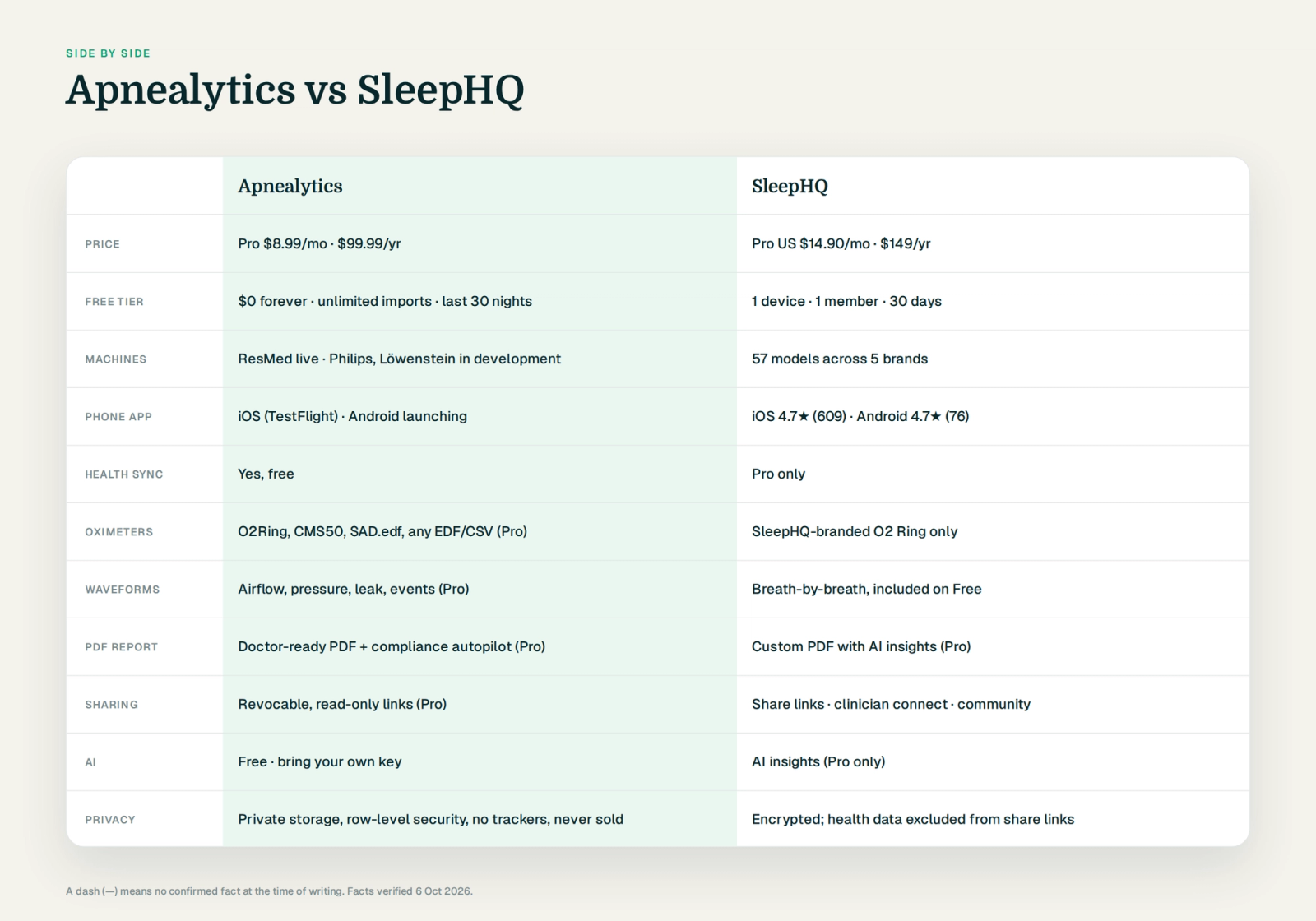
What it is: A cloud CPAP platform with a web dashboard, an iOS app (4.7 stars, 609 ratings), a community forum and AI insights on Pro. Reads 57 machine models across 5 brands including ResMed, Philips, Löwenstein, Fisher & Paykel and BMC.
Price: Pro US $14.90/month or $149/year. Free tier: 1 device, 1 member, 30 days, no Health sync, no community.
Pros
Phone app and cloud access.
Broad brand coverage, second only to OSCAR.
Built-in community.
Magic Uploader Pro (AU$399, ResMed only, requires Pro) uploads without a computer, when in stock; it is listed as sold out at the time of writing.
Cons
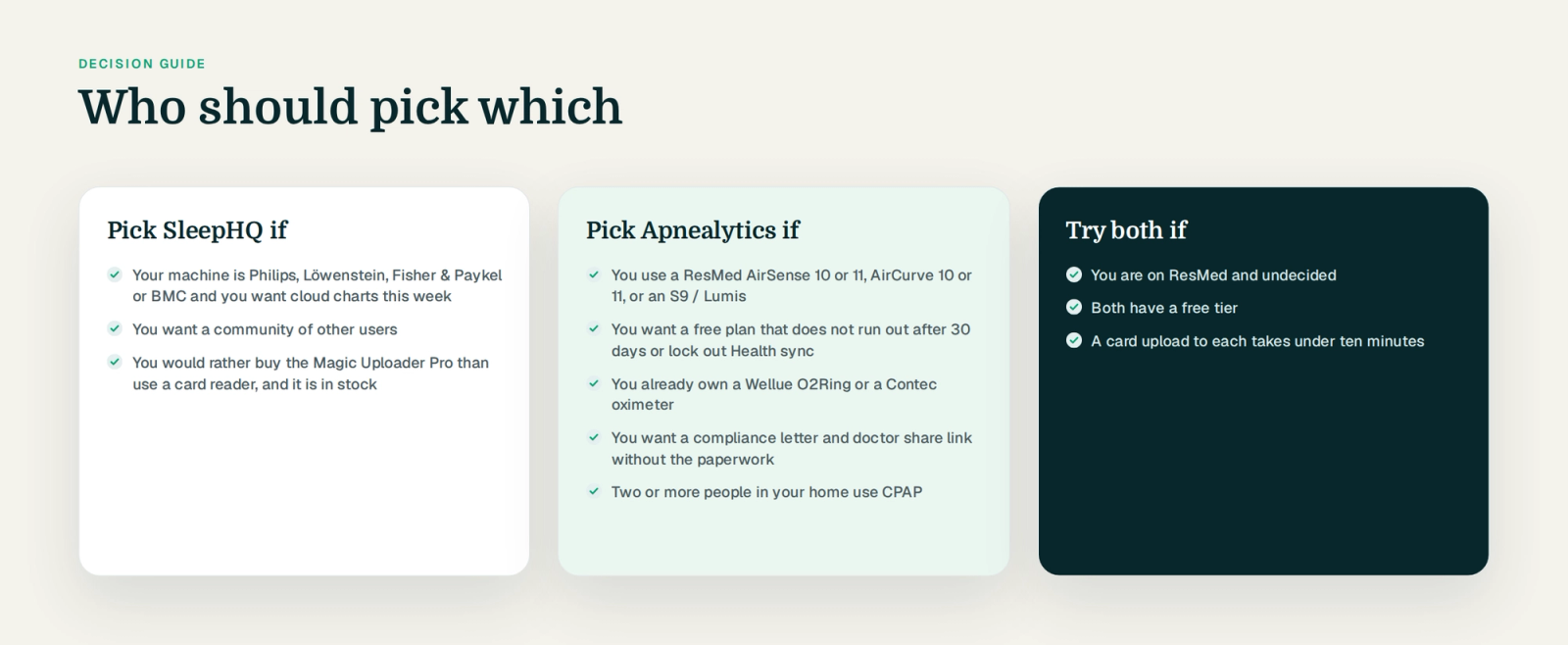
Best for: people who want a phone app and a community, and especially Philips, Löwenstein, Fisher & Paykel or BMC users who want cloud charts today.
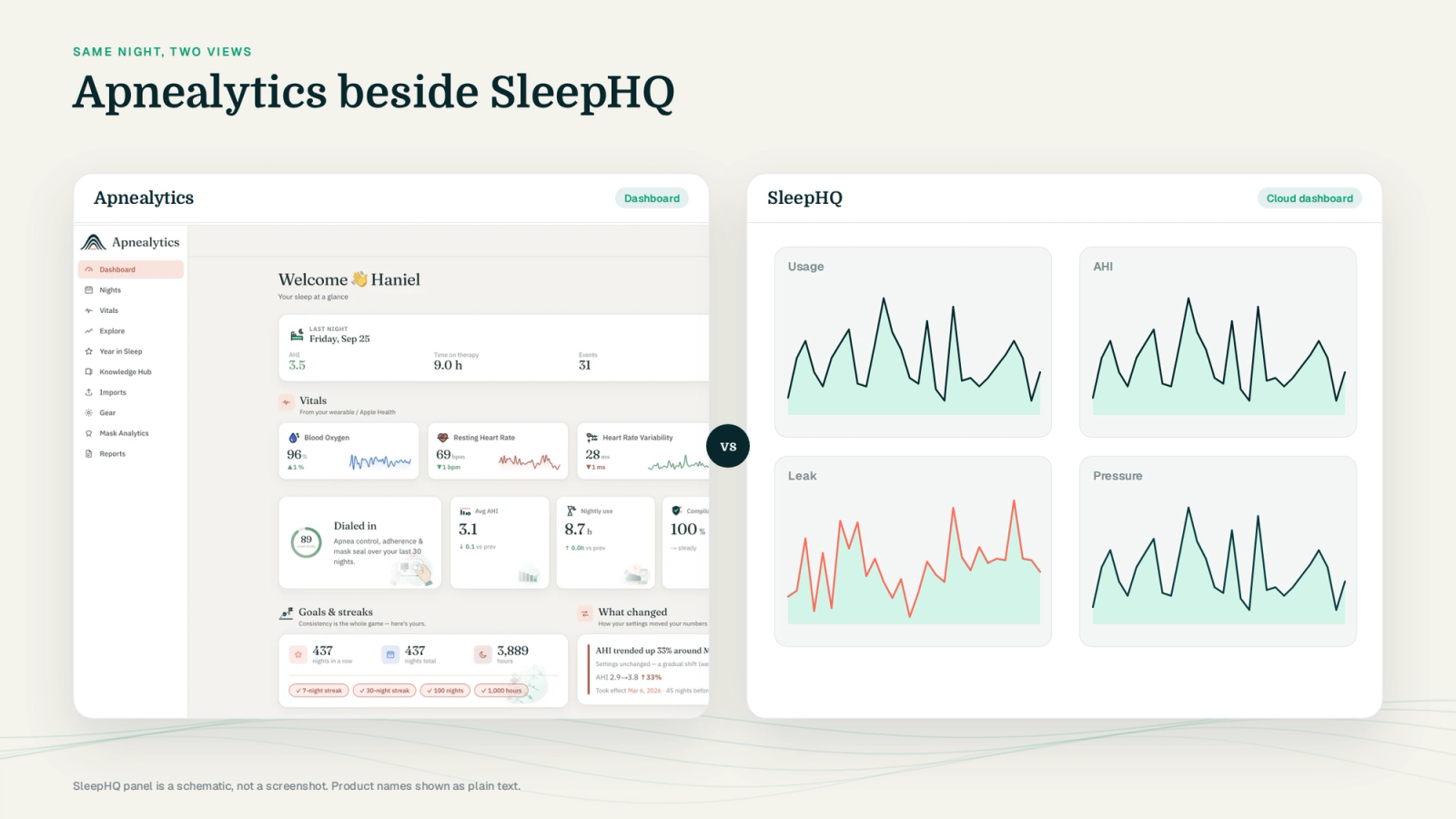
What it is: A cloud CPAP platform from Creative Labs LLC. Upload the SD card on the web portal and the full dataset is parsed into a Sleep Score, nightly AHI with band, usage, leak P95, pressure P95, event composition, 30-night trends, "What changed?" and "Heads up" alerts, Mask Analytics and more. Phone apps sync Apple Health or Health Connect (iOS on the App Store; Android on Google Play).
Price: Free tier, $0 forever: unlimited imports, nightly dashboard, last 30 nights of history, Apple Health / Health Connect sync, Ask your data, Knowledge Hub, family logins, data export. Pro $8.99/month or $99.99/year: full history, per-night waveforms, oximetry overlays, PDF report, share links, multiple machines and gear history, API.
Pros
The least expensive paid tier on this list, and a free tier that does not expire.
Apple Health / Health Connect sync on the free tier: resting heart rate, HRV, SpO₂, sleep hours and weight beside therapy.
Widest oximeter support: Wellue O2Ring, Contec CMS50 family, ResMed SAD.edf, any EDF/CSV oximeter, with ODI₃, ODI₄ and T90.
Compliance autopilot finds the qualifying window and drafts the letter; doctor-ready PDF; revocable, read-only, aggregate-only share links.
Ask your data on the free tier, with your own OpenAI or Anthropic key, read-only.
Family logins free; one Pro covers every login.
Privacy model: direct upload to private storage, never through a middle server; row-level security; no ads or trackers on health pages; export or delete everything.
Cons
Best for: ResMed users who want a daily phone-friendly view, Health sync, a flexible oximeter choice, a compliance report without paperwork, and a lower price.
| Feature | myAir | DreamMapper | OSCAR | SleepHQ | Apnealytics |
|---|---|---|---|---|---|
| Price | Free | Free | Free | Pro US $14.90/mo, $149/yr | Pro $8.99/mo, $99.99/yr |
| Free tier | All | All | All | 1 device, 1 member, 30 days | $0 forever; 30 nights history, Health sync, AI, family, export |
| Machines | ResMed | Philips | ResMed, Philips, F&P, Löwenstein, others | 57 models, 5 brands | ResMed, Philips DreamStation, F&P SleepStyle (live); Löwenstein partial |
| Phone app | Yes | Yes | No | iOS; Android | iOS and Android |
| Apple Health / Health Connect | No | Not on Free; Pro | Yes, free | ||
| Oximeters | No | No | Several | SleepHQ O2 Ring only | O2Ring, CMS50, SAD.edf, any EDF/CSV (Pro) |
| Waveforms | No | No | All channels | Yes | Airflow, pressure, leak, events (Pro) |
| PDF report | No | Print/export | Yes + compliance autopilot (Pro) | ||
| Sharing | AirView | Care Orchestrator | No | Community; clinician | Revocable read-only links (Pro) |
| AI | No | No | No | Pro only | Free, BYOK |
| Privacy model | ResMed servers | Philips servers | Fully local | Cloud | Private storage, RLS, no trackers, never sold |
AirMini owner: myAir. Nothing else can read it.
Any ResMed or Philips user, as a baseline: the manufacturer app. Keep it.
Want depth, free, on a desktop: OSCAR.
Philips, Löwenstein, F&P or BMC and want cloud and phone today: SleepHQ.
ResMed and want phone, Health sync, oximeter choice, compliance report, lower price: Apnealytics.
ResMed and undecided between the two cloud tools: both have free tiers. Upload one card to each.
Want the daily view and the deep dive: a cloud tool plus OSCAR. Same card, no conflict.
There is no single best. myAir and DreamMapper are the free manufacturer baselines. OSCAR is the free desktop tool with the most depth and the widest brand coverage. SleepHQ is the cloud platform with the broadest brand list and a community. Apnealytics is the cloud platform with the lowest Pro price, a non-expiring free tier, Health sync and the widest oximeter support, with ResMed, Philips DreamStation and Fisher & Paykel SleepStyle machines supported today.
myAir, DreamMapper and OSCAR are entirely free. Apnealytics has a free tier that does not expire, with unlimited imports, a nightly dashboard, 30 nights of history, Apple Health / Health Connect sync, Ask your data, family logins and data export. SleepHQ has a free tier limited to one device, one member and 30 days.
Only myAir, which receives AirMini data over Bluetooth. The AirMini has no SD card, so OSCAR, SleepHQ and Apnealytics cannot read it. If you travel with an AirMini and sleep at home on an AirSense, the third-party tools track your home nights.
No. The manufacturer apps and OSCAR are free, and Apnealytics Free covers daily tracking without expiry. Paying buys full cloud history, waveforms in a browser, oximetry overlays, a compliance report and share links. Whether that is worth $8.99 to $14.90 a month depends on how often you would use those things.
Apnealytics syncs Apple Health and Health Connect on its free tier, showing resting heart rate, HRV, SpO₂, sleep hours and weight beside therapy; only daily summaries leave the device. SleepHQ's free tier excludes Health sync; check its Pro tier. OSCAR has no Health integration. myAir and DreamMapper:.
The web app is live today. iPhone and iPad are on the App Store. Android is on Google Play. Your first 30 nights are free, forever.
 DashboardSleep Score, AHI band, leak and pressure
 Trends & historyA year down to a night
 Breath-by-breath viewerAirflow, pressure, leak tracesPro
 SpO₂ overlayOximeter data on the same nightPro
 Pressure insightsP95, set range, EPR and ramp
 SD card importDrop the card folder, only new nights added
 Mask fit & gearWhich mask actually seals
 Ask your dataPlain-English questions, your own AI keyBYOK
 Year in SleepYour therapy year in one storyNew
 Compliance reportFinds the qualifying window for youPro
 Share with your doctorRead-only, revocable links
 Companion appiPhone, iPad and Android
 Privacy & securityYour data, locked to you
 ResMed AirSense 10 & 11Supported
 ResMed AirCurve 10 & 11 VAutoSupported
 ResMed S9 / LumisSupported
 Philips DreamStation 1 & 2Supported
 Fisher & Paykel SleepStyleSupported
 Löwenstein / DeVilbissPartial
 React Health Luna G3Waitlist
 Transcend MicroWaitlist
 Full face masksFit, leak signature, Mask Analytics
 Nasal masksOver-nose and cradle styles
 Nasal pillowsMinimal-contact fit tips
 Wellue O2RingSupported
 Contec CMS50 familySupported
 Apple Health / Health ConnectResting HR, HRV, SpO₂, sleepSupported
 What is AHI?The apnea-hypopnea index, explained
 What is a good AHI on CPAP?
 CPAP leak rate explained
 Pressure settings explained
 Reading CPAP waveformsAll 14 explainers
 Apnealytics vs SleepHQ
 Apnealytics vs OSCAR
 Apnealytics vs myAir
 Apnealytics vs DreamMapper
 SleepHQ vs OSCARBest CPAP apps in 2026
 How to read CPAP dataStart here: six numbers, in order
 Read your CPAP SD card
 Share data with your doctorChoosing a CPAP mask
 Travel with CPAPAll guides
 Mask finderSeven questions, a ranked mask typeYour data
 Machine finderA two-machine shortlist for your prescription
 iPhone / iPhone DuoLast night before you are out of bed. Apple Health vitals, Face ID.Live
 iPadSame universal app, side-by-side panes and full-width waveforms.Live
 AndroidPhones, tablets and foldables, with Health Connect built in.Live
 Web portalWhere your SD card goes. Every chart, report and setting.Live

