



iPhone / iPhone Duo Live
Last night before you are out of bed. Apple Health vitals, Face ID.
Download on the App Store Apnealytics
Free on every plan: unlimited imports, the full dashboard and your last 30 nights.
 Compatibility checkerWill my machine work?Type your model. You get a straight answer: supported, partial, waitlist, or why not.Check my machine
 If it writes an SD card, we probably read it. ResMed AirMini has no card, so no app can read it.
Sleep Check-up
3 of 6 checks done
Six short screeners, one picture of how you sleep. Earn a milestone for each, save results and get retake reminders.
Latest milestone: Sleepiness check done
 NEWTrack your 90-day compliance windowOpen the calculator
 13 free tools. No account needed — sign in to save results and fill answers from your own CPAP data.
Last night before you are out of bed. Apple Health vitals, Face ID.
Download on the App Store


One account on every screen. Apple Watch vitals sync through Apple Health.
Your Apple Watch records overnight SpO₂, resting heart rate, HRV and sleep. Apnealytics reads the daily summaries from Apple Health on your iPhone and shows them beside your CPAP nights. There is no standalone Apple Watch app yet, and this page is honest about what that means.
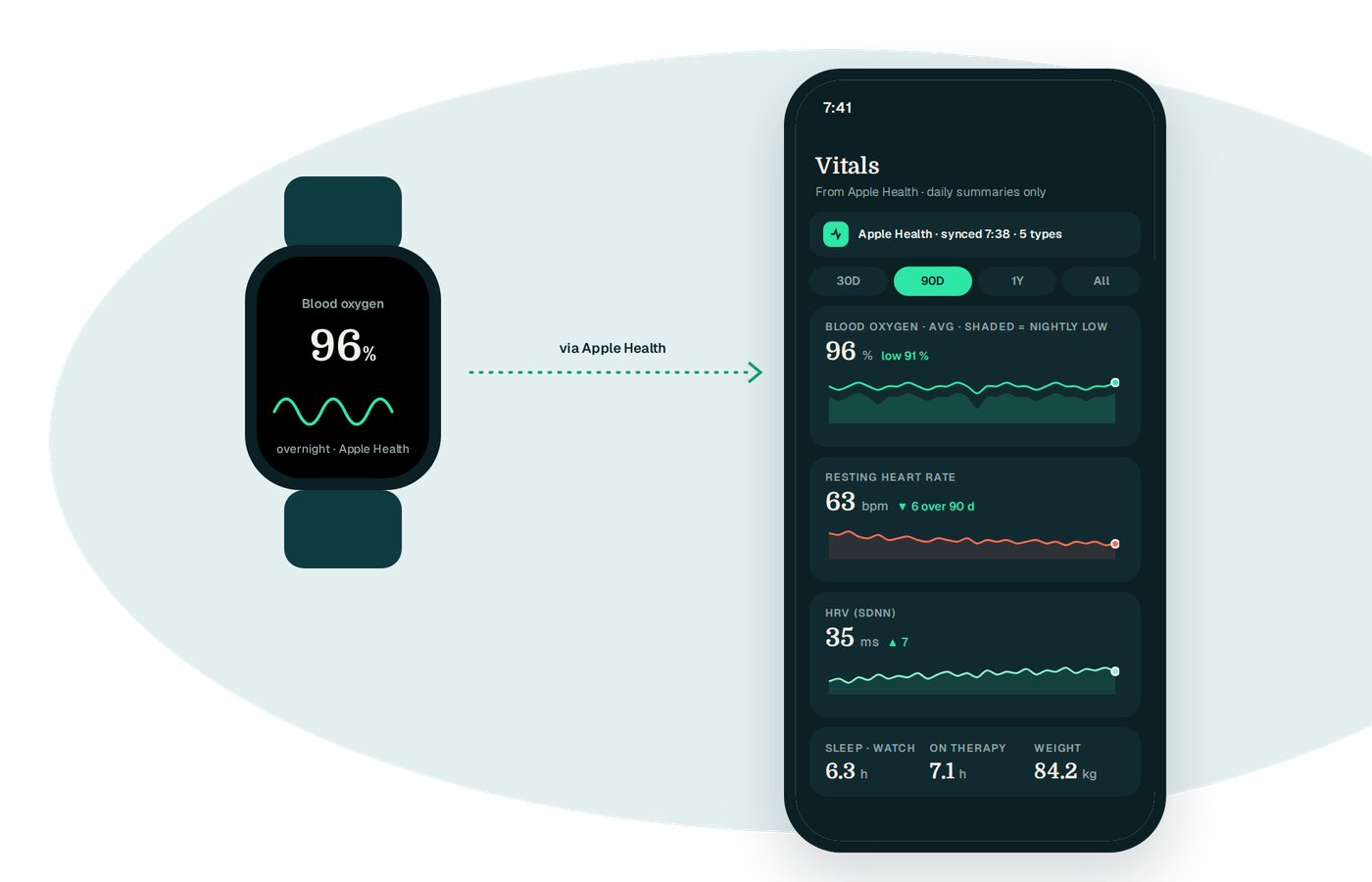
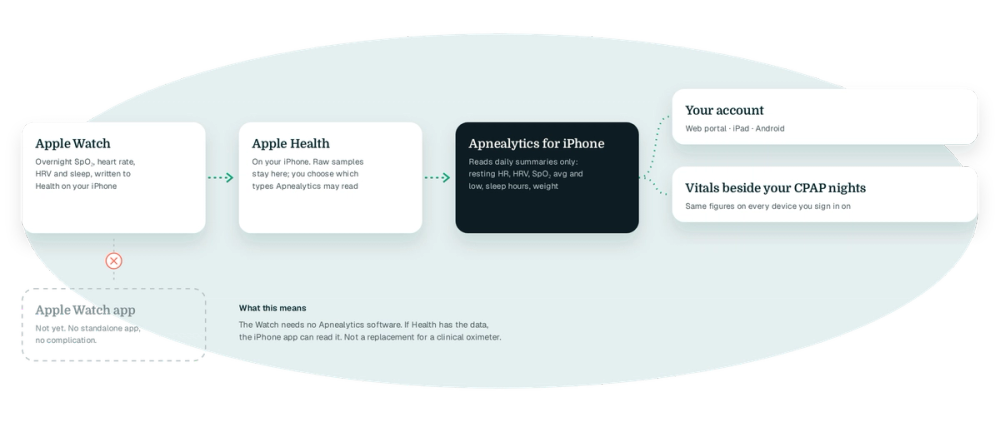
watchOS writes blood oxygen readings, heart rate, HRV (SDNN) and sleep stages to the Health app on your paired iPhone overnight.
With your permission, Apnealytics for iPhone reads daily summaries: resting heart rate, HRV, SpO₂ average and low, sleep hours and weight. Only those daily figures leave the device; raw per-second samples stay in Health.
On the Vitals screen and the Home tiles, your Watch vitals sit next to the AHI, usage and leak from your CPAP card, on every device where you sign in, including the web portal.
Each tile opens a chart with 30D, 90D, 1Y and All ranges and single-day drill-downs, drawn on the same timeline as your AHI trend.
| Watch records | Shown in Apnealytics as |
|---|---|
| Blood oxygen (overnight readings) | SpO₂ average with the nightly low shaded |
| Heart rate | Daily resting heart rate |
| Heart rate variability | HRV (SDNN), daily |
| Sleep | Sleep hours per night |
| Weight (if logged in Health) | Weight trend, shown against your weight goal |
Seeing whether a bad night was a bad night. An AHI spike alongside a higher resting heart rate and a lower SpO₂ low tells a fuller story than any one number.
Catching usage slips early. Sleep hours from the Watch next to usage hours from the machine make a gap obvious: six hours asleep, three on the mask.
Tracking the slow stuff. Resting heart rate and HRV often move over months as therapy settles. The 1Y view puts them next to pressure changes and mask swaps.
Apple Watch SpO₂ is a wellness feature with spot readings during sleep, not a continuous recording. For desaturation analytics (ODI₃, ODI₄, T90) overlaid on your night's waveforms, Apnealytics uses a recording pulse oximeter such as the Wellue O2Ring or a CMS50-family device. That is a Pro feature and the data is imported as a CSV or EDF export. See Oximeters.
Watch-based sleep apnea notifications, where available, are Apple's feature and stay in the Health app. Apnealytics does not read or interpret them.
Not yet. Apnealytics does not have a standalone watchOS app, complications or a Watch face. Your Watch contributes data through Apple Health; the viewing happens on iPhone, iPad, Android or the web. A Watch app is not on the published roadmap today. If you would use one, tell us at info@apnealytics.com, because that is how we decide.
Make sure your Watch is recording sleep and blood oxygen in the Watch app on your iPhone (Sleep and Blood Oxygen settings).
Install Apnealytics for iPhone (App Store) and sign in.
Open Settings, tap Apple Health, and allow the categories you want to share. You can allow some and not others.
Vitals populate within a few minutes and update daily.
Full steps with screenshots are in Connect Apple Health. To disconnect, open the Health app, go to Sharing, choose Apnealytics and turn off the categories, or delete the app.
Daily summaries only. Nothing per-second, nothing per-beat. Health data is never included in clinician share links by default, never appears in push notifications on your lock screen, and is never in our logs. You can export or delete everything, and deletion completes within 30 days. Read more at Privacy and security.
Apple Health sync, including everything your Watch contributes, is free. Pro adds oximetry overlays from a recording ring, per-night waveforms, full history and reports.
Not yet. There is no standalone watchOS app or complication. Your Watch's overnight SpO₂, resting heart rate, HRV and sleep reach Apnealytics through Apple Health on your iPhone, and you view them in the iPhone and iPad apps, on Android or on the web portal.
Not for desaturation analytics. The Watch takes periodic spot readings; a recording oximeter like the O2Ring samples continuously all night, which is what ODI₃, ODI₄ and T90 need. Apnealytics shows Watch SpO₂ as a daily average and low, and overlays recording-oximeter data on waveforms on Pro.
Daily summaries only: resting heart rate, HRV (SDNN), SpO₂ average and low, sleep hours and weight. You choose which categories to allow in the Health app, and only those daily figures leave the device.
Yes. Once the iPhone app has synced a day's summaries to your account, the Vitals tiles and charts appear on the web portal, iPad and Android too. The web cannot connect to Apple Health directly, so the iPhone app does the reading.
Yes. Open the Health app on your iPhone, go to Sharing, select Apnealytics and switch off any category. Summaries already synced stay in your account until you delete them, which you can do from Settings.
The web app is live today. iPhone and iPad are on the App Store. Android is on Google Play. Your first 30 nights are free, forever.
 DashboardSleep Score, AHI band, leak and pressure
 Trends & historyA year down to a night
 Breath-by-breath viewerAirflow, pressure, leak tracesPro
 SpO₂ overlayOximeter data on the same nightPro
 Pressure insightsP95, set range, EPR and ramp
 SD card importDrop the card folder, only new nights added
 Mask fit & gearWhich mask actually seals
 Ask your dataPlain-English questions, your own AI keyBYOK
 Year in SleepYour therapy year in one storyNew
 Compliance reportFinds the qualifying window for youPro
 Share with your doctorRead-only, revocable links
 Companion appiPhone, iPad and Android
 Privacy & securityYour data, locked to you
 ResMed AirSense 10 & 11Supported
 ResMed AirCurve 10 & 11 VAutoSupported
 ResMed S9 / LumisSupported
 Philips DreamStation 1 & 2Supported
 Fisher & Paykel SleepStyleSupported
 Löwenstein / DeVilbissPartial
 React Health Luna G3Waitlist
 Transcend MicroWaitlist
 Full face masksFit, leak signature, Mask Analytics
 Nasal masksOver-nose and cradle styles
 Nasal pillowsMinimal-contact fit tips
 Wellue O2RingSupported
 Contec CMS50 familySupported
 Apple Health / Health ConnectResting HR, HRV, SpO₂, sleepSupported
 What is AHI?The apnea-hypopnea index, explained
 What is a good AHI on CPAP?
 CPAP leak rate explained
 Pressure settings explained
 Reading CPAP waveformsAll 14 explainers
 Apnealytics vs SleepHQ
 Apnealytics vs OSCAR
 Apnealytics vs myAir
 Apnealytics vs DreamMapper
 SleepHQ vs OSCARBest CPAP apps in 2026
 How to read CPAP dataStart here: six numbers, in order
 Read your CPAP SD card
 Share data with your doctorChoosing a CPAP mask
 Travel with CPAPAll guides
 Mask finderSeven questions, a ranked mask typeYour data
 Machine finderA two-machine shortlist for your prescription
 iPhone / iPhone DuoLast night before you are out of bed. Apple Health vitals, Face ID.Live
 iPadSame universal app, side-by-side panes and full-width waveforms.Live
 AndroidPhones, tablets and foldables, with Health Connect built in.Live
 Web portalWhere your SD card goes. Every chart, report and setting.Live

