



iPhone / iPhone Duo Live
Last night before you are out of bed. Apple Health vitals, Face ID.
Download on the App Store Apnealytics
Free on every plan: unlimited imports, the full dashboard and your last 30 nights.
 Compatibility checkerWill my machine work?Type your model. You get a straight answer: supported, partial, waitlist, or why not.Check my machine
 If it writes an SD card, we probably read it. ResMed AirMini has no card, so no app can read it.
Sleep Check-up
3 of 6 checks done
Six short screeners, one picture of how you sleep. Earn a milestone for each, save results and get retake reminders.
Latest milestone: Sleepiness check done
 NEWTrack your 90-day compliance windowOpen the calculator
 13 free tools. No account needed — sign in to save results and fill answers from your own CPAP data.
Last night before you are out of bed. Apple Health vitals, Face ID.
Download on the App Store


One account on every screen. Apple Watch vitals sync through Apple Health.
CPAP pressure settings describe how much air pressure your machine delivers to hold your airway open, measured in centimetres of water (cmH₂O). Your clinician prescribes them. This guide explains what each setting does and how to read the pressure data your machine records, so you understand your therapy without adjusting it yourself.
Obstructive sleep apnea happens because the soft tissue of the throat relaxes and collapses during sleep. CPAP works as a pneumatic splint: a column of air at slightly above atmospheric pressure holds the airway open from the inside. The pressure needed varies from person to person and from moment to moment within the same night, depending on sleep stage, position, nasal congestion, alcohol and weight.
The unit is cmH₂O, the pressure exerted by a column of water that many centimetres tall. Typical therapy pressures run from 4 to 20 cmH₂O. For scale, 10 cmH₂O is about 1 percent of atmospheric pressure; it feels like a steady breeze, not a gale.
Fixed CPAP delivers one pressure all night. Your clinician chooses it, often from a titration study where a technologist adjusted pressure until events stopped. It is simple and predictable, and some people sleep better with no pressure changes.
Auto-adjusting CPAP (APAP) delivers a range. You or your clinician set a minimum and a maximum, and the machine moves between them in response to what it detects. A ResMed AirSense in AutoSet mode watches for flow limitation, snoring and apneas and raises pressure when it sees them, then slowly lowers it when breathing is settled. It does not raise pressure for apneas it judges to be central, because more pressure does not help those. The ResMed AirSense 10 AutoSet and AirSense 11 AutoSet both work this way.
Bilevel (BiPAP, VPAP) delivers two pressures: a higher one on inhale (IPAP) and a lower one on exhale (EPAP). The gap is called pressure support. The ResMed AirCurve 10 VAuto and AirCurve 11 VAuto are auto-adjusting bilevel machines.
Most people reading this are on APAP, so the rest of the guide leans that way.
The floor and ceiling the machine is allowed to use. A common default range is 4 to 20 cmH₂O, but clinicians often narrow it once they know where you tend to sit. A minimum set too low can leave you starved for air at the start of the night; a maximum set too low can leave obstructive events untreated.
Ramp starts the night at a lower pressure and climbs to your therapy pressure over a set time, typically 5 to 45 minutes, so you can fall asleep before the full pressure arrives. ResMed also offers AutoRamp, which holds the start pressure until the machine detects that you are asleep, then ramps. Time spent in ramp is at reduced pressure, so a long ramp on a short night can affect your numbers.
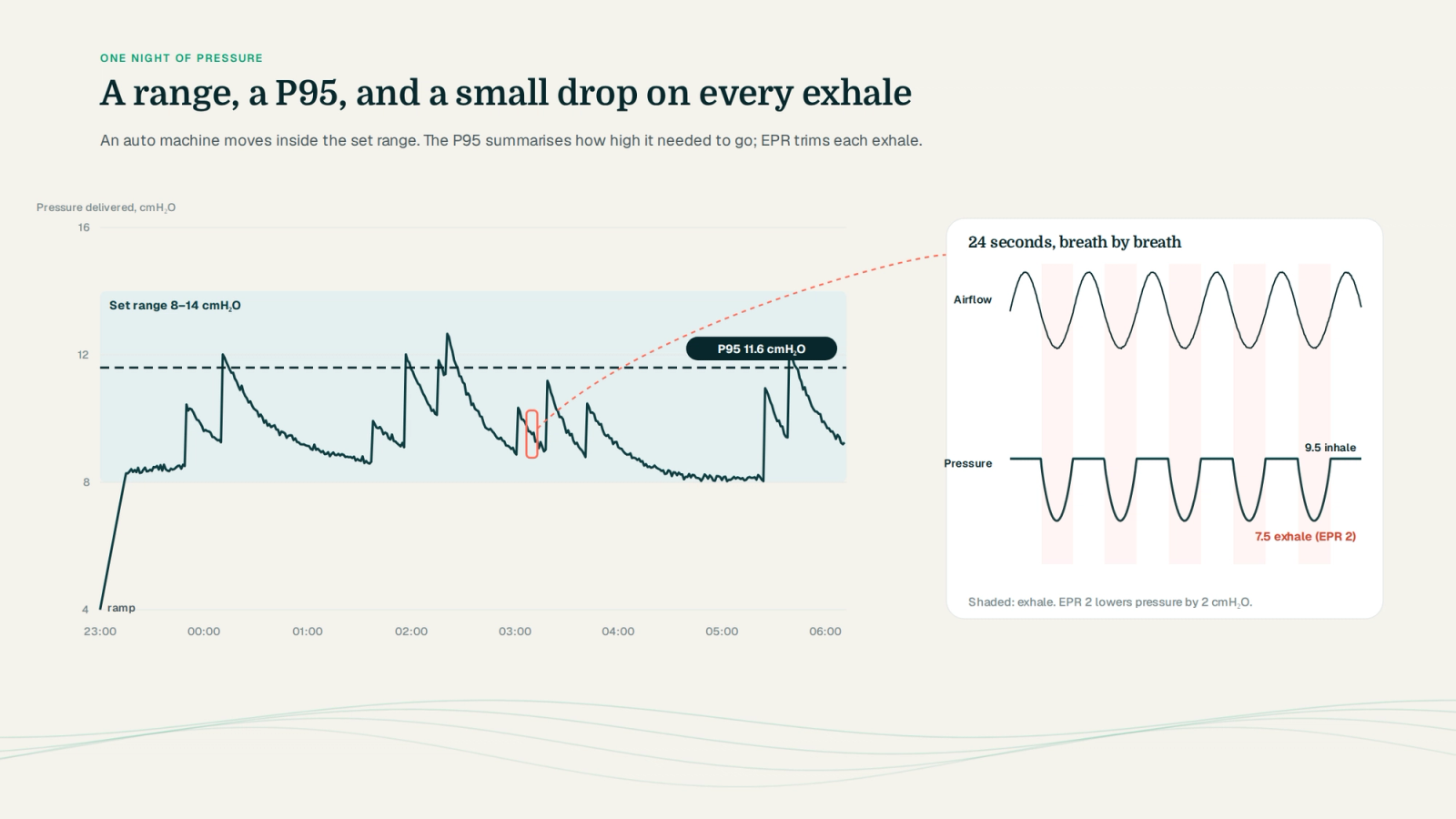
A small drop in pressure on each exhale, by 1, 2 or 3 cmH₂O, to make breathing out feel easier. It is a comfort setting with therapy implications. The EPR and Flex explainer covers it in detail.
ResMed's AirSense 11 has a Soft response option that makes pressure increases more gradual. It trades speed of response for comfort.
CPAP, AutoSet, AutoSet for Her (a variant with a gentler response algorithm), and on bilevel machines S, VAuto and others. Mode is a prescription setting.
The settings tell you what is allowed. The data tells you what happened. On an auto machine the two can be very different, and the gap is informative.
Your machine records a pressure trace through the night and summarises it as median, 95th percentile and maximum. The 95th-percentile pressure (P95) is the headline figure: the pressure you were at or below for 95 percent of the night. It filters out brief spikes and shows where the machine needed to be when it was working hardest. What is P95 pressure? goes into why that percentile is used.
Patterns worth noticing:
P95 sitting at the maximum night after night. The machine may be wanting more pressure than it is allowed. Whether raising the ceiling is right depends on your AHI, leak and event types. Raise it with your clinician.
P95 well below the maximum with a good AHI. The range is comfortable and the ceiling is not constraining anything.
Median hugging the minimum with flow limitation. Some people find the machine is slow to leave the floor; a higher minimum is a common clinical adjustment, and again a clinical one.
P95 that jumps on specific nights. Usually alcohol, congestion or back sleeping. Correlate with your trigger journal.
As pressure rises, the force pushing the cushion away from your face rises too. Many people have a pressure above which their mask starts to leak. On an auto machine that creates a feedback loop: the machine raises pressure to clear events, the mask leaks, the machine cannot see clearly, and it may hold pressure high or mark events as unclassified. If your leak P95 rises in step with your pressure P95, mask fit is the first thing to look at. See CPAP leak rate explained.
For a minority of people, higher pressures provoke central apneas, where the airway is open but the breathing drive pauses. This is often called treatment-emergent central sleep apnea. An auto machine will not raise pressure for a central event, but if obstructive events push the pressure up and centrals follow, the night can be messy. If your event composition shows a growing share of central events, that is a clinician conversation. See central vs obstructive apnea on CPAP.
The pressure insights feature reads pressure P95 and your configured minimum and maximum from each night's summary on the SD card. On the dashboard the pressure tile shows P95 against the set range, with EPR level beside it.
In Trends, P95 is drawn as a line inside the shaded band of your set range, so a night pressed against the ceiling is visible at a glance. When the card shows a new range, EPR level or mode, the "What changed?" panel drops a dated marker on the chart. You can then compare AHI, leak and event composition before and after the change.
Pro users can open the pressure trace in the breath-by-breath viewer: the ramp climbing at the start, the small dip on each exhale from EPR, and the step-ups the machine makes when it responds to flow limitation or events.
Pressure settings are a prescription. Apnealytics shows you what your machine did; it does not tell you what to set, and it cannot change anything on your device. We would ask you to involve your clinician in any change. The useful thing you can do with your data is arrive at that conversation with a clear trend and a specific question.
There is no single normal. Therapy pressures range from about 4 to 20 cmH₂O, and most adults settle somewhere between 6 and 14. The right pressure for you depends on your airway, weight, sleep position and more, which is why it is prescribed after a sleep study or set by an auto machine within a clinician-chosen range.
Centimetres of water. It is the pressure a column of water that many centimetres tall exerts at its base. CPAP uses it because the pressures involved are small: 10 cmH₂O is roughly 1 percent of atmospheric pressure. It feels like a steady breeze when you open your mouth with the mask on.
Neither is universally better. Auto machines adapt to position, sleep stage and congestion, and many people need less average pressure as a result. Fixed pressure is simpler and some people sleep better without changes. Bilevel machines suit people who need high pressures or struggle to exhale. Your clinician chooses based on your study and how you respond.
On an auto machine, a 95th-percentile pressure at the ceiling means the machine was trying to go higher and was stopped by your settings. It can mean the maximum is too low, or that leak or central events are confusing the algorithm. Look at AHI, leak and event types alongside it, then discuss with your clinician.
Pressure is a prescribed setting and changing it is a clinical decision. Even when the machine's clinical menu is accessible, adjustments without guidance can leave events untreated or provoke central apneas. Apnealytics shows what your machine did so you can have an informed conversation; it never changes a setting and never recommends one.
The web app is live today. iPhone and iPad are on the App Store. Android is on Google Play. Your first 30 nights are free, forever.
 DashboardSleep Score, AHI band, leak and pressure
 Trends & historyA year down to a night
 Breath-by-breath viewerAirflow, pressure, leak tracesPro
 SpO₂ overlayOximeter data on the same nightPro
 Pressure insightsP95, set range, EPR and ramp
 SD card importDrop the card folder, only new nights added
 Mask fit & gearWhich mask actually seals
 Ask your dataPlain-English questions, your own AI keyBYOK
 Year in SleepYour therapy year in one storyNew
 Compliance reportFinds the qualifying window for youPro
 Share with your doctorRead-only, revocable links
 Companion appiPhone, iPad and Android
 Privacy & securityYour data, locked to you
 ResMed AirSense 10 & 11Supported
 ResMed AirCurve 10 & 11 VAutoSupported
 ResMed S9 / LumisSupported
 Philips DreamStation 1 & 2Supported
 Fisher & Paykel SleepStyleSupported
 Löwenstein / DeVilbissPartial
 React Health Luna G3Waitlist
 Transcend MicroWaitlist
 Full face masksFit, leak signature, Mask Analytics
 Nasal masksOver-nose and cradle styles
 Nasal pillowsMinimal-contact fit tips
 Wellue O2RingSupported
 Contec CMS50 familySupported
 Apple Health / Health ConnectResting HR, HRV, SpO₂, sleepSupported
 What is AHI?The apnea-hypopnea index, explained
 What is a good AHI on CPAP?
 CPAP leak rate explained
 Pressure settings explained
 Reading CPAP waveformsAll 14 explainers
 Apnealytics vs SleepHQ
 Apnealytics vs OSCAR
 Apnealytics vs myAir
 Apnealytics vs DreamMapper
 SleepHQ vs OSCARBest CPAP apps in 2026
 How to read CPAP dataStart here: six numbers, in order
 Read your CPAP SD card
 Share data with your doctorChoosing a CPAP mask
 Travel with CPAPAll guides
 Mask finderSeven questions, a ranked mask typeYour data
 Machine finderA two-machine shortlist for your prescription
 iPhone / iPhone DuoLast night before you are out of bed. Apple Health vitals, Face ID.Live
 iPadSame universal app, side-by-side panes and full-width waveforms.Live
 AndroidPhones, tablets and foldables, with Health Connect built in.Live
 Web portalWhere your SD card goes. Every chart, report and setting.Live

