



iPhone / iPhone Duo Live
Last night before you are out of bed. Apple Health vitals, Face ID.
Download on the App Store Apnealytics
Free on every plan: unlimited imports, the full dashboard and your last 30 nights.
 Compatibility checkerWill my machine work?Type your model. You get a straight answer: supported, partial, waitlist, or why not.Check my machine
 If it writes an SD card, we probably read it. ResMed AirMini has no card, so no app can read it.
Sleep Check-up
3 of 6 checks done
Six short screeners, one picture of how you sleep. Earn a milestone for each, save results and get retake reminders.
Latest milestone: Sleepiness check done
 NEWTrack your 90-day compliance windowOpen the calculator
 13 free tools. No account needed — sign in to save results and fill answers from your own CPAP data.
Last night before you are out of bed. Apple Health vitals, Face ID.
Download on the App Store


One account on every screen. Apple Watch vitals sync through Apple Health.
Your CPAP machine estimates how often your breathing was disturbed. A pulse oximeter records what happened to your oxygen. Apnealytics puts the two on the same timeline: a CPAP oximeter overlay that lays SpO₂ and pulse over the night's airflow, pressure and events, then summarises the desaturations as ODI₃, ODI₄ and T90. Oximetry overlays are part of the Pro plan.
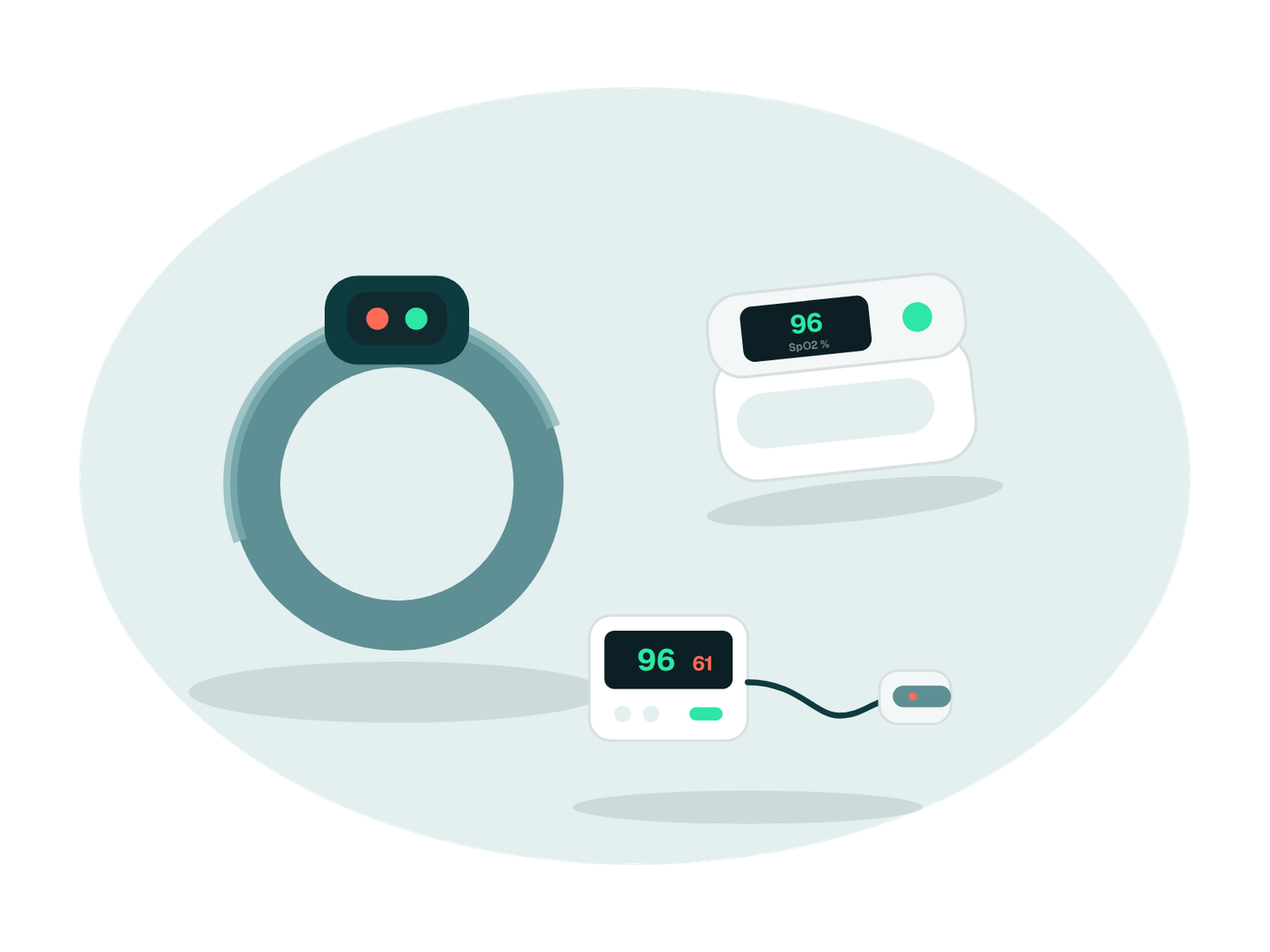
If your oximeter exports a file with a timestamp, SpO₂ and pulse columns, it will import. If it exports only to a closed app with no file, it will not.
| Device | Import path | Status |
|---|---|---|
| Wellue O2Ring (and O2Ring variants) | CSV export from the Wellue app | Supported, Pro |
| Contec CMS50 family (CMS50D+, CMS50F, CMS50I and others) | CSV export from Contec's desktop software or app | Supported, Pro |
| ResMed oximetry (SAD.edf) | Read automatically from the SD card when a ResMed-compatible oximeter module was attached | Supported, Pro |
| Any oximeter that exports EDF or CSV | File import, with a column mapper for CSV | Supported, Pro |
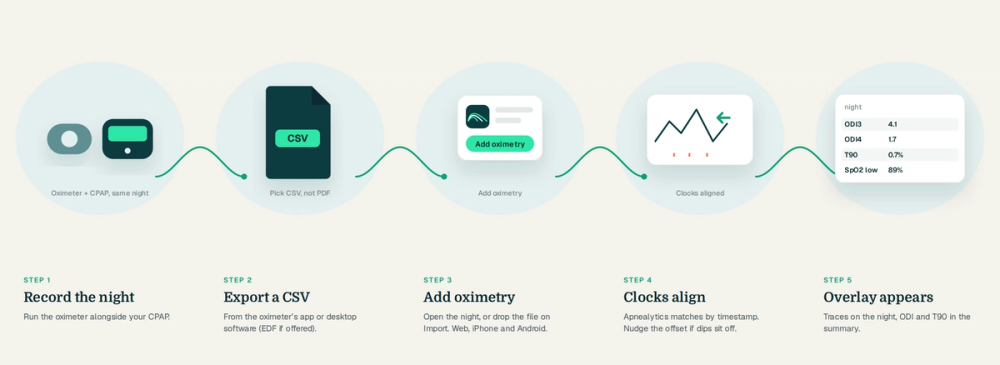
Record the night with the oximeter running alongside your CPAP.
Export the session from the oximeter's app or desktop software as CSV (or EDF if offered).
In Apnealytics, open the night and choose Add oximetry, or drop the file on Import. The web portal and the iPhone and Android apps all accept oximeter files.
If the clocks differ, you can nudge the offset by hand.
The overlay appears on the night, and ODI₃, ODI₄ and T90 are added to the night's summary.
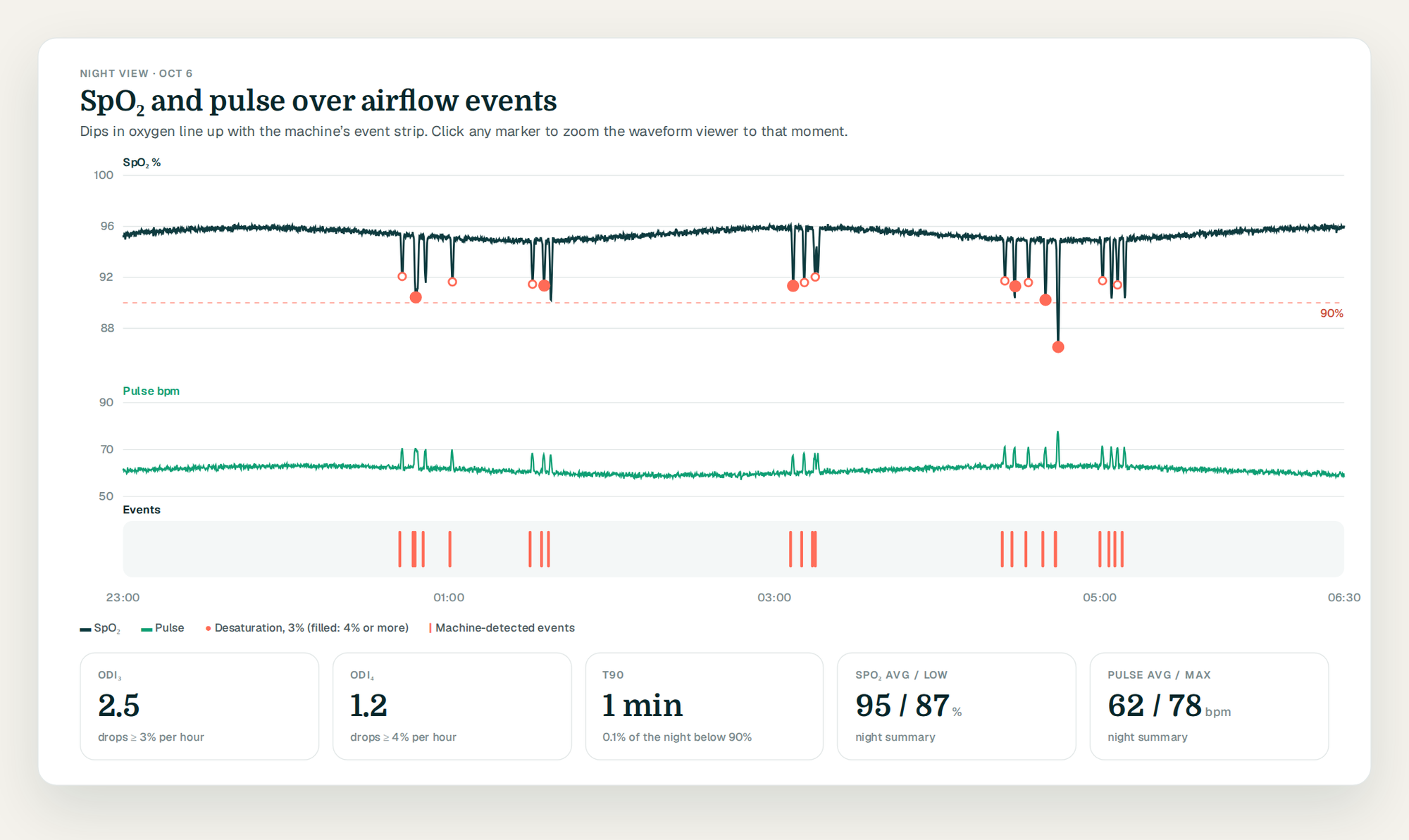
Scroll the night and watch whether a cluster of hypopneas on the event strip lines up with a dip in SpO₂ and a rise in pulse. If it does, the events had a cost. If it does not, the machine may have flagged events that were not deep enough to matter, or the oximeter may have missed them. Either is worth knowing.
Each drop of 3 percent or more from the preceding baseline is marked, and each drop of 4 percent or more is marked more strongly. You can click any marker to zoom the Pro waveform viewer to that moment.
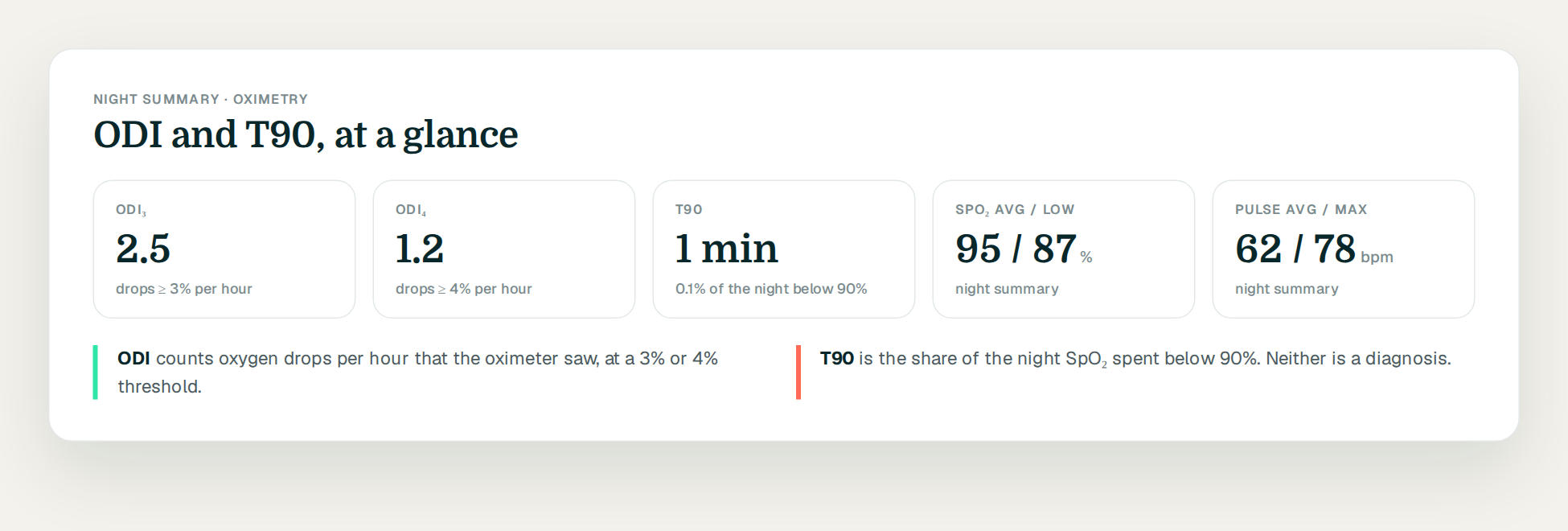
Average SpO₂, lowest SpO₂, average and highest pulse, ODI₃, ODI₄ and T90 for the night, and trends of each across 30 nights or any range.
ODI₃ (oxygen desaturation index, 3 percent) is the number of times per hour SpO₂ dropped by at least 3 percent from its recent baseline. ODI₄ uses a 4 percent threshold and is stricter.
T90 is the share of the night, in minutes or percent, that SpO₂ spent below 90 percent.
ODI is not the same as AHI. AHI counts airflow events the machine detected; ODI counts oxygen drops the oximeter detected. They often move together but can diverge. Neither is a diagnosis. Read more in SpO₂ explained.
Oximetry import and overlays are a Pro feature at $8.99 a month or $99.99 a year. Pro is per account, so every family login on the account gets it. The Free plan still syncs the daily SpO₂ average and low from Apple Health or Health Connect, which is a daily summary rather than a night-long trace. See pricing.
Any oximeter that exports a file works, so the choice comes down to comfort and battery. Ring-style devices like the O2Ring are the most comfortable for all-night wear. Finger-clip devices like the CMS50 family are cheaper and widely available, but a clip on the finger can come loose during sleep. Wrist units with a soft finger probe sit in between. Apnealytics does not sell oximeters or take referral payments.
The Wellue O2Ring, the Contec CMS50 family, ResMed's SAD.edf oximetry file, and any oximeter that exports EDF or CSV with timestamp, SpO₂ and pulse columns. Import is on the web portal and in the iPhone and Android apps. Oximetry overlays are a Pro feature.
AHI is the number of apneas and hypopneas per hour that your CPAP machine detected from airflow. ODI is the number of oxygen desaturations per hour that your oximeter detected. They measure different things and can disagree. Seeing both on one timeline is the point of the overlay. Neither is a diagnosis.
No. Apple Health provides daily SpO₂ summaries (average and low), not a continuous overnight trace, and Apnealytics shows those beside your therapy on every plan. For a night-long overlay you need a dedicated oximeter that exports a file. See Apple Watch and Apple Health.
Apnealytics aligns the two by timestamp automatically. Oximeter clocks drift, so if the SpO₂ dips sit a minute or two off the events, drag the offset control on the night to correct it. Setting the oximeter's clock from your phone before each recording keeps drift small.
Not the overlay. The Free plan includes the daily SpO₂ average and low from Apple Health or Health Connect. Night-long oximeter import, the overlay, ODI₃, ODI₄ and T90 are Pro features.
The web app is live today. iPhone and iPad are on the App Store. Android is on Google Play. Your first 30 nights are free, forever.
 DashboardSleep Score, AHI band, leak and pressure
 Trends & historyA year down to a night
 Breath-by-breath viewerAirflow, pressure, leak tracesPro
 SpO₂ overlayOximeter data on the same nightPro
 Pressure insightsP95, set range, EPR and ramp
 SD card importDrop the card folder, only new nights added
 Mask fit & gearWhich mask actually seals
 Ask your dataPlain-English questions, your own AI keyBYOK
 Year in SleepYour therapy year in one storyNew
 Compliance reportFinds the qualifying window for youPro
 Share with your doctorRead-only, revocable links
 Companion appiPhone, iPad and Android
 Privacy & securityYour data, locked to you
 ResMed AirSense 10 & 11Supported
 ResMed AirCurve 10 & 11 VAutoSupported
 ResMed S9 / LumisSupported
 Philips DreamStation 1 & 2Supported
 Fisher & Paykel SleepStyleSupported
 Löwenstein / DeVilbissPartial
 React Health Luna G3Waitlist
 Transcend MicroWaitlist
 Full face masksFit, leak signature, Mask Analytics
 Nasal masksOver-nose and cradle styles
 Nasal pillowsMinimal-contact fit tips
 Wellue O2RingSupported
 Contec CMS50 familySupported
 Apple Health / Health ConnectResting HR, HRV, SpO₂, sleepSupported
 What is AHI?The apnea-hypopnea index, explained
 What is a good AHI on CPAP?
 CPAP leak rate explained
 Pressure settings explained
 Reading CPAP waveformsAll 14 explainers
 Apnealytics vs SleepHQ
 Apnealytics vs OSCAR
 Apnealytics vs myAir
 Apnealytics vs DreamMapper
 SleepHQ vs OSCARBest CPAP apps in 2026
 How to read CPAP dataStart here: six numbers, in order
 Read your CPAP SD card
 Share data with your doctorChoosing a CPAP mask
 Travel with CPAPAll guides
 Mask finderSeven questions, a ranked mask typeYour data
 Machine finderA two-machine shortlist for your prescription
 iPhone / iPhone DuoLast night before you are out of bed. Apple Health vitals, Face ID.Live
 iPadSame universal app, side-by-side panes and full-width waveforms.Live
 AndroidPhones, tablets and foldables, with Health Connect built in.Live
 Web portalWhere your SD card goes. Every chart, report and setting.Live

