



iPhone / iPhone Duo Live
Last night before you are out of bed. Apple Health vitals, Face ID.
Download on the App Store Apnealytics
Free on every plan: unlimited imports, the full dashboard and your last 30 nights.
 Compatibility checkerWill my machine work?Type your model. You get a straight answer: supported, partial, waitlist, or why not.Check my machine
 If it writes an SD card, we probably read it. ResMed AirMini has no card, so no app can read it.
Sleep Check-up
3 of 6 checks done
Six short screeners, one picture of how you sleep. Earn a milestone for each, save results and get retake reminders.
Latest milestone: Sleepiness check done
 NEWTrack your 90-day compliance windowOpen the calculator
 13 free tools. No account needed — sign in to save results and fill answers from your own CPAP data.
Last night before you are out of bed. Apple Health vitals, Face ID.
Download on the App Store


One account on every screen. Apple Watch vitals sync through Apple Health.
Your sleep doctor has about twelve minutes with you. Walk in with a laptop full of charts and most of that time goes to finding the right one. Walk in with a single page that shows usage, AHI trend, leak and pressure for the last 90 days, and the conversation starts where it should. This guide to how to share CPAP data with your doctor covers what clinicians actually want, how to prepare it, and the two ways Apnealytics sends it: a doctor-ready PDF and a revocable, read-only share link. Both are Pro features ($8.99/month or $99.99/year).

If your machine's modem is on, your DME and possibly your physician can already see summary data in the manufacturer's clinician portal (ResMed AirView, Philips Care Orchestrator). That covers usage, AHI, leak and pressure at a nightly level. What they usually do not have:
Anything from before the modem was active, or from a machine you bought privately.
Waveforms around specific events.
Your oximeter data.
Your notes: what changed, when, and how you felt.
Health data such as resting heart rate, HRV or sleep hours from your watch.
So the point of sharing is not to duplicate what they have. It is to add the parts they do not.
Before the appointment, ask the clinic one question: "Do you want a PDF, a link, or a printout?" Some practices will only accept a document they can attach to the chart. Some are happy to open a link on the room's computer. A few want paper. The answer determines which of the two Apnealytics options you use, and saves you from arriving with the wrong one.
Data without a question is a wall of numbers. Write one sentence: "My AHI has risen from 2 to 6 over the last two months and leak has not changed." Or: "I feel unrested despite a good AHI; here is my oximetry." The report should support that sentence. If you cannot write the sentence, the appointment may be routine, and the compliance page alone is enough.
The doctor-ready PDF puts the whole picture on a few pages, compliance first, clinical detail second.
Sign in at my.apnealytics.com and open Reports.
Choose the date range. 90 days is the usual clinical window; use 30 if the question is recent, a year if it is about a slow drift.
Choose what to include. By default: compliance summary (nights used, nights at or above 4 hours, percentage, average usage), 30-night rolling AHI trend, event composition, leak P95, pressure P95 against set range, EPR. Optionally: oximetry (ODI₃, ODI₄, T90) if you have imported it, Mask Analytics if you changed masks, Health vitals, and your trigger-journal notes.
Decide on identifiers. Your name and date of birth are off by default. Turn them on if the clinic needs them to file the document; leave them off if you are emailing it.
Generate. Download the PDF, or send it to yourself.
Print one copy for the room. Even clinics that accept PDFs appreciate paper during the conversation.
A share link lets the clinician open a live, read-only view of your data in their browser, without an account.
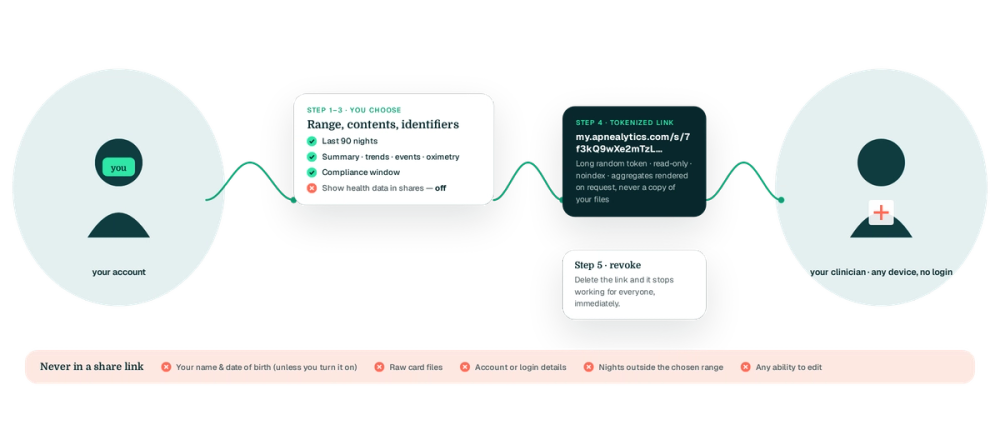
In Reports or Share, choose Create clinician link.
Choose the scope: date range and which sections. Links are aggregate-only: they show nightly summaries, trends and the report tiles, not raw files or your account settings.
Set an expiry, or leave it open and revoke it manually later.
Copy the link and send it by the clinic's preferred channel, or show the QR code on your phone in the room.
After the appointment, revoke it in Share if you no longer want it active.
What the link is, specifically: tokenized (a long random address, not guessable), read-only (nothing can be changed from it), aggregate-only, revocable at any time, not indexed by search engines, with health identifiers excluded by default. The clinician sees your therapy data, not your name, unless you choose to include it.
Lead with your sentence from Step 3.
Hand over the page or open the link.
Point to the chart that supports the sentence. One chart.
Let them look. Resist narrating.
Ask what they would change and what they want to see next time.
If a setting changes as a result, Apnealytics will mark it in "What changed?" when the next card upload shows the new pressure range, so the follow-up appointment has a before-and-after.
Revoke the share link if it is no longer needed.
Note the visit and any changes in the trigger journal.
Set a reminder for the follow-up and plan to upload the card a few days before it, so the report is current.
If the visit is the day-31-to-91 compliance follow-up, use the compliance autopilot first. It finds the qualifying 30-day window inside your first 90 days and drafts the letter, and the result goes on the front page of the PDF. The full guide is on CPAP compliance report for insurance.
The web app is live today. iPhone and iPad are on the App Store. Android is on Google Play. Your first 30 nights are free, forever.
 DashboardSleep Score, AHI band, leak and pressure
 Trends & historyA year down to a night
 Breath-by-breath viewerAirflow, pressure, leak tracesPro
 SpO₂ overlayOximeter data on the same nightPro
 Pressure insightsP95, set range, EPR and ramp
 SD card importDrop the card folder, only new nights added
 Mask fit & gearWhich mask actually seals
 Ask your dataPlain-English questions, your own AI keyBYOK
 Year in SleepYour therapy year in one storyNew
 Compliance reportFinds the qualifying window for youPro
 Share with your doctorRead-only, revocable links
 Companion appiPhone, iPad and Android
 Privacy & securityYour data, locked to you
 ResMed AirSense 10 & 11Supported
 ResMed AirCurve 10 & 11 VAutoSupported
 ResMed S9 / LumisSupported
 Philips DreamStation 1 & 2Supported
 Fisher & Paykel SleepStyleSupported
 Löwenstein / DeVilbissPartial
 React Health Luna G3Waitlist
 Transcend MicroWaitlist
 Full face masksFit, leak signature, Mask Analytics
 Nasal masksOver-nose and cradle styles
 Nasal pillowsMinimal-contact fit tips
 Wellue O2RingSupported
 Contec CMS50 familySupported
 Apple Health / Health ConnectResting HR, HRV, SpO₂, sleepSupported
 What is AHI?The apnea-hypopnea index, explained
 What is a good AHI on CPAP?
 CPAP leak rate explained
 Pressure settings explained
 Reading CPAP waveformsAll 14 explainers
 Apnealytics vs SleepHQ
 Apnealytics vs OSCAR
 Apnealytics vs myAir
 Apnealytics vs DreamMapper
 SleepHQ vs OSCARBest CPAP apps in 2026
 How to read CPAP dataStart here: six numbers, in order
 Read your CPAP SD card
 Share data with your doctorChoosing a CPAP mask
 Travel with CPAPAll guides
 Mask finderSeven questions, a ranked mask typeYour data
 Machine finderA two-machine shortlist for your prescription
 iPhone / iPhone DuoLast night before you are out of bed. Apple Health vitals, Face ID.Live
 iPadSame universal app, side-by-side panes and full-width waveforms.Live
 AndroidPhones, tablets and foldables, with Health Connect built in.Live
 Web portalWhere your SD card goes. Every chart, report and setting.Live

