



iPhone / iPhone Duo Live
Last night before you are out of bed. Apple Health vitals, Face ID.
Download on the App Store Apnealytics
Free on every plan: unlimited imports, the full dashboard and your last 30 nights.
 Compatibility checkerWill my machine work?Type your model. You get a straight answer: supported, partial, waitlist, or why not.Check my machine
 If it writes an SD card, we probably read it. ResMed AirMini has no card, so no app can read it.
Sleep Check-up
3 of 6 checks done
Six short screeners, one picture of how you sleep. Earn a milestone for each, save results and get retake reminders.
Latest milestone: Sleepiness check done
 NEWTrack your 90-day compliance windowOpen the calculator
 13 free tools. No account needed — sign in to save results and fill answers from your own CPAP data.
Last night before you are out of bed. Apple Health vitals, Face ID.
Download on the App Store


One account on every screen. Apple Watch vitals sync through Apple Health.
CPAP leak rate is the amount of air escaping your mask that is not supposed to. It is measured in litres per minute. Some leak is normal and expected; too much lets pressure drop, makes the machine's event detection unreliable, and is the most common reason a good therapy setup quietly stops working.
Every CPAP mask leaks on purpose. The small vent holes in the mask or elbow flush out the carbon dioxide you exhale so you do not rebreathe it. That is intentional leak, sometimes called vent flow, and it rises with pressure in a predictable way that the manufacturer publishes for each mask.
Unintentional leak is everything else: air escaping between the cushion and your face, out of your mouth if you wear a nasal mask or pillows, or through a cracked cushion, a loose connection or a worn tube. This is the leak that matters.
Manufacturers handle these differently in their reports, and it trips people up.
ResMed reports unintentional leak only. The machine knows roughly what the vent should be passing at the current pressure, subtracts it, and reports the remainder. A ResMed leak of 0 L/min means "no more than expected," not "no air escaping at all."
Philips reports total leak, intentional plus unintentional. The same physical leak reads as a much larger number on a Philips machine. Apnealytics reads Philips DreamStation 1 and 2 and labels the measure by name; this guide focuses on ResMed.
If you ever compare your leak with someone else's, check which machine they use first.
The machine has a flow sensor at the blower. It knows how much air it is pushing out. It estimates how much is being used by your breathing and how much the vent is passing, and attributes the difference to unintentional leak. It samples this continuously and stores a leak trace on the SD card alongside flow and pressure.
From that trace the machine summarises the night. The figures that matter are:
Leak median: the middle value across the night.
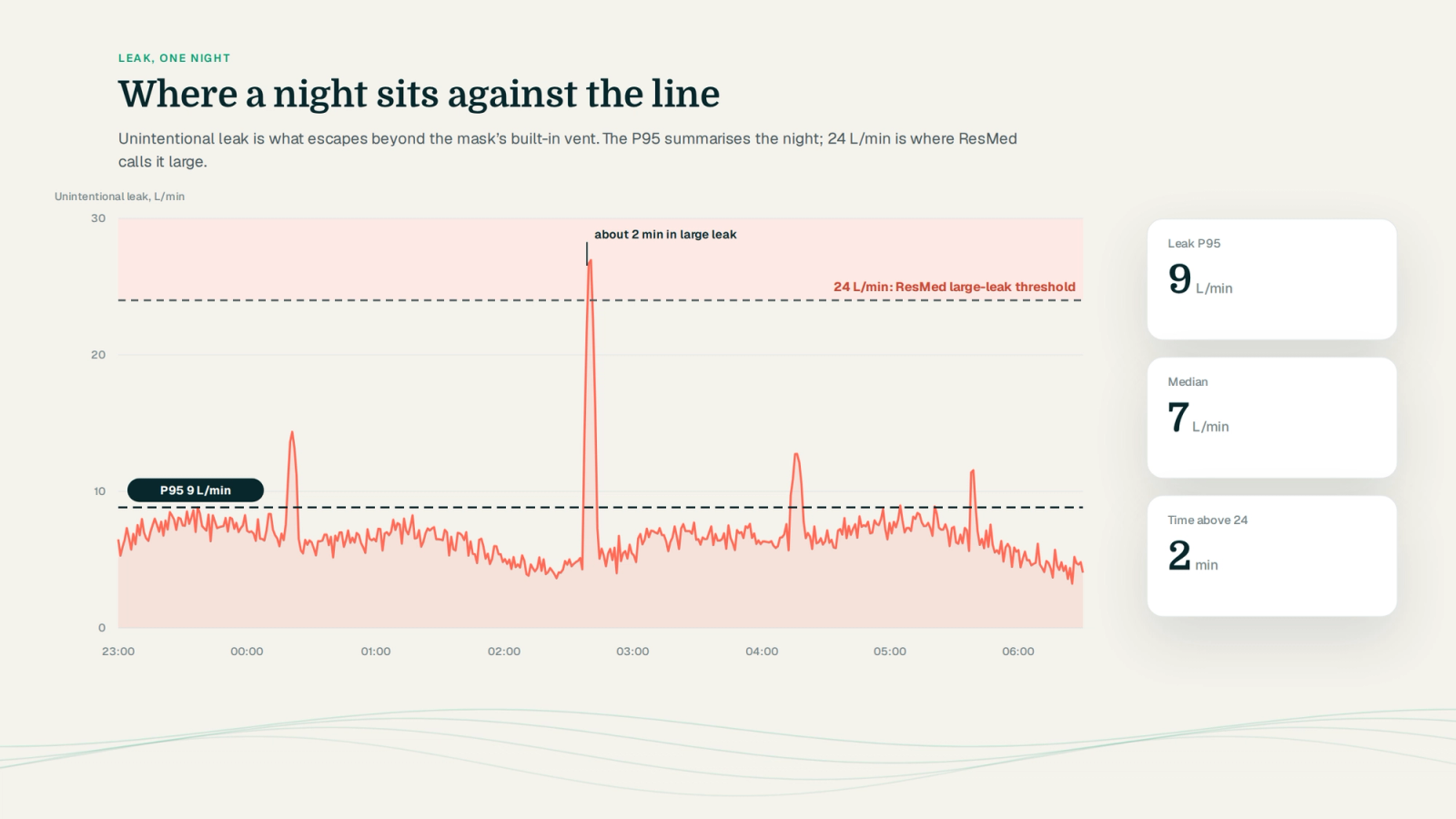
Leak 95th percentile (P95): the value you were under for 95 percent of the night. This is the headline leak number and the one Apnealytics shows on your dashboard.
Leak maximum: the single worst moment, which is often a mask being pulled off and is rarely useful on its own.
Time in large leak: how long the leak stayed above the manufacturer's threshold.
ResMed's documentation defines large leak as unintentional leak above 24 L/min. Above that, the machine notes that event detection and pressure delivery may be compromised, and myAir's mask seal component starts to lose points.
That number is a device threshold, not a clinical verdict. Plenty of people run a leak P95 of 10 to 20 L/min without any effect on AHI or comfort. A P95 under the large-leak line most nights is the practical goal. Occasional spikes to 40 or 60 are usually a position change or a mask knocked loose and are not something to worry about unless they are frequent or sustained.
Three reasons, in order of importance.
It hides events. The machine detects apneas and hypopneas by watching airflow. When a large share of that air is escaping sideways, the flow signal is noisy and the algorithm can neither trust a reduction nor confidently classify a pause as obstructive or central. ResMed marks apneas detected during high leak as unclassified. A night with low AHI and high leak may be a night the machine could not see well, not a good night. Always read AHI and leak together.
It lowers delivered pressure. Auto machines try to compensate by increasing blower speed, and they are good at it up to a point. Beyond that, the pressure at your airway is lower than the pressure the machine reports, and obstructive events can return.
It wrecks comfort. Air across your eyes, noise, a dry mouth and the cold spot where a cushion lifts all disturb sleep. Many people abandon therapy over leak they never identified as leak.
With a full-face mask, almost all unintentional leak is cushion seal: strap tension, cushion size, facial hair, pillow pressure on one side. With a nasal mask or nasal pillows, you have a second route: your mouth. If your mouth falls open during sleep, pressurised air flows in through your nose and straight out through your lips.
The leak trace looks different for each. Seal leak tends to be steady or to step up and down with position changes. Mouth leak often appears as a sustained plateau that starts some time after you fall asleep, when jaw muscles relax, and disappears when you roll or briefly wake. A dry mouth on waking is the classic sign.
The fix is different too. Seal leak responds to fitting and replacing the cushion. Mouth leak responds to a chin strap, mouth tape (discuss with your clinician), or a switch to a full-face mask. The mask fit and leak feature in Apnealytics tracks leak per mask so you can see which hardware is leaking, and the masks hub explains the trade-offs between types.
On the dashboard, leak P95 appears as a tile beside AHI and usage, with a status colour against the large-leak line. The Nights list shows leak for every night in a column so you can scan for a cluster of bad ones.
In Trends, you can overlay leak P95 with AHI over 30, 90 or 365 nights. The pattern to look for is leak rising in step with AHI, which usually means the mask is the problem rather than the pressure. The "What changed?" panel marks the date you logged a new mask or cushion in Gear, so the before-and-after is visible.
Mask Analytics, in the Gear section, aggregates seal, AHI and usage for every mask you have used. When a cushion ages, you can watch its leak creep up over the weeks and get a replacement reminder before it becomes a problem.
Pro users can open the leak trace for any night in the breath-by-breath viewer alongside airflow and pressure, with a crosshair to read the exact value at any moment and a shaded band for time in large leak. That is where the difference between a two-minute spike and a two-hour plateau becomes obvious.
None of this is medical advice; it is mask hygiene.
at therapy pressure, lying in your usual position.
Over-tightening folds the cushion and often makes leak worse.
Silicone softens and loses shape; Apnealytics' replacement reminders exist for this reason.
Elbow swivels, tube connection and humidifier seal all leak when worn.
Nasal pillows, nasal masks and full-face masks each suit different faces.
with your clinician if you use a nasal interface.
Side sleepers often push the mask out of position.
On a ResMed machine, which reports unintentional leak only, a leak P95 under roughly 24 L/min is the usual benchmark. Many people run single digits. Brief spikes during position changes are normal. If your P95 is regularly above the large-leak line or your time in large leak is more than a few minutes a night, look at mask fit first.
ResMed defines large leak as unintentional leak above 24 L/min. Above this level the machine's event detection and pressure compensation become less reliable, and apneas detected during large leak are marked as unclassified. The summary data on your SD card records how long you spent above the threshold each night.
Because high leak can hide events. The machine detects apneas and hypopneas from airflow, and when much of that air is escaping sideways the signal is too noisy to score reliably. A low AHI on a high-leak night should be treated with caution. Fix the leak first, then see what the AHI does.
On ResMed machines, no. ResMed subtracts the expected vent flow for your pressure and reports only unintentional leak. Philips machines report total leak including the vent, so numbers are not comparable between brands. Apnealytics shows the value as your machine reports it and labels it accordingly.
Mouth leak typically shows as a long, steady plateau in the leak trace that begins after you fall asleep and clears when you roll or wake. Waking with a dry mouth is the usual clue. It only happens with nasal masks and pillows. A full-face mask or a chin strap removes the route; discuss options with your clinician or equipment provider.
The web app is live today. iPhone and iPad are on the App Store. Android is on Google Play. Your first 30 nights are free, forever.
 DashboardSleep Score, AHI band, leak and pressure
 Trends & historyA year down to a night
 Breath-by-breath viewerAirflow, pressure, leak tracesPro
 SpO₂ overlayOximeter data on the same nightPro
 Pressure insightsP95, set range, EPR and ramp
 SD card importDrop the card folder, only new nights added
 Mask fit & gearWhich mask actually seals
 Ask your dataPlain-English questions, your own AI keyBYOK
 Year in SleepYour therapy year in one storyNew
 Compliance reportFinds the qualifying window for youPro
 Share with your doctorRead-only, revocable links
 Companion appiPhone, iPad and Android
 Privacy & securityYour data, locked to you
 ResMed AirSense 10 & 11Supported
 ResMed AirCurve 10 & 11 VAutoSupported
 ResMed S9 / LumisSupported
 Philips DreamStation 1 & 2Supported
 Fisher & Paykel SleepStyleSupported
 Löwenstein / DeVilbissPartial
 React Health Luna G3Waitlist
 Transcend MicroWaitlist
 Full face masksFit, leak signature, Mask Analytics
 Nasal masksOver-nose and cradle styles
 Nasal pillowsMinimal-contact fit tips
 Wellue O2RingSupported
 Contec CMS50 familySupported
 Apple Health / Health ConnectResting HR, HRV, SpO₂, sleepSupported
 What is AHI?The apnea-hypopnea index, explained
 What is a good AHI on CPAP?
 CPAP leak rate explained
 Pressure settings explained
 Reading CPAP waveformsAll 14 explainers
 Apnealytics vs SleepHQ
 Apnealytics vs OSCAR
 Apnealytics vs myAir
 Apnealytics vs DreamMapper
 SleepHQ vs OSCARBest CPAP apps in 2026
 How to read CPAP dataStart here: six numbers, in order
 Read your CPAP SD card
 Share data with your doctorChoosing a CPAP mask
 Travel with CPAPAll guides
 Mask finderSeven questions, a ranked mask typeYour data
 Machine finderA two-machine shortlist for your prescription
 iPhone / iPhone DuoLast night before you are out of bed. Apple Health vitals, Face ID.Live
 iPadSame universal app, side-by-side panes and full-width waveforms.Live
 AndroidPhones, tablets and foldables, with Health Connect built in.Live
 Web portalWhere your SD card goes. Every chart, report and setting.Live

