



iPhone / iPhone Duo Live
Last night before you are out of bed. Apple Health vitals, Face ID.
Download on the App Store Apnealytics
Free on every plan: unlimited imports, the full dashboard and your last 30 nights.
 Compatibility checkerWill my machine work?Type your model. You get a straight answer: supported, partial, waitlist, or why not.Check my machine
 If it writes an SD card, we probably read it. ResMed AirMini has no card, so no app can read it.
Sleep Check-up
3 of 6 checks done
Six short screeners, one picture of how you sleep. Earn a milestone for each, save results and get retake reminders.
Latest milestone: Sleepiness check done
 NEWTrack your 90-day compliance windowOpen the calculator
 13 free tools. No account needed — sign in to save results and fill answers from your own CPAP data.
Last night before you are out of bed. Apple Health vitals, Face ID.
Download on the App Store


One account on every screen. Apple Watch vitals sync through Apple Health.
CPAP data security at Apnealytics rests on a few plain commitments: every database row is locked to the account that owns it, raw files sit in private storage reachable only through short-lived signed links, nothing that could identify a person's health goes into logs, and you can export or delete everything, with deletion complete within 30 days. This page is written for the person at a clinic or DME whose job is to ask.
A patient owns an account. Everything in it, nights, vitals, gear, raw card files, belongs to that account and is isolated at the database layer. Family members are separate logins on the same account. Providers see data only through what the patient shares: a tokenized read-only link or a PDF. There is no provider back door today; the coming roster view will be built on explicit, per-provider, patient-revocable consent.
Every table in the database carries a row-level security policy that ties rows to the owning account. Queries run as the signed-in user, so a request can only ever return that account's rows, even if application code had a bug. This is enforced by the database, not by a filter the app remembers to apply.
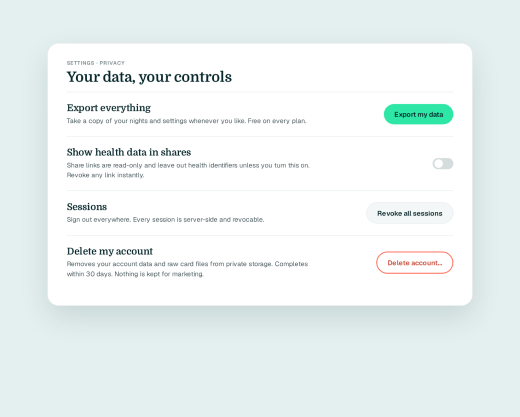
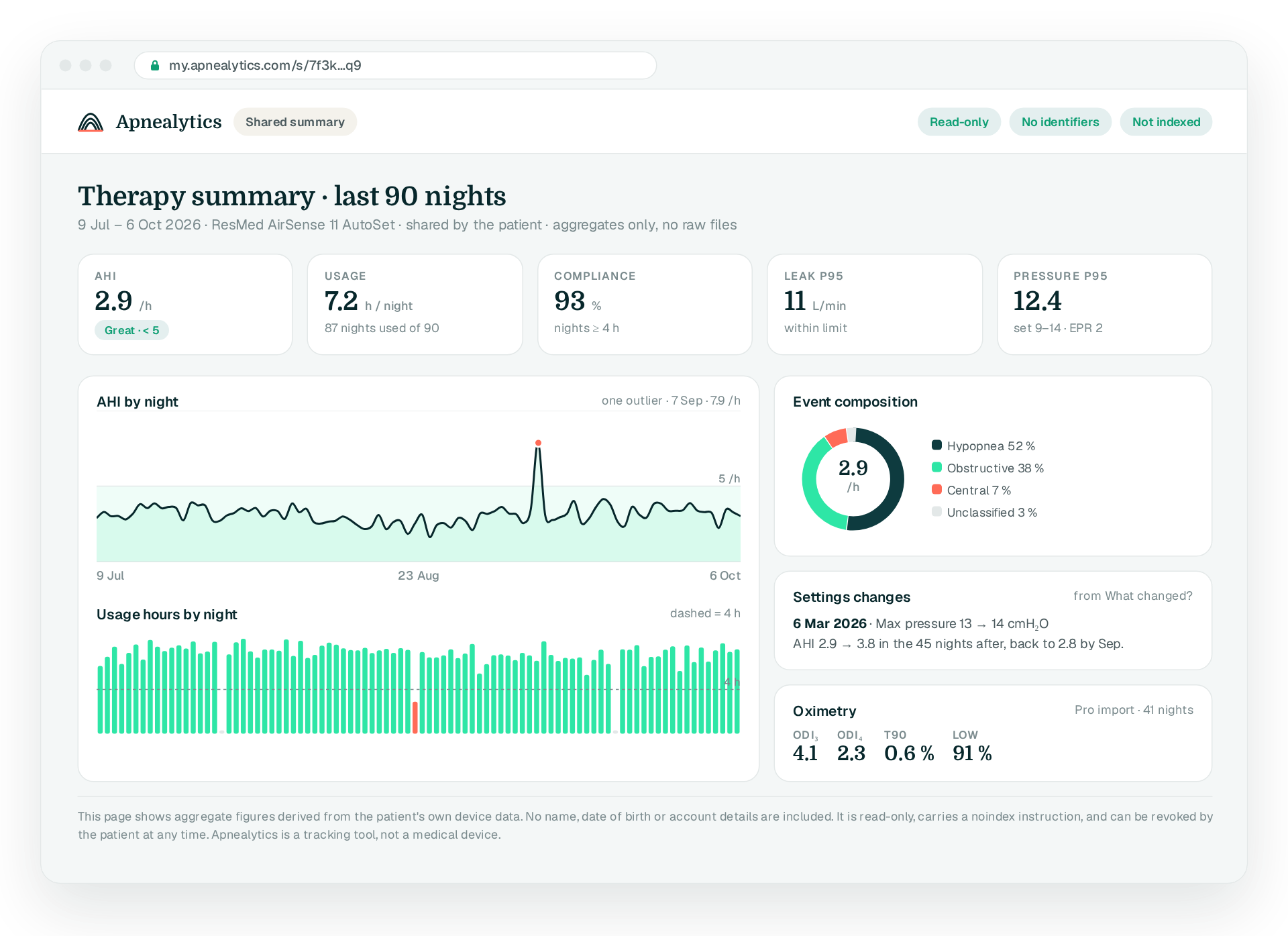
A clinician share link is a random, unguessable token tied to one account and one scope: aggregate therapy data, read-only. Share pages are served with headers that keep them out of search engines. Health identifiers are excluded by default; the patient can switch them on per link. Revoking the token ends access immediately. Links also stop working if the owner's Pro plan lapses.
The AI assistant reads your account's aggregates and nothing else. It cannot write, delete or reach another account. Questions and the figures needed to answer them go to the provider whose key you supplied (OpenAI or Anthropic), under their terms.
Card files upload from the browser straight to private object storage (Cloudflare R2). No Apnealytics server handles the bytes in transit, which removes a whole class of risk. Uploads are resumable and folder-aware; integrity is checked per file.
Buckets are private. Nothing is publicly listable or fetchable. When the app needs a raw file, for example to parse a night's waveforms in the browser, it requests a short-lived signed URL scoped to that object, valid for minutes.
TLS on every connection, web and mobile.
Magic-link, Google sign-in and email plus password, with email verification and rate-limited sign-in.
Sessions are server-side and revocable. Signing out one device, or all devices, invalidates tokens immediately rather than waiting for them to expire.
Optional app lock behind Face ID, Touch ID, fingerprint or device PIN on the phone apps.
Push notifications never carry health numbers; the lock screen shows only that a reminder exists.
No health values, identifiers or raw file contents in application logs. Logs record that an action happened, for which account ID, and whether it succeeded.
No advertising SDKs. No third-party trackers on pages that show health data.
Crash reporting excludes payloads that could contain health data.
Export everything from Settings, on Free or Pro, at any time.
Delete your account in-app. Deletion removes database rows and raw files and completes within 30 days; backups age out on the same schedule.
Disconnect Apple Health or Health Connect from your phone's settings at any time; only daily summaries ever synced.
Never sold. No data is sold or shared with advertisers.
Application and database hosting, object storage on Cloudflare R2, subscriptions through RevenueCat, covering web checkout and in-app purchase on iOS and Android. Card details never touch Apnealytics; RevenueCat, Apple and Google handle them.
Apnealytics is a tracking and coaching tool, not a medical device, and makes no diagnoses. When patients share their own data with you via links and PDFs, Apnealytics is acting for the patient. For the coming roster view, where providers would access patient data inside Apnealytics under consent, we expect to operate as a business associate and to sign BAAs. We will not claim certifications we do not hold.
Email info@apnealytics.com with details. We acknowledge reports promptly and will tell you what we did.
Patients sharing their own data with a provider through revocable links and PDFs does not make Apnealytics a business associate. For the coming provider roster view we expect to sign BAAs. The technical controls on this page, row-level security, private storage, signed URLs, no PHI in logs, apply to every account today.
Parsed nights live in a database with row-level security tied to your account. Raw card files live in private object storage on Cloudflare R2, reachable only by short-lived signed URLs. Uploads go directly from your browser to that storage.
Access to production data is restricted to a small number of engineers for support and incident response, logged, and never used for anything else. Health values are never in logs, and the AI assistant only ever reads your own account.
Your database rows and raw files are removed and deletion completes within 30 days. Share links stop working immediately. Health summaries synced from Apple Health or Health Connect are deleted with the account; the originals stay on your phone.
They are unguessable tokens, read-only, aggregate-only and not indexed, and they exclude health identifiers by default. Anyone with the link can view it, so treat it like a document: send it to the clinician, and revoke it when the visit is done.
Nothing to install. Patients upload on the web, you open a read-only share link or a compliance PDF.
 DashboardSleep Score, AHI band, leak and pressure
 Trends & historyA year down to a night
 Breath-by-breath viewerAirflow, pressure, leak tracesPro
 SpO₂ overlayOximeter data on the same nightPro
 Pressure insightsP95, set range, EPR and ramp
 SD card importDrop the card folder, only new nights added
 Mask fit & gearWhich mask actually seals
 Ask your dataPlain-English questions, your own AI keyBYOK
 Year in SleepYour therapy year in one storyNew
 Compliance reportFinds the qualifying window for youPro
 Share with your doctorRead-only, revocable links
 Companion appiPhone, iPad and Android
 Privacy & securityYour data, locked to you
 ResMed AirSense 10 & 11Supported
 ResMed AirCurve 10 & 11 VAutoSupported
 ResMed S9 / LumisSupported
 Philips DreamStation 1 & 2Supported
 Fisher & Paykel SleepStyleSupported
 Löwenstein / DeVilbissPartial
 React Health Luna G3Waitlist
 Transcend MicroWaitlist
 Full face masksFit, leak signature, Mask Analytics
 Nasal masksOver-nose and cradle styles
 Nasal pillowsMinimal-contact fit tips
 Wellue O2RingSupported
 Contec CMS50 familySupported
 Apple Health / Health ConnectResting HR, HRV, SpO₂, sleepSupported
 What is AHI?The apnea-hypopnea index, explained
 What is a good AHI on CPAP?
 CPAP leak rate explained
 Pressure settings explained
 Reading CPAP waveformsAll 14 explainers
 Apnealytics vs SleepHQ
 Apnealytics vs OSCAR
 Apnealytics vs myAir
 Apnealytics vs DreamMapper
 SleepHQ vs OSCARBest CPAP apps in 2026
 How to read CPAP dataStart here: six numbers, in order
 Read your CPAP SD card
 Share data with your doctorChoosing a CPAP mask
 Travel with CPAPAll guides
 Mask finderSeven questions, a ranked mask typeYour data
 Machine finderA two-machine shortlist for your prescription
 iPhone / iPhone DuoLast night before you are out of bed. Apple Health vitals, Face ID.Live
 iPadSame universal app, side-by-side panes and full-width waveforms.Live
 AndroidPhones, tablets and foldables, with Health Connect built in.Live
 Web portalWhere your SD card goes. Every chart, report and setting.Live

