



iPhone / iPhone Duo Live
Last night before you are out of bed. Apple Health vitals, Face ID.
Download on the App Store Apnealytics
Free on every plan: unlimited imports, the full dashboard and your last 30 nights.
 Compatibility checkerWill my machine work?Type your model. You get a straight answer: supported, partial, waitlist, or why not.Check my machine
 If it writes an SD card, we probably read it. ResMed AirMini has no card, so no app can read it.
Sleep Check-up
3 of 6 checks done
Six short screeners, one picture of how you sleep. Earn a milestone for each, save results and get retake reminders.
Latest milestone: Sleepiness check done
 NEWTrack your 90-day compliance windowOpen the calculator
 13 free tools. No account needed — sign in to save results and fill answers from your own CPAP data.
Last night before you are out of bed. Apple Health vitals, Face ID.
Download on the App Store


One account on every screen. Apple Watch vitals sync through Apple Health.
CPAP compliance for DMEs comes down to one question in the first 90 days: did the patient use the machine four or more hours on at least 70 percent of nights in some consecutive 30-day stretch? Apnealytics compliance autopilot answers it from the patient's own card, finds the window, and drafts the letter. Gear replacement reminders then feed your resupply cycle.
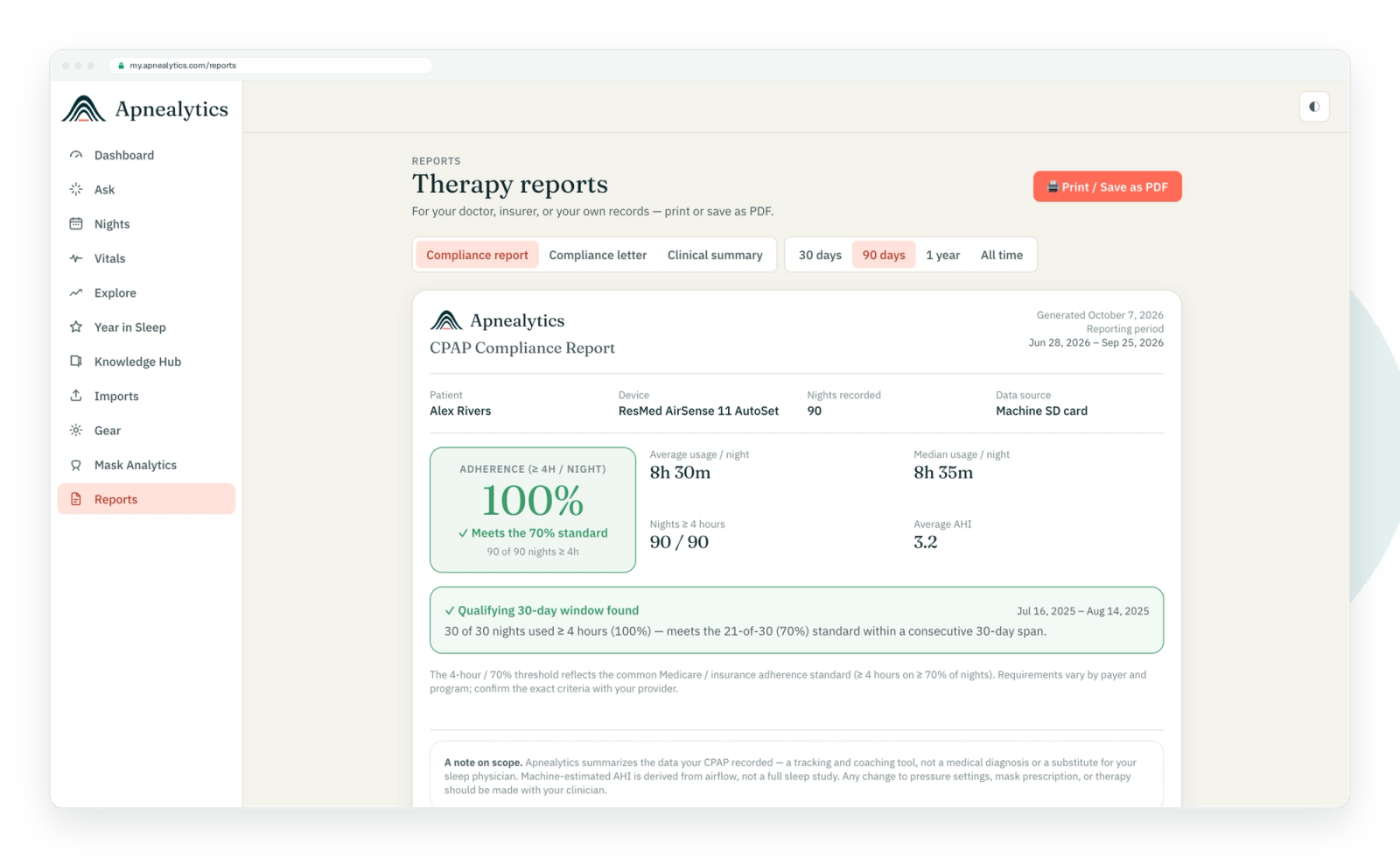
Payers in the US commonly require documented adherence, four or more hours a night on 70 percent of nights during a consecutive 30-day period within the first 90 days of therapy, before continuing to cover the device. Missing the window means paperwork, a returned machine, or a patient who quietly stops.
For machines on a manufacturer cloud, the data is there if you have portal access. For everything else, cash-pay patients, machines bought secondhand, patients who declined the modem, it means asking the patient to bring the card in. Apnealytics gives those patients a way to read the card themselves and hand you the result.
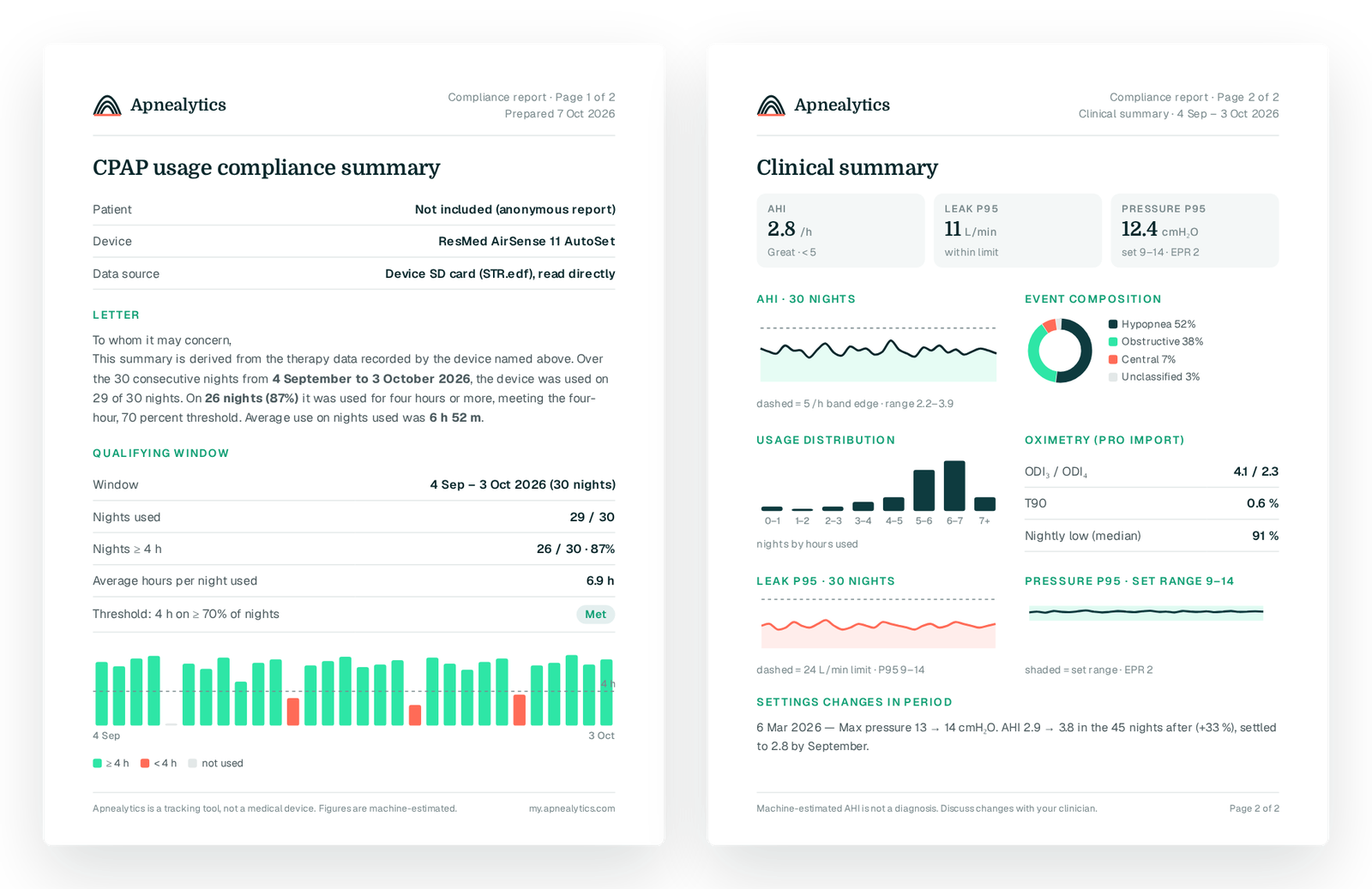
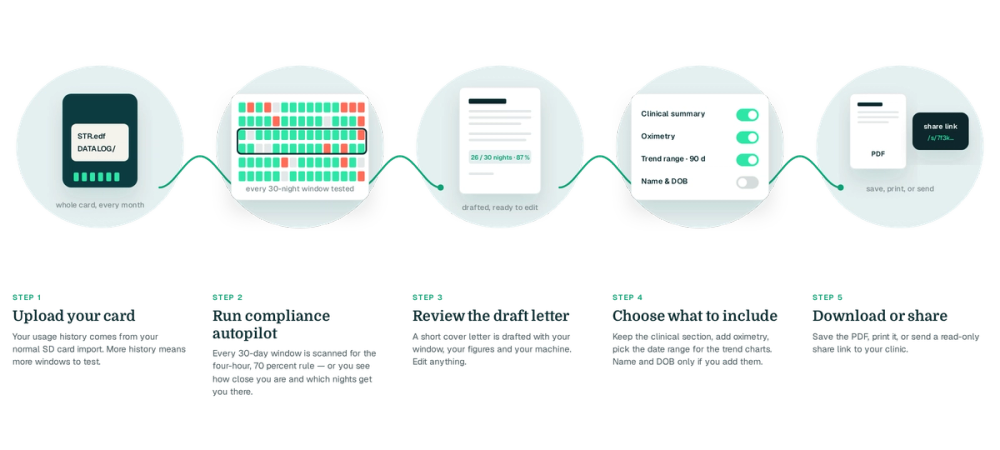
from the patient's uploaded ResMed card: usage hours, nights used, AHI, leak.
from the start date the patient sets, or from the first night on the card.
automatically: the first consecutive 30-day span where at least 70 percent of nights reach four hours. If several qualify, it shows the strongest.
with the dates, nights used, nights at four or more hours, percentage, average usage, average AHI and the machine's serial and model filled in.
as the doctor-ready PDF alongside the clinical summary, or the patient creates a clinician share link for you to view the window live.
If no window qualifies yet, autopilot says so and shows how many more compliant nights are needed before the 90 days run out. That is the number a coaching call needs.
The patient is the account holder. They either:
Download the compliance PDF and email, upload or bring it, or
Create a clinician share link, which is read-only, aggregate-only, revocable, not indexed and excludes health identifiers by default. You open it in a browser, no account required.
Both need the patient on Pro ($8.99 a month or $99.99 a year). Comp codes exist, so a DME that wants to cover Pro for patients in their first 90 days can talk to us about that.
Apnealytics tracks the patient's mask and machine from a catalog of 45 machines and 62 masks, with replacement reminders for cushions, filters and tubing and a one-tap reorder action. Today the reorder points to the patient's chosen retailer. On Pro, Mask Analytics shows seal, AHI and usage per mask, which tells you whether a resupply request is about a worn cushion or the wrong mask.
Push notifications for gear due never show health numbers on the lock screen, so a patient's phone saying "Cushion due" is all anyone else sees.
The roadmap item that matters most to DMEs is the consented roster view: your resupply-eligible patients, their last upload and compliance status in one list. It is coming, not here. See Clinics for what is live today.
ResMed AirSense 10 and 11, AirCurve 10 and 11, S9 and Lumis patients, from the SD card. Live.
Philips DreamStation 1 and 2, Fisher & Paykel SleepStyle: supported. Löwenstein prisma: partial.
Fisher & Paykel SleepStyle, BMC/React Health Luna/G3, Transcend: waitlist.
ResMed AirMini: no SD card, cannot be read by any tool.
Upload happens on the web portal; the phone apps show the result. The upload is incremental, so a patient who uploads once a month has everything you need for the window.
Give them three things at setup: the card reader they will need (see Which SD card reader), the Getting started link, and the date their 90 days began. Autopilot does the rest when they ask for a report.
Compliance autopilot reads every night from the patient's uploaded card, scans the 90-day period from the start date, and finds the first consecutive 30-day span where at least 70 percent of nights reach four or more hours of usage. It drafts the compliance letter with dates and figures filled in, exportable as a PDF.
Not today. Apnealytics is patient-owned. The patient sends you the compliance PDF or a revocable share link. A consented roster view for providers is coming; email info@apnealytics.com if you want to be in the first group.
The draft includes dates, nights used, nights at four or more hours, the percentage, average usage and average AHI, and identifies the machine model. Health identifiers are excluded from share links by default; the PDF is the patient's to hand over.
Yes. Apnealytics reads the SD card, not the cellular modem, so it works for cash-pay patients, secondhand machines and patients who declined connectivity. Card import is on the web portal at my.apnealytics.com.
Replacement reminders and one-tap reorder exist for the patient today. Routing reorders to a specific DME is not a published feature. Talk to us about what you need; it shapes what we build next.
Nothing to install. Patients upload on the web, you open a read-only share link or a compliance PDF.

 DashboardSleep Score, AHI band, leak and pressure
 Trends & historyA year down to a night
 Breath-by-breath viewerAirflow, pressure, leak tracesPro
 SpO₂ overlayOximeter data on the same nightPro
 Pressure insightsP95, set range, EPR and ramp
 SD card importDrop the card folder, only new nights added
 Mask fit & gearWhich mask actually seals
 Ask your dataPlain-English questions, your own AI keyBYOK
 Year in SleepYour therapy year in one storyNew
 Compliance reportFinds the qualifying window for youPro
 Share with your doctorRead-only, revocable links
 Companion appiPhone, iPad and Android
 Privacy & securityYour data, locked to you
 ResMed AirSense 10 & 11Supported
 ResMed AirCurve 10 & 11 VAutoSupported
 ResMed S9 / LumisSupported
 Philips DreamStation 1 & 2Supported
 Fisher & Paykel SleepStyleSupported
 Löwenstein / DeVilbissPartial
 React Health Luna G3Waitlist
 Transcend MicroWaitlist
 Full face masksFit, leak signature, Mask Analytics
 Nasal masksOver-nose and cradle styles
 Nasal pillowsMinimal-contact fit tips
 Wellue O2RingSupported
 Contec CMS50 familySupported
 Apple Health / Health ConnectResting HR, HRV, SpO₂, sleepSupported
 What is AHI?The apnea-hypopnea index, explained
 What is a good AHI on CPAP?
 CPAP leak rate explained
 Pressure settings explained
 Reading CPAP waveformsAll 14 explainers
 Apnealytics vs SleepHQ
 Apnealytics vs OSCAR
 Apnealytics vs myAir
 Apnealytics vs DreamMapper
 SleepHQ vs OSCARBest CPAP apps in 2026
 How to read CPAP dataStart here: six numbers, in order
 Read your CPAP SD card
 Share data with your doctorChoosing a CPAP mask
 Travel with CPAPAll guides
 Mask finderSeven questions, a ranked mask typeYour data
 Machine finderA two-machine shortlist for your prescription
 iPhone / iPhone DuoLast night before you are out of bed. Apple Health vitals, Face ID.Live
 iPadSame universal app, side-by-side panes and full-width waveforms.Live
 AndroidPhones, tablets and foldables, with Health Connect built in.Live
 Web portalWhere your SD card goes. Every chart, report and setting.Live

