



iPhone / iPhone Duo Live
Last night before you are out of bed. Apple Health vitals, Face ID.
Download on the App Store Apnealytics
Free on every plan: unlimited imports, the full dashboard and your last 30 nights.
 Compatibility checkerWill my machine work?Type your model. You get a straight answer: supported, partial, waitlist, or why not.Check my machine
 If it writes an SD card, we probably read it. ResMed AirMini has no card, so no app can read it.
Sleep Check-up
3 of 6 checks done
Six short screeners, one picture of how you sleep. Earn a milestone for each, save results and get retake reminders.
Latest milestone: Sleepiness check done
 NEWTrack your 90-day compliance windowOpen the calculator
 13 free tools. No account needed — sign in to save results and fill answers from your own CPAP data.
Last night before you are out of bed. Apple Health vitals, Face ID.
Download on the App Store


One account on every screen. Apple Watch vitals sync through Apple Health.
An obstructive apnea is a pause in breathing because the airway has closed. A central apnea is a pause because the brain briefly stopped sending the signal to breathe, with the airway still open. On CPAP the distinction matters, because pressure fixes the first and not the second. This guide explains how your machine tells them apart and what the breakdown on your dashboard means.
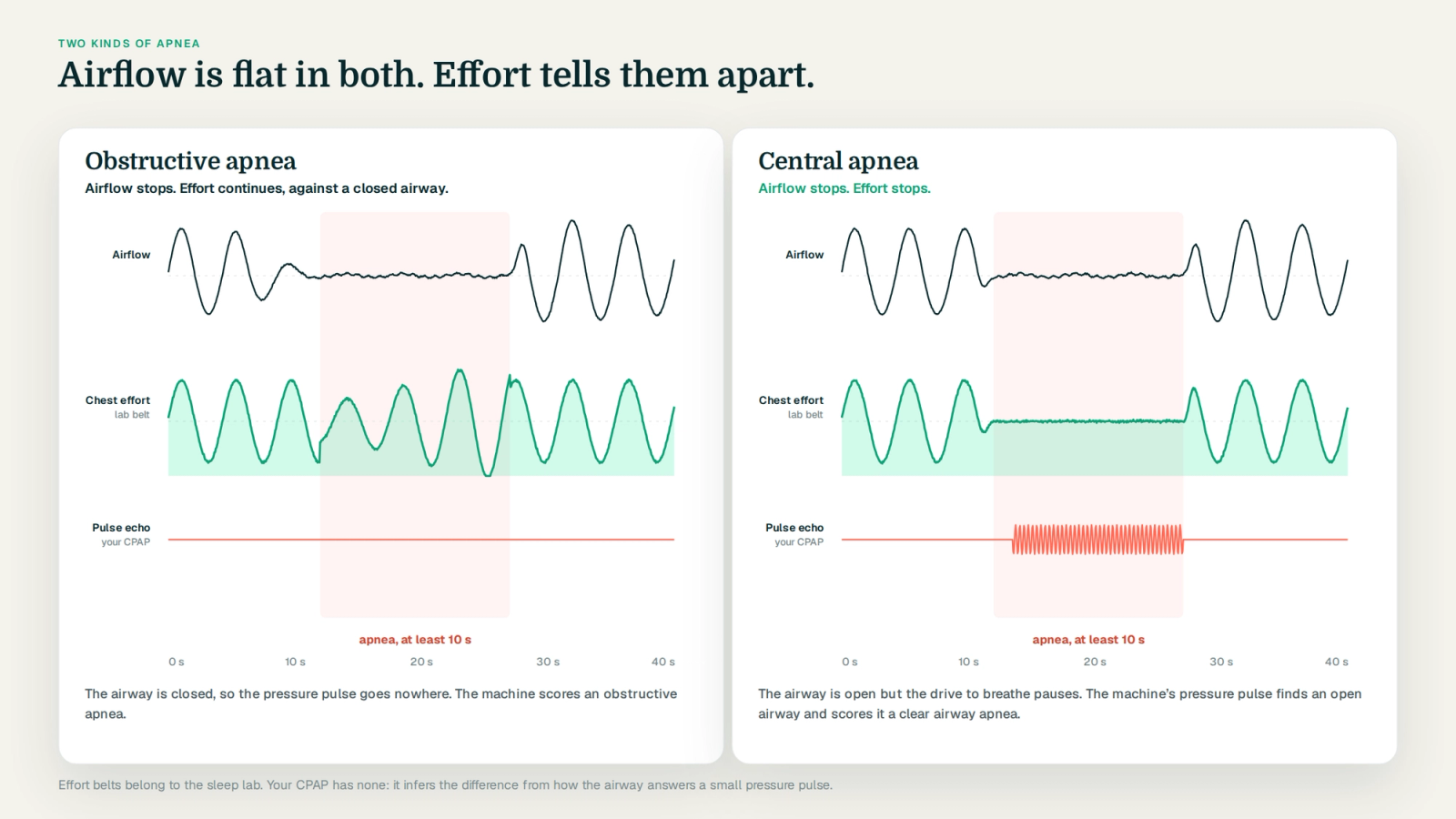
In obstructive sleep apnea (OSA), the muscles of the throat relax during sleep and the soft tissue collapses inward. You keep trying to breathe; your chest and abdomen move, often harder and harder, but little or no air gets through. The event ends when you rouse slightly and muscle tone returns. CPAP treats this directly by holding the airway open with air pressure.
In central sleep apnea (CSA), the airway is open but the respiratory drive pauses. There is no effort: the chest is still, the abdomen is still, nothing is being blocked. The event ends when carbon dioxide builds up enough to restart the drive. Pressure does not help, because there was nothing to splint open.
Most people on CPAP have OSA. But a proportion of residual events on therapy are central, and for a minority of people they are the main thing left.
In polysomnography, the technologist watches the effort belts around the chest and abdomen. Airflow stops in both kinds of apnea; the difference is whether effort continues. Obstructive: effort continues or increases. Central: effort stops. A mixed apnea starts central and ends obstructive, with effort returning before airflow does.
Your machine has no effort belts. It has a flow sensor and a blower. So how does a ResMed AirSense decide an apnea was obstructive or central?
It uses a technique called the forced oscillation technique (FOT). When the machine detects that airflow has stopped for long enough to count as an apnea, it superimposes a small, rapid oscillation on the delivered pressure, a gentle pulse at a few hertz that you would not notice. It then measures how much flow that pulse produces.
If the airway is open, the pressure pulse pushes a small amount of air in and out of the lungs, and the flow sensor sees the oscillation echoed back. ResMed calls this a clear airway (CA) apnea, its label for a central event.
If the airway is closed, the pulse goes nowhere. The flow sensor sees almost no response. That is scored as an obstructive apnea (OA).
This is clever and generally works well, but it is an inference, not a direct measurement of effort. There are situations where it is less reliable, and the main one is leak.
When unintentional leak is high, the pressure oscillation leaks out through the gap in the mask rather than into your airway, and the machine cannot tell whether the response it sees came from your lungs or from the leak. In that case ResMed marks the event as an unclassified apnea (UA). It knows breathing stopped; it does not know why.
A night with a large share of unclassified events is almost always a night with a leak problem. Fix the leak and the events will sort themselves into the right columns, or disappear. See CPAP leak rate explained.
A few scenarios account for most central events on therapy.
Treatment-emergent central sleep apnea. Some people with pure OSA start showing central apneas once their obstruction is treated. The usual explanation is that CPAP improves ventilation, carbon dioxide falls, and in people with a sensitive respiratory controller it dips below the threshold that keeps breathing going. For most of them this settles over weeks to months as the body recalibrates. For a few it persists and needs a different approach.
Pressure-related. Higher pressures can increase central events in susceptible people, for the same reason: more effective ventilation, lower CO₂. An auto machine will not raise pressure for a clear-airway event, but if obstructive events or flow limitation push pressure up, centrals can follow.
Sleep-wake transitions. Breathing is less regular when you are drifting off or briefly waking. A few central events at the start of the night, or after an arousal, are normal and not a concern.
Underlying conditions. Heart failure, opioid medications, stroke and living at high altitude all predispose to central apnea. Cheyne-Stokes breathing, a waxing-and-waning pattern seen in heart failure, is a specific form that ResMed machines flag separately.
If your residual events are obstructive, the conversation with your clinician is about pressure, mask and position: the standard levers.
If they are central, more pressure is not the answer and may make things worse. Clinicians may wait to see whether treatment-emergent centrals settle, lower pressure, adjust EPR, review medications, or in persistent cases move to adaptive servo-ventilation (ASV), a bilevel machine that adjusts breath-by-breath to smooth out the pauses. ASV has specific contraindications and is a specialist decision.
Two people with an AHI of 8 can therefore be in completely different situations. The number alone does not tell you which.
The dashboard does not stop at AHI. Beneath the headline tile sits the event composition ring: obstructive, central, hypopnea and unclassified, each as a share of the night's events. The night detail page lists the counts.
In Trends you can chart each event type separately over 30, 90 or 365 nights. A central share that climbs after a pressure increase, or an unclassified share that tracks your leak P95, is visible as two lines moving together. The "What changed?" panel dates your settings changes on the same axis.
On Pro, the breath-by-breath viewer shows each event as a labelled flag on the airflow trace. A clear-airway event looks like a flat line with no struggle before or after; an obstructive event often shows breaths shrinking into the pause and a large recovery breath coming out of it. You can also see the FOT pulse itself as a small ripple on the pressure trace during the pause.
The compliance report and share links include the event breakdown, so your clinician sees the composition, not just the total.
Central events making up more than a quarter of your residual AHI, consistently.
A central share that rose after a pressure or EPR change.
Central events clustered through the night rather than only at sleep onset.
Any sign of a waxing-and-waning breathing pattern on the waveform.
Unclassified events that persist after you have fixed leak.
Bring the trend and a few screenshots. "My centrals went from 5 percent to 30 percent of events after my max pressure went up" is a sentence a clinician can act on.
Clear airway (CA) is ResMed's term for a central apnea: a pause in breathing where the machine determined the airway was open. It tests this by sending a small pressure oscillation during the pause and checking whether flow responds. An open airway lets the oscillation through; a closed one does not. CA events are not treated by more pressure.
ResMed machines use the forced oscillation technique. When airflow stops, the machine adds a small, rapid pressure pulse and measures the flow response. If the pulse produces flow, the airway is open and the event is scored as clear airway (central). If it produces none, the airway is closed and it is scored as obstructive. High leak defeats the test, producing an unclassified apnea.
This is called treatment-emergent central sleep apnea and it is fairly common in the early months of therapy. Treating the obstruction improves ventilation, carbon dioxide falls, and in some people the breathing drive pauses as a result. For most it settles within weeks to months. If it persists or your central share is large, tell your clinician.
No. Central apneas happen with the airway open, so there is nothing for pressure to hold open, and higher pressure can increase them in susceptible people by lowering carbon dioxide further. Auto machines are designed not to raise pressure for clear-airway events. If centrals dominate your residual events, the approach is different and is a clinician decision.
An unclassified apnea is a pause in breathing the machine detected but could not sort into obstructive or central, almost always because leak was too high for the airway test to work. A night with many unclassified events is usually a night with a mask leak problem. Reduce leak and the events will either classify properly or disappear.
The web app is live today. iPhone and iPad are on the App Store. Android is on Google Play. Your first 30 nights are free, forever.
 DashboardSleep Score, AHI band, leak and pressure
 Trends & historyA year down to a night
 Breath-by-breath viewerAirflow, pressure, leak tracesPro
 SpO₂ overlayOximeter data on the same nightPro
 Pressure insightsP95, set range, EPR and ramp
 SD card importDrop the card folder, only new nights added
 Mask fit & gearWhich mask actually seals
 Ask your dataPlain-English questions, your own AI keyBYOK
 Year in SleepYour therapy year in one storyNew
 Compliance reportFinds the qualifying window for youPro
 Share with your doctorRead-only, revocable links
 Companion appiPhone, iPad and Android
 Privacy & securityYour data, locked to you
 ResMed AirSense 10 & 11Supported
 ResMed AirCurve 10 & 11 VAutoSupported
 ResMed S9 / LumisSupported
 Philips DreamStation 1 & 2Supported
 Fisher & Paykel SleepStyleSupported
 Löwenstein / DeVilbissPartial
 React Health Luna G3Waitlist
 Transcend MicroWaitlist
 Full face masksFit, leak signature, Mask Analytics
 Nasal masksOver-nose and cradle styles
 Nasal pillowsMinimal-contact fit tips
 Wellue O2RingSupported
 Contec CMS50 familySupported
 Apple Health / Health ConnectResting HR, HRV, SpO₂, sleepSupported
 What is AHI?The apnea-hypopnea index, explained
 What is a good AHI on CPAP?
 CPAP leak rate explained
 Pressure settings explained
 Reading CPAP waveformsAll 14 explainers
 Apnealytics vs SleepHQ
 Apnealytics vs OSCAR
 Apnealytics vs myAir
 Apnealytics vs DreamMapper
 SleepHQ vs OSCARBest CPAP apps in 2026
 How to read CPAP dataStart here: six numbers, in order
 Read your CPAP SD card
 Share data with your doctorChoosing a CPAP mask
 Travel with CPAPAll guides
 Mask finderSeven questions, a ranked mask typeYour data
 Machine finderA two-machine shortlist for your prescription
 iPhone / iPhone DuoLast night before you are out of bed. Apple Health vitals, Face ID.Live
 iPadSame universal app, side-by-side panes and full-width waveforms.Live
 AndroidPhones, tablets and foldables, with Health Connect built in.Live
 Web portalWhere your SD card goes. Every chart, report and setting.Live

