



iPhone / iPhone Duo Live
Last night before you are out of bed. Apple Health vitals, Face ID.
Download on the App Store Apnealytics
Free on every plan: unlimited imports, the full dashboard and your last 30 nights.
 Compatibility checkerWill my machine work?Type your model. You get a straight answer: supported, partial, waitlist, or why not.Check my machine
 If it writes an SD card, we probably read it. ResMed AirMini has no card, so no app can read it.
Sleep Check-up
3 of 6 checks done
Six short screeners, one picture of how you sleep. Earn a milestone for each, save results and get retake reminders.
Latest milestone: Sleepiness check done
 NEWTrack your 90-day compliance windowOpen the calculator
 13 free tools. No account needed — sign in to save results and fill answers from your own CPAP data.
Last night before you are out of bed. Apple Health vitals, Face ID.
Download on the App Store


One account on every screen. Apple Watch vitals sync through Apple Health.
CPAP compliance, in the insurance sense, means using your machine for at least 4 hours a night on at least 70 percent of nights in a consecutive 30-day period. In the clinical sense it means something simpler: the more hours you wear it while asleep, the more of your apnea is treated. This guide covers both.
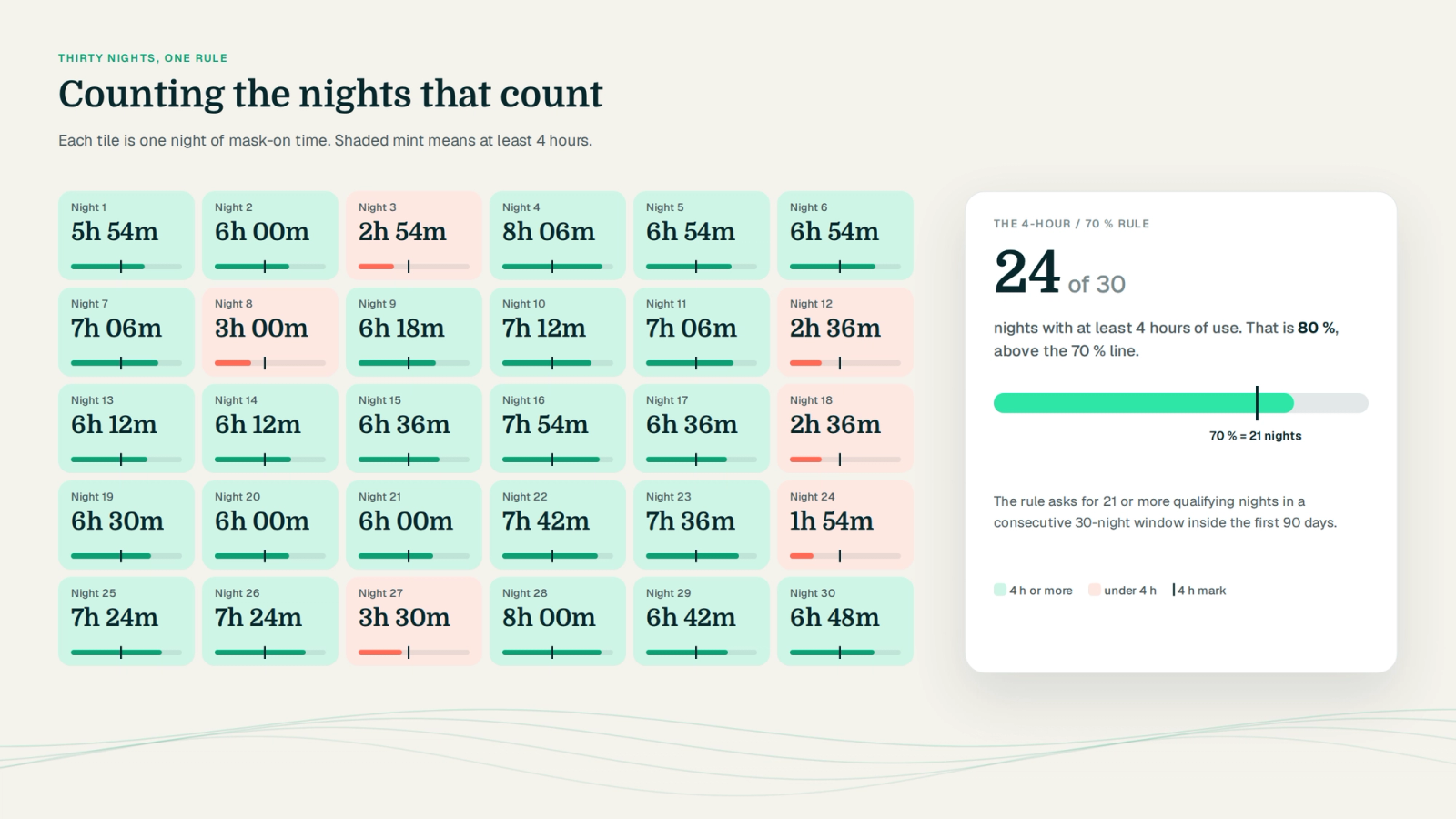
Your machine records usage as the time the blower was running with the mask on and air flowing to a person. ResMed machines detect mask-on and mask-off from the flow and pressure signals and write the total for each session to the SD card. If you take the mask off for twenty minutes at 3 a.m., that twenty minutes is not counted.
Usage is the denominator in your AHI: events are divided by hours of use, not hours of sleep. Time lying awake with the mask on counts as usage even though you are not asleep. See what is AHI for why that matters.
A "night" on ResMed machines runs from noon to noon, so a session that starts before midnight and one that starts after both land on the same day. Shift workers and nappers sometimes see their usage split oddly as a result.
In the United States, the Centers for Medicare and Medicaid Services (CMS) set the adherence standard that most private insurers mirror. To keep coverage of a CPAP beyond the initial trial period, you must demonstrate:
use of at least 4 hours per night,
on at least 70 percent of nights,
during a consecutive 30-day period,
that falls within the first 90 days of therapy.
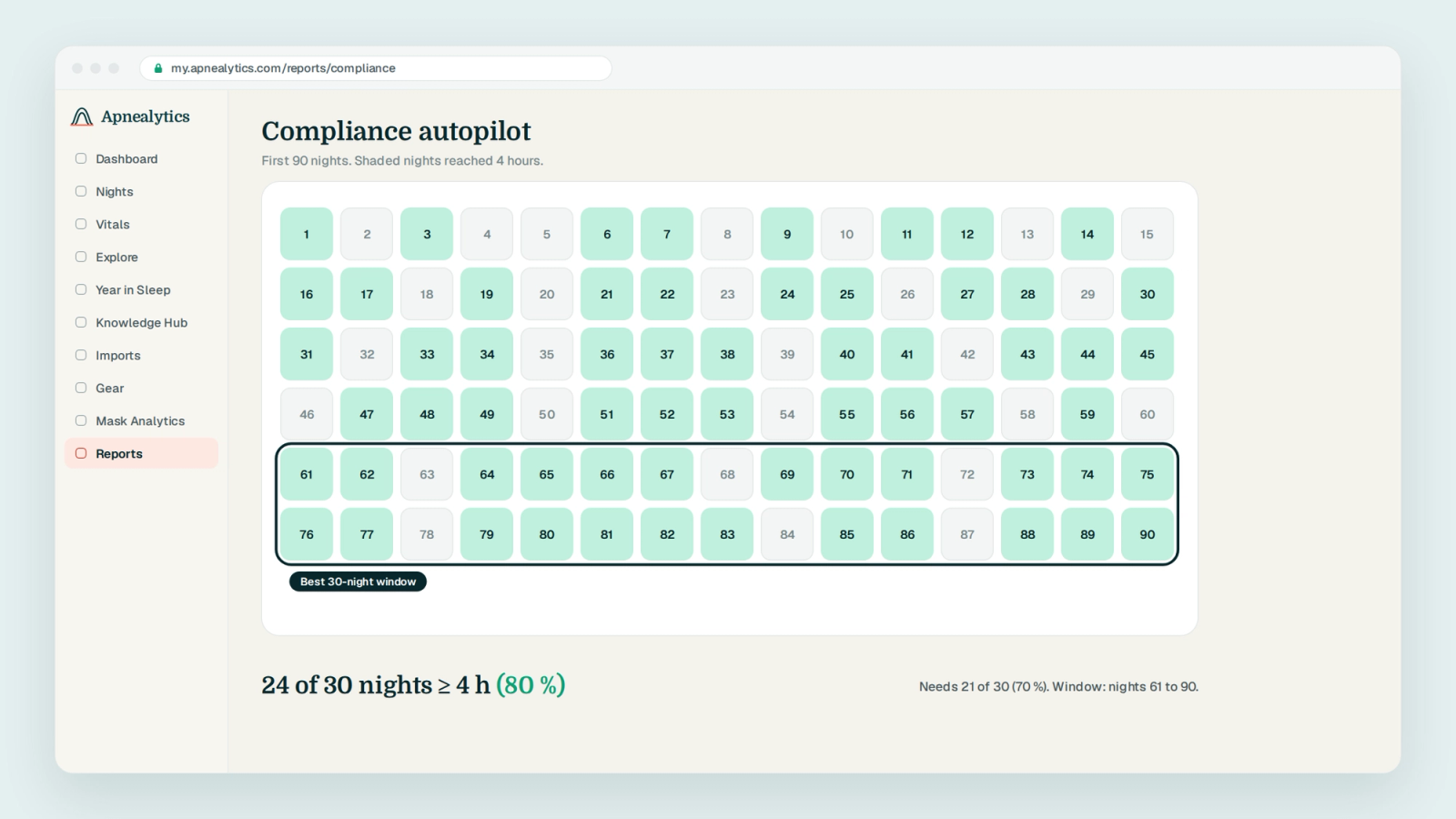
In a 30-night window, 70 percent is 21 nights. So you need 21 or more nights of 4 hours or more somewhere in a rolling 30-day block inside your first three months. Most insurers also require a face-to-face follow-up with your prescriber in that period, documenting that the therapy is helping.
Miss it and the insurer may decline to continue paying for the machine, which means returning it or buying it outright. The rule is a blunt instrument and it causes a lot of anxiety in the first weeks, but the arithmetic is straightforward and it is worth knowing where you stand.
Rules outside the US differ. Some countries have no usage requirement for funding; others set their own thresholds. The 4-hour figure has nonetheless become a worldwide shorthand.
The threshold is administrative, not biological. It came from early studies where 4 hours was a convenient dividing line between "using" and "not using," and it stuck. There is nothing special about hour four. Research on CPAP outcomes shows a dose-response relationship: more hours of use produce greater improvements in sleepiness, blood pressure and quality of life, with benefits continuing to rise well past 4 hours. Six or seven hours of treated sleep is better than four. Four is better than two.
Put differently: 4 hours keeps your insurer happy. Wearing it all night keeps you well.
Usage problems are almost never laziness. The common causes are concrete and mostly fixable:
Mask discomfort or leak. Air in the eyes, pressure sores, noise. See CPAP leak rate explained.
Pressure intolerance. Difficulty exhaling, feeling of too much air. Ramp and EPR exist for this. See EPR and Flex explained.
Dryness or congestion. Humidifier and heated tube settings.
Claustrophobia. Often eased by daytime practice wearing the mask while awake.
Taking the mask off in sleep. Usually a sign of one of the above.
Life. Travel, illness, a bad week.
Each of these shows up differently in the data. Short sessions with high leak point to the mask. Sessions that end abruptly at the same time each night suggest an arousal pattern. Multiple short sessions suggest mask-off episodes.
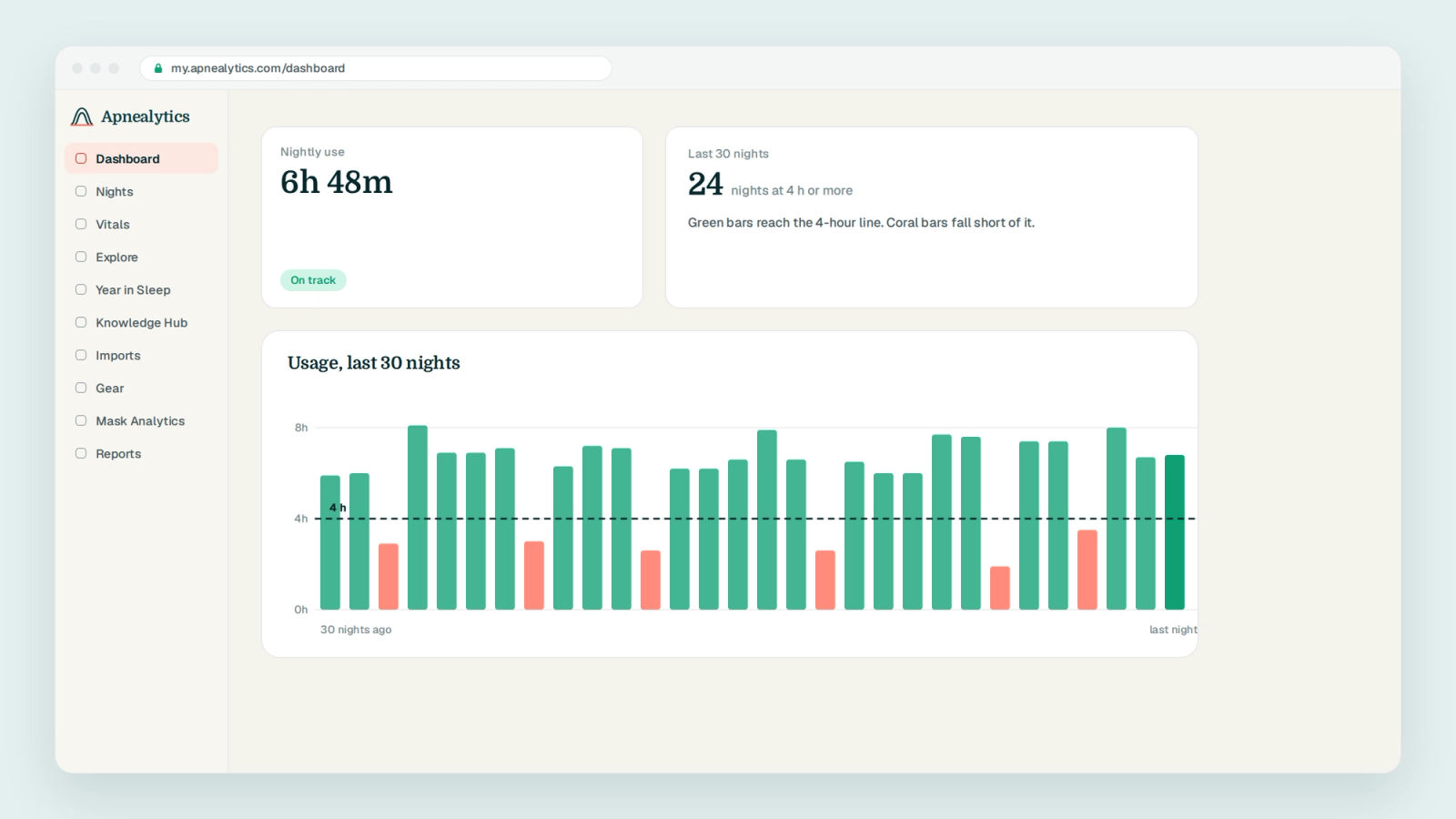
Usage hours appear as a tile on the dashboard beside AHI and leak, with last night's figure and a 30-night trend.
The Nights list shows usage for every night, so a run of short sessions is visible at a glance. The Goals and streaks panel lets you set a usage target and tracks consecutive nights that meet it, which some people find more motivating than the raw number.
Push notifications on the phone apps can nudge you when usage slips below your goal, without putting any health numbers on your lock screen.
Finding the qualifying window by hand means scanning 90 nights for any 30-night block with 21 or more nights of 4+ hours. The compliance report does this automatically. It scans your history, finds the best 30-day window, shows how many qualifying nights it contains and where you stand against the 70 percent line, and drafts the compliance letter with the dates and figures filled in.
If you are still inside the window, it shows how many more qualifying nights you need and by when. The resulting PDF carries the usage data plus AHI and leak summaries in a format your prescriber and equipment provider recognise.
Share links give your clinician a read-only, aggregate-only view of your usage and therapy trend. They are tokenized, revocable and not indexed by search engines, and health identifiers are excluded by default.
A few things that tend to work, none of them medical:
including naps. Consistency builds the association faster than long nights alone.
Most usage problems are mask problems in disguise.
your clinician has enabled. Falling asleep before full pressure helps.
Twenty minutes watching television with the mask on takes the strangeness out of it.
People who look at their data use their machines more. That is partly why Apnealytics exists.
if you are struggling. The 90-day clock does not pause.
Once you have met the adherence requirement, the insurer stops checking as closely. Your body does not. Sleep apnea does not resolve because a form was filed, and every night without the mask is a night of untreated apnea. The long-term goal is not 4 hours on 70 percent of nights; it is all night, every night, for as long as you sleep.
The US Medicare adherence standard, mirrored by most insurers, requires at least 4 hours of use per night on at least 70 percent of nights during a consecutive 30-day period within the first 90 days of therapy. In a 30-night window that means 21 or more nights of 4 hours or more. Meeting it is usually required to keep insurance coverage of the machine.
The machine records the time the blower was running with the mask on and air flowing to a person. Mask-off periods are excluded. Time awake with the mask on counts. ResMed machines group sessions into a therapy day that runs from noon to noon, so a session before midnight and one after both count toward the same night.
Four hours satisfies the insurance threshold, but it is not a clinical target. Benefits of CPAP increase with more hours of use, and the hours you sleep without the mask are hours of untreated apnea. Aim to wear it for your whole sleep period. If you cannot, the data usually shows why, and that is worth raising with your clinician.
If you do not demonstrate adherence in the first 90 days, your insurer may stop covering the machine and you may have to return it or pay for it. Many prescribers can restart the clock with a new evaluation, and some insurers allow a second attempt. Talk to your prescriber and equipment provider early if you are struggling; the window is short.
You need any 30 consecutive nights, within your first 90 days, in which at least 21 nights had 4 or more hours of use. Apnealytics' compliance autopilot (Pro) scans your history, finds the best window automatically, shows how many qualifying nights it contains, and drafts the letter. You can also check your Nights list and count by hand.
The web app is live today. iPhone and iPad are on the App Store. Android is on Google Play. Your first 30 nights are free, forever.
 DashboardSleep Score, AHI band, leak and pressure
 Trends & historyA year down to a night
 Breath-by-breath viewerAirflow, pressure, leak tracesPro
 SpO₂ overlayOximeter data on the same nightPro
 Pressure insightsP95, set range, EPR and ramp
 SD card importDrop the card folder, only new nights added
 Mask fit & gearWhich mask actually seals
 Ask your dataPlain-English questions, your own AI keyBYOK
 Year in SleepYour therapy year in one storyNew
 Compliance reportFinds the qualifying window for youPro
 Share with your doctorRead-only, revocable links
 Companion appiPhone, iPad and Android
 Privacy & securityYour data, locked to you
 ResMed AirSense 10 & 11Supported
 ResMed AirCurve 10 & 11 VAutoSupported
 ResMed S9 / LumisSupported
 Philips DreamStation 1 & 2Supported
 Fisher & Paykel SleepStyleSupported
 Löwenstein / DeVilbissPartial
 React Health Luna G3Waitlist
 Transcend MicroWaitlist
 Full face masksFit, leak signature, Mask Analytics
 Nasal masksOver-nose and cradle styles
 Nasal pillowsMinimal-contact fit tips
 Wellue O2RingSupported
 Contec CMS50 familySupported
 Apple Health / Health ConnectResting HR, HRV, SpO₂, sleepSupported
 What is AHI?The apnea-hypopnea index, explained
 What is a good AHI on CPAP?
 CPAP leak rate explained
 Pressure settings explained
 Reading CPAP waveformsAll 14 explainers
 Apnealytics vs SleepHQ
 Apnealytics vs OSCAR
 Apnealytics vs myAir
 Apnealytics vs DreamMapper
 SleepHQ vs OSCARBest CPAP apps in 2026
 How to read CPAP dataStart here: six numbers, in order
 Read your CPAP SD card
 Share data with your doctorChoosing a CPAP mask
 Travel with CPAPAll guides
 Mask finderSeven questions, a ranked mask typeYour data
 Machine finderA two-machine shortlist for your prescription
 iPhone / iPhone DuoLast night before you are out of bed. Apple Health vitals, Face ID.Live
 iPadSame universal app, side-by-side panes and full-width waveforms.Live
 AndroidPhones, tablets and foldables, with Health Connect built in.Live
 Web portalWhere your SD card goes. Every chart, report and setting.Live

