



iPhone / iPhone Duo Live
Last night before you are out of bed. Apple Health vitals, Face ID.
Download on the App Store Apnealytics
Free on every plan: unlimited imports, the full dashboard and your last 30 nights.
 Compatibility checkerWill my machine work?Type your model. You get a straight answer: supported, partial, waitlist, or why not.Check my machine
 If it writes an SD card, we probably read it. ResMed AirMini has no card, so no app can read it.
Sleep Check-up
3 of 6 checks done
Six short screeners, one picture of how you sleep. Earn a milestone for each, save results and get retake reminders.
Latest milestone: Sleepiness check done
 NEWTrack your 90-day compliance windowOpen the calculator
 13 free tools. No account needed — sign in to save results and fill answers from your own CPAP data.
Last night before you are out of bed. Apple Health vitals, Face ID.
Download on the App Store


One account on every screen. Apple Watch vitals sync through Apple Health.
The Apnealytics Sleep Score is a single number from 0 to 100 that summarises how last night's CPAP therapy went. It is a composite of your AHI, your usage hours and your leak, and it exists so you can glance at one figure before you look at the details. This guide explains what goes into it, how to read it, and what it deliberately does not try to measure.
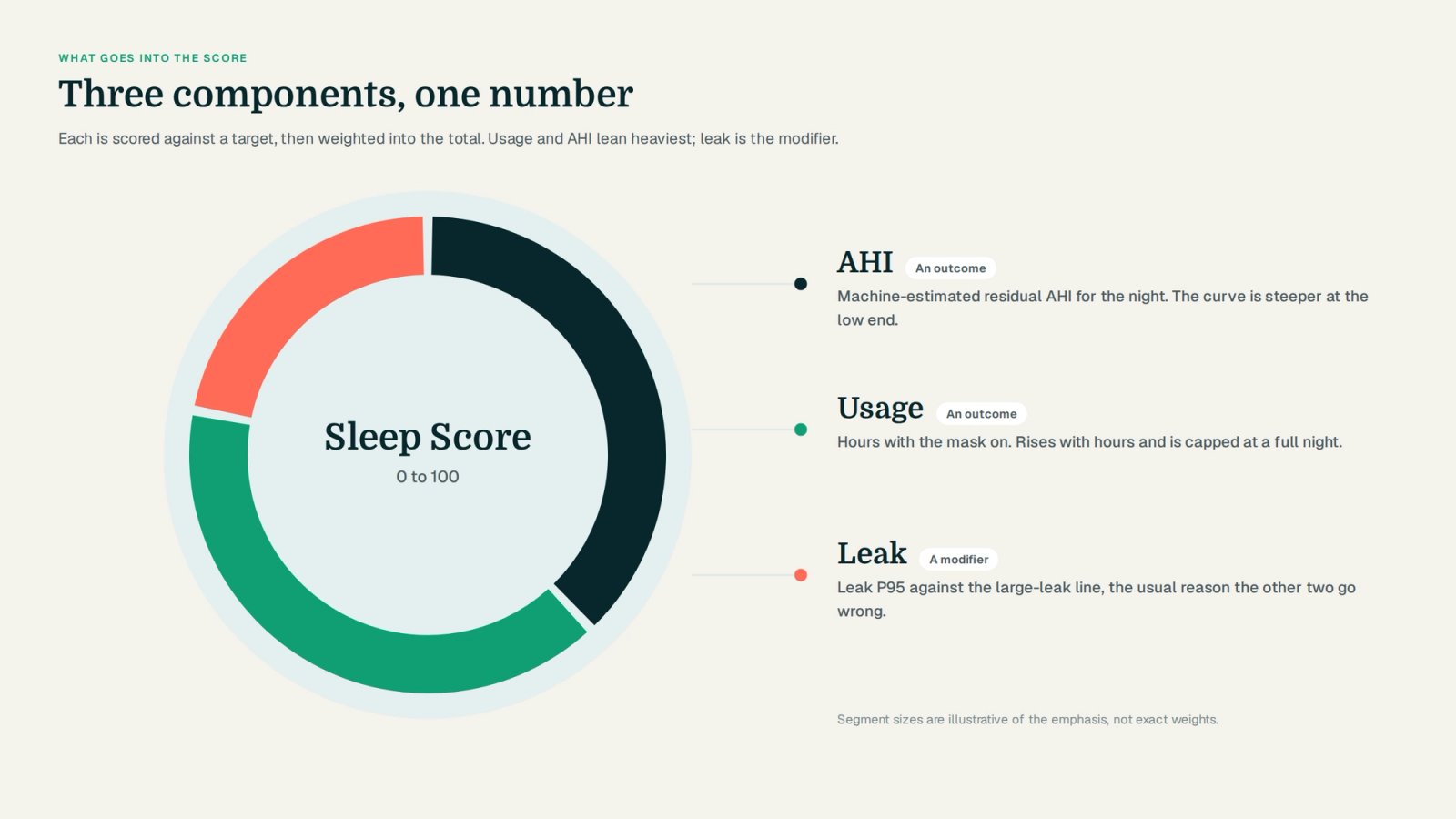
Three numbers describe a CPAP night well: how many events got through (AHI), how long you wore the mask (usage), and how well it sealed (leak). Each is on a different scale and each can be good while another is bad. A low AHI on a three-hour night is not a success. Low leak and long usage with an AHI of 12 is not either.
A score folds those three into one direction: higher is better. It is a convenience for the morning glance and for spotting trends, not a replacement for the underlying numbers, which sit directly beneath it on the dashboard.
The Sleep Score is built from three components, each scored against a target and then weighted into the total.
AHI. Your machine-estimated residual AHI for the night. Below the normal threshold of 5 events per hour scores well; the component falls as AHI rises through the mild, moderate and high bands. The curve is steeper at the low end, so the difference between 2 and 6 matters more than the difference between 20 and 24.
Usage hours. Time with the mask on and the blower running. The component rises with hours and is capped at a full night, so there is no reward for lying awake with the mask on past the point of a complete sleep. The 4-hour mark used by the compliance rule is a floor, not a target; the score keeps rewarding you well past it.
Leak. Your leak 95th percentile for the night, scored against the large-leak threshold your machine uses. Low leak scores fully; the component falls as P95 approaches and exceeds the line, and time in large leak counts against it.
exact component weights and scoring curves — current implementation to be confirmed with the product team before publication. Placeholder wording above avoids stating specific percentages.
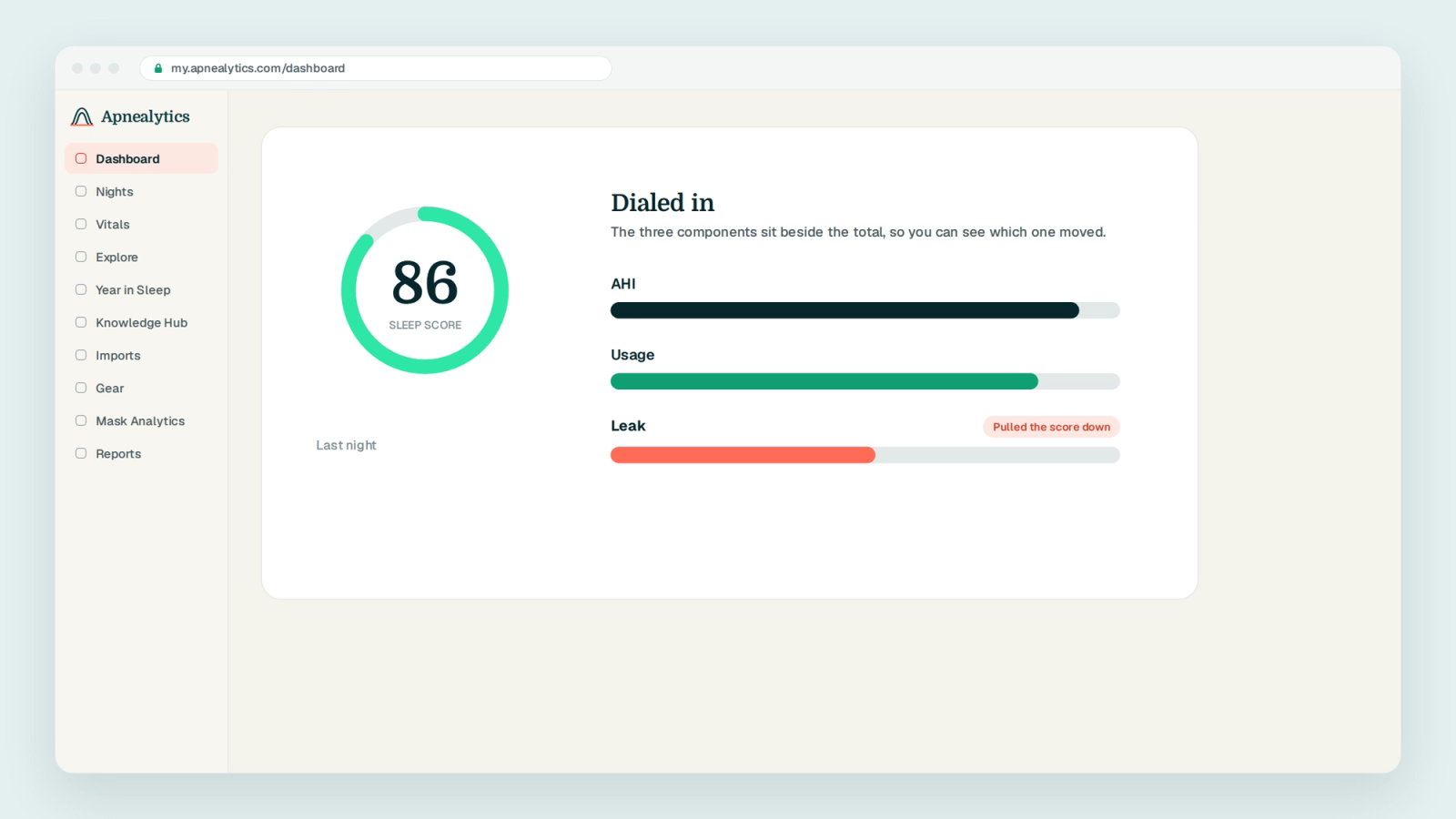
The weights lean toward usage and AHI, with leak as a modifier, on the reasoning that the first two are the outcomes and leak is the most common reason they go wrong. The three component scores are shown beneath the total so you can always see which one moved.
Treat the Sleep Score like a weather summary. It tells you whether to look closer.
High and steady. Therapy is doing its job and you are wearing it. Look at the details when you feel like it.
Dropped suddenly. Open the night. One of the three components fell; the bars show which. A leak spike, a short night and an AHI jump each have different fixes.
Drifting down over weeks. The 30-night trend in Trends will show whether it is leak creeping up as a cushion ages, usage slipping, or AHI rising. Each is a different conversation.
High score, still tired. The score measures therapy delivery, not how you feel. See the section below on what it cannot tell you.
The Heads up panel on the dashboard adds context in words: a score that is well below your own recent average is flagged, with the component that caused it named.
The Sleep Score is not a sleep quality score. It does not know your sleep stages, how many times you woke, how long you took to fall asleep or how rested you feel. Your CPAP machine cannot measure any of those, so the score does not pretend to. Apps built on wearables score "sleep" using movement and heart rate; this score measures therapy.
It is not a clinical measure. No clinician uses it, no guideline references it, and it should not be quoted in place of AHI, usage and leak. The compliance report and share links give your clinician the underlying numbers, not the score.
It is not comparable across people. A score of 80 for someone with severe apnea and a leaky full-face mask and a score of 80 for someone with mild apnea and nasal pillows mean different things. Compare your score with your own history.
And it is not a target to optimise. The point of the score is to stop you missing something. Chasing 100 by lying in bed longer with the mask on is not better therapy. Use the components as the guide.
ResMed's myAir app also produces a 0 to 100 score, built from usage, mask seal, events per hour and the number of times the mask came off. It is a reasonable summary and many people are used to it. The main differences are that myAir's score weights usage heavily and reports it with limited detail, while Apnealytics shows the components beside the total, lets you see the score over any period, and sits on top of the full data from your SD card rather than the summary the machine sends over the air. See myAir score explained for a factual walkthrough.
The Sleep Score is the first tile on your dashboard, with last night's value, the three component bars and a 30-night sparkline. It is in the Nights list as a column so you can sort and scan. In Trends it is a chartable series over 30, 90 or 365 nights, and in period-over-period comparison it gives a one-number summary of before and after a change. The Year in Sleep recap uses it to pick out your best and worst months.
It is available on the free plan for your last 30 nights and across your full history on Pro.
You can set a Sleep Score goal in the Goals and streaks panel. Hit it on consecutive nights and the streak counts up. People find this motivating in the early weeks of therapy, when the habit is fragile. The goal is yours to set; Apnealytics does not pick one for you.
A single 0 to 100 number summarising last night's CPAP therapy. It combines your machine-estimated AHI, your usage hours and your leak P95, each scored against a target and weighted into the total. The three component scores are shown beneath it so you can see which one moved. It is a convenience for the morning glance, not a clinical measure.
There is no universal threshold. The score is most useful compared with your own recent nights: a value near your 30-night average is a normal night, and a drop of 10 or more points is worth opening. Broadly, a controlled AHI, a full night of use and low leak together produce a high score. The components tell you what to fix when it is low.
No. Your CPAP machine cannot detect sleep stages, awakenings or how you feel, so the score does not include them. It measures therapy delivery: how many events got through, how long you wore the mask and how well it sealed. A high score with poor-quality sleep is possible and is worth raising with your clinician.
One or more of the three components fell. Open the night and look at the component bars: a short leak bar means leak P95 rose or time in large leak increased; a short usage bar means a short night or mask-off periods; a short AHI bar means more events than usual. The Heads up panel names the cause in plain words when a night is well below your average.
No. Both are 0 to 100 and both use usage, events and leak, but they are built differently. myAir's score comes from the summary your ResMed machine sends over its modem, weights usage heavily and shows limited detail. The Apnealytics Sleep Score is built from the full SD card data, shows its components beside the total, and can be charted over any period.
The web app is live today. iPhone and iPad are on the App Store. Android is on Google Play. Your first 30 nights are free, forever.
 DashboardSleep Score, AHI band, leak and pressure
 Trends & historyA year down to a night
 Breath-by-breath viewerAirflow, pressure, leak tracesPro
 SpO₂ overlayOximeter data on the same nightPro
 Pressure insightsP95, set range, EPR and ramp
 SD card importDrop the card folder, only new nights added
 Mask fit & gearWhich mask actually seals
 Ask your dataPlain-English questions, your own AI keyBYOK
 Year in SleepYour therapy year in one storyNew
 Compliance reportFinds the qualifying window for youPro
 Share with your doctorRead-only, revocable links
 Companion appiPhone, iPad and Android
 Privacy & securityYour data, locked to you
 ResMed AirSense 10 & 11Supported
 ResMed AirCurve 10 & 11 VAutoSupported
 ResMed S9 / LumisSupported
 Philips DreamStation 1 & 2Supported
 Fisher & Paykel SleepStyleSupported
 Löwenstein / DeVilbissPartial
 React Health Luna G3Waitlist
 Transcend MicroWaitlist
 Full face masksFit, leak signature, Mask Analytics
 Nasal masksOver-nose and cradle styles
 Nasal pillowsMinimal-contact fit tips
 Wellue O2RingSupported
 Contec CMS50 familySupported
 Apple Health / Health ConnectResting HR, HRV, SpO₂, sleepSupported
 What is AHI?The apnea-hypopnea index, explained
 What is a good AHI on CPAP?
 CPAP leak rate explained
 Pressure settings explained
 Reading CPAP waveformsAll 14 explainers
 Apnealytics vs SleepHQ
 Apnealytics vs OSCAR
 Apnealytics vs myAir
 Apnealytics vs DreamMapper
 SleepHQ vs OSCARBest CPAP apps in 2026
 How to read CPAP dataStart here: six numbers, in order
 Read your CPAP SD card
 Share data with your doctorChoosing a CPAP mask
 Travel with CPAPAll guides
 Mask finderSeven questions, a ranked mask typeYour data
 Machine finderA two-machine shortlist for your prescription
 iPhone / iPhone DuoLast night before you are out of bed. Apple Health vitals, Face ID.Live
 iPadSame universal app, side-by-side panes and full-width waveforms.Live
 AndroidPhones, tablets and foldables, with Health Connect built in.Live
 Web portalWhere your SD card goes. Every chart, report and setting.Live

