



iPhone / iPhone Duo Live
Last night before you are out of bed. Apple Health vitals, Face ID.
Download on the App Store Apnealytics
Free on every plan: unlimited imports, the full dashboard and your last 30 nights.
 Compatibility checkerWill my machine work?Type your model. You get a straight answer: supported, partial, waitlist, or why not.Check my machine
 If it writes an SD card, we probably read it. ResMed AirMini has no card, so no app can read it.
Sleep Check-up
3 of 6 checks done
Six short screeners, one picture of how you sleep. Earn a milestone for each, save results and get retake reminders.
Latest milestone: Sleepiness check done
 NEWTrack your 90-day compliance windowOpen the calculator
 13 free tools. No account needed — sign in to save results and fill answers from your own CPAP data.
Last night before you are out of bed. Apple Health vitals, Face ID.
Download on the App Store


One account on every screen. Apple Watch vitals sync through Apple Health.
Supported. The original Philips Respironics DreamStation Auto CPAP writes its data to an SD card in Philips' proprietary P-Series format, and Apnealytics reads it alongside the DreamStation 2. This page covers what the machine records, where the card lives, how to import it, and what Apnealytics shows for DreamStation Auto CPAP data.
In June 2021 Philips announced a voluntary recall of certain DreamStation and System One devices over sound-abatement foam. Many units were repaired or replaced; some owners moved to the DreamStation 2 or to another brand. Apnealytics has no part in that programme and makes no safety claims; we mention it only because it affects which machine many former DreamStation users have today. Check your serial number with Philips if you are unsure.
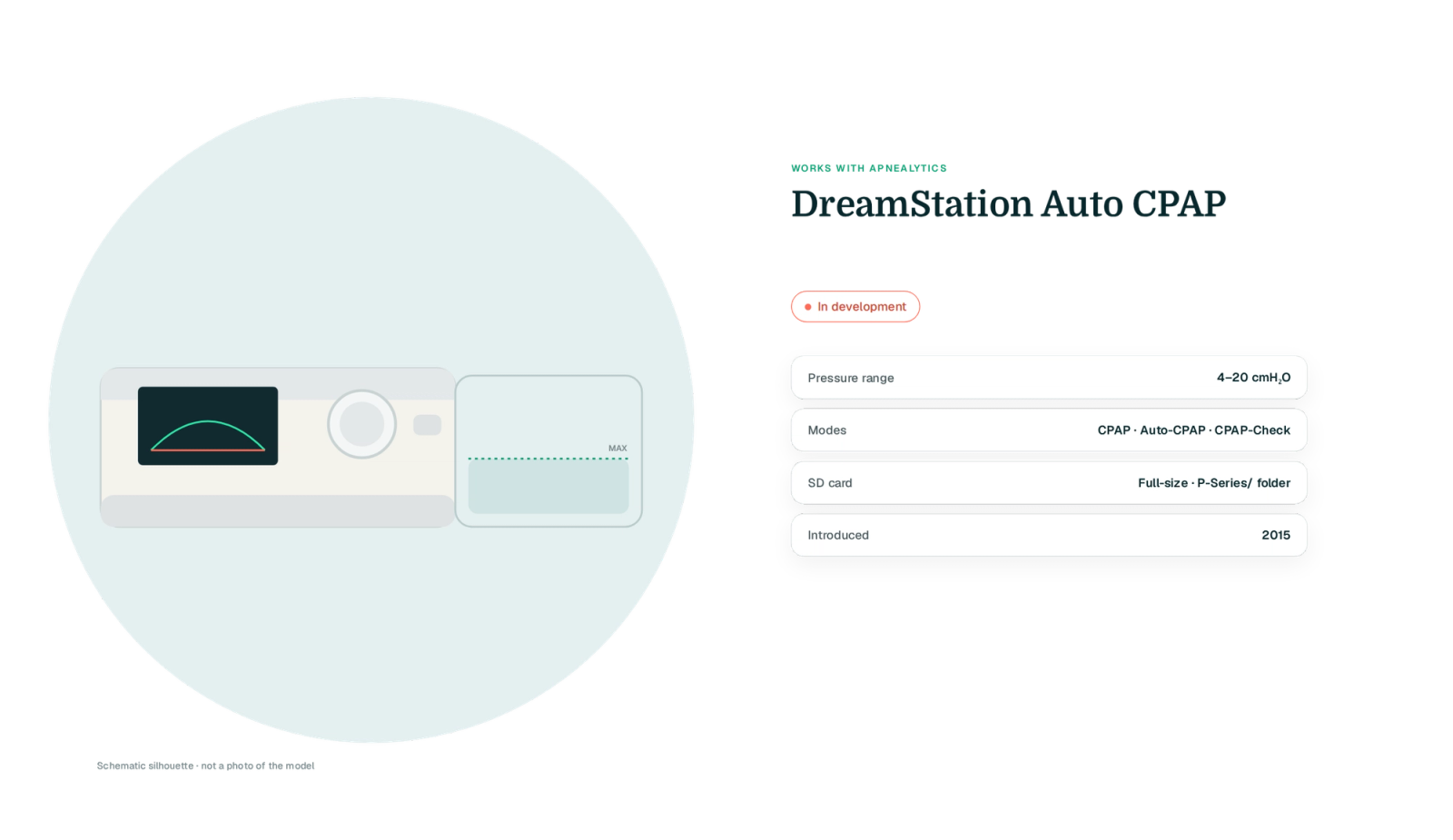
| Spec | DreamStation Auto CPAP |
|---|---|
| Pressure range | 4–20 cmH₂O |
| Modes | CPAP, Auto-CPAP, CPAP-Check (on some models) |
| Comfort | A-Flex / C-Flex pressure relief (0–3), SmartRamp |
| Humidifier | Detachable heated humidifier, heated tube optional |
| SD card | Full-size SD card in a slot on the side of the main unit |
| Data files written | P-Series/ folder with Pxxxxxxxx/ sub-folder holding numbered binary files (.001 summary,.002 events,.005 waveforms) |
| Bluetooth / app | Yes — Bluetooth to DreamMapper; cellular modem on most units |
| Year introduced | 2015 |
| Apnealytics status | Supported |
![Drawn schematic silhouette of a DreamStation-style body with detachable humidifier on a teal blob, SD slot on the left side highlighted in mint [VERIFY: left side], with three fact rows (not a photo of the model)](https://cdn.sanity.io/images/xljt2bp4/staging/2f7102247c4491a7d3f1c651c87ad31fc6dfb68d-2380x1344.png?w=2000&fit=max&auto=format)
The slot is on the side of the main unit, not the humidifier. Turn the machine off, wait for the screen to settle and press the card to release it. Keep a card in at all times: like every machine here, the DreamStation records detailed data only to the card.
![Two-view schematic: DreamStation front (drawn silhouette) on a teal blob and a side elevation with the SD slot highlighted in mint, on the side of the main unit, not the humidifier [VERIFY: slot side and cover], with the power-off reminder](https://cdn.sanity.io/images/xljt2bp4/staging/5aa2dbedc614edf4c6cf82b1b63f189a576205a9-2400x1140.png?w=1000&fit=max&auto=format)
Turn the DreamStation off and remove the SD card.
Card import is web-only.
Sign in at my.apnealytics.com and open Import.
Files travel direct to private storage on Cloudflare R2, resumable.
Nights are parsed and deduplicated against anything already in your account.
If the parser improves later, Re-process in your import history updates past nights without a second upload.
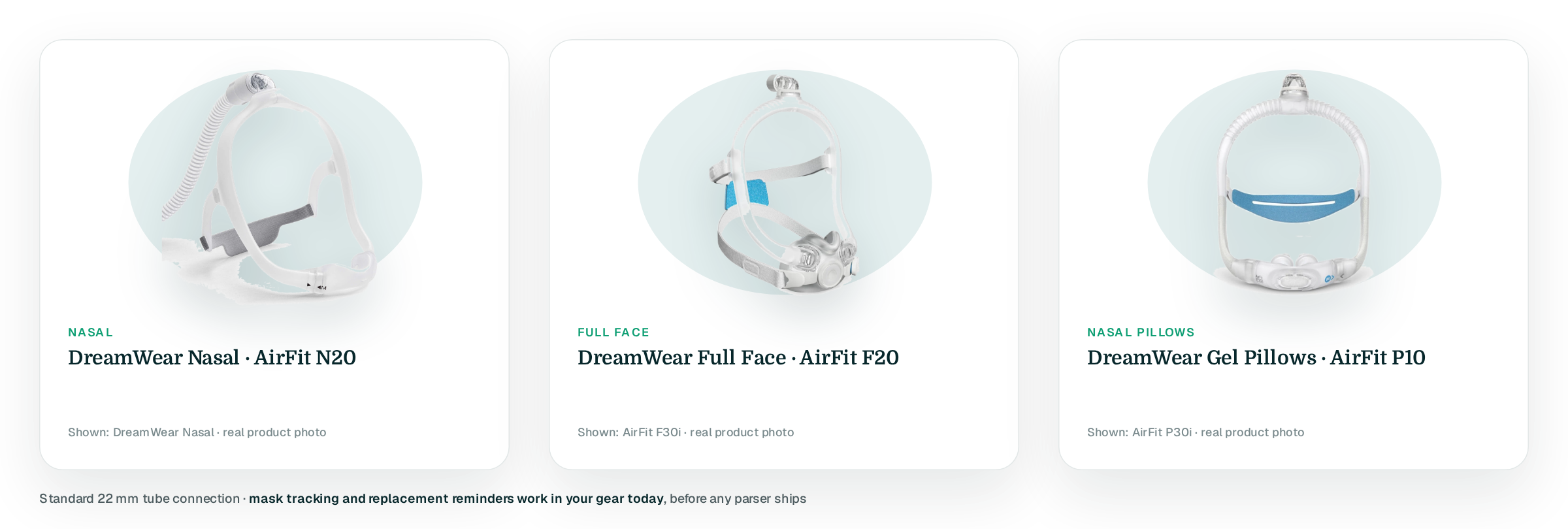
The DreamStation records obstructive apneas, clear-airway apneas, hypopneas, RERAs, flow limitation, periodic breathing and vibratory snore. These map into Apnealytics' obstructive, central, hypopnea and unclassified composition, with the Philips-specific flags in the event strip.
Auto-CPAP nights show the 90th-percentile pressure against the set minimum and maximum, with the Flex level alongside.
Philips reports total leak rather than unintentional leak. Apnealytics labels it as such and Mask Analytics compares it per mask. On Pro, the waveform viewer reads the high-resolution.005 files for airflow and pressure.
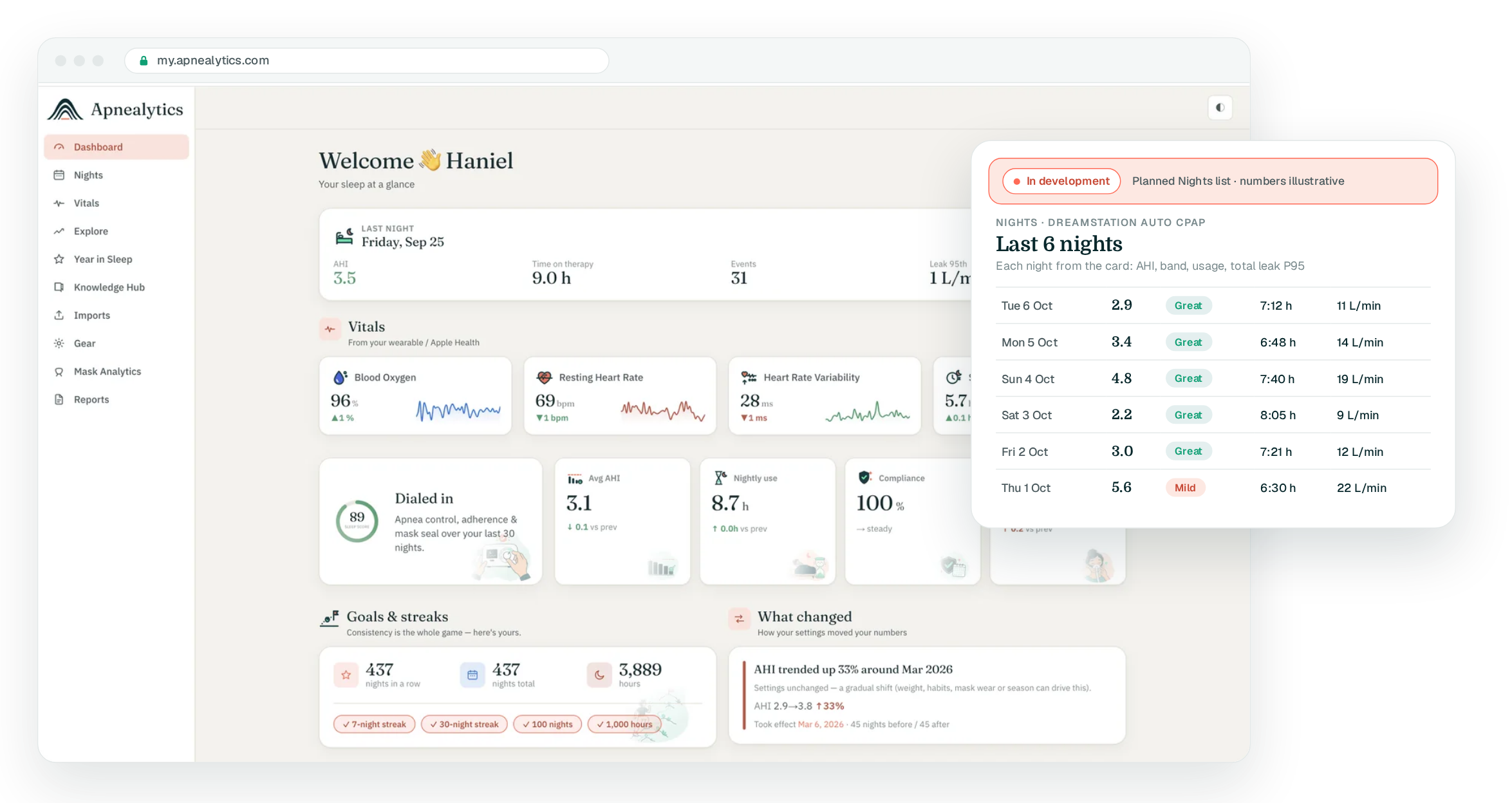
Undocumented format. Philips has never published the P-Series layout. Everything known about it comes from community work, and our parser is tested against cards contributed by users.
Humidifier and tube data. The DreamStation records humidifier and heated-tube settings in the summary. These show in "What changed?" as with ResMed.
Firmware variations. Later DreamStation firmware added fields that early firmware lacks. The parser handles both.
Clock and daylight saving. The DreamStation's handling of clock changes can produce a night that appears split or doubled in community tools. We dedup these on import.
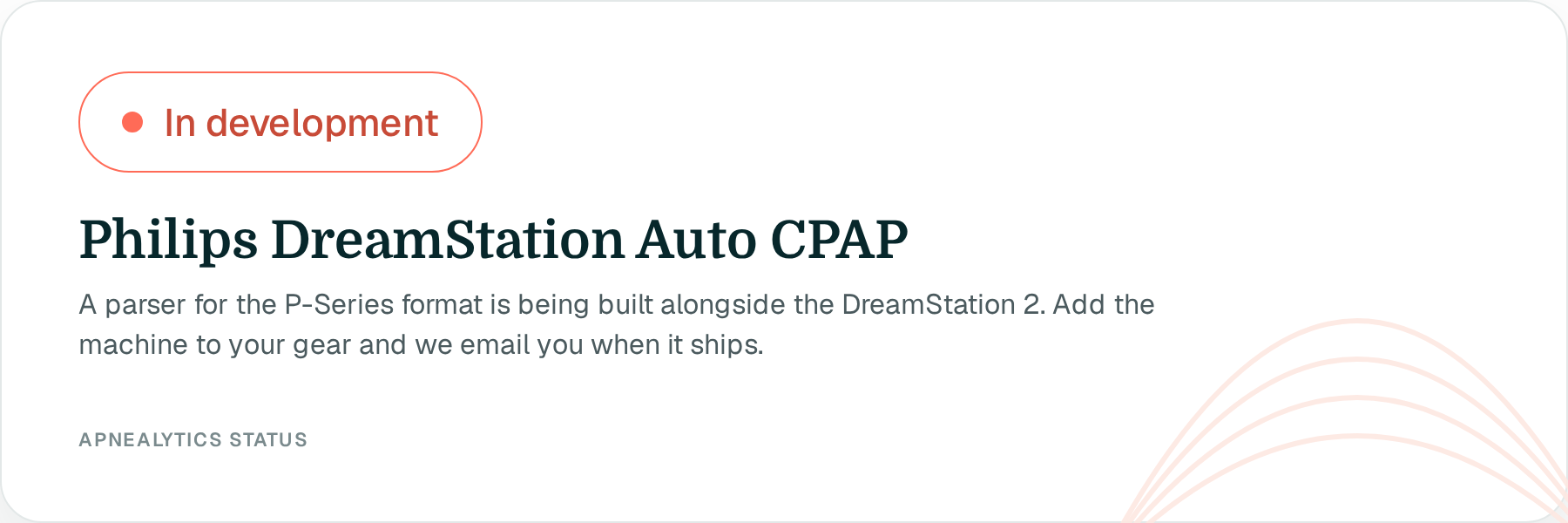
The DreamStation uses a standard 22 mm tube connection and accepts Philips, ResMed and Fisher & Paykel masks. Mask tracking and replacement reminders work in your gear:
DreamWear Nasal, AirFit N20
DreamWear Full Face, AirFit F20
DreamWear Gel Pillows, AirFit P10
Create a free account, add the DreamStation to your gear and upload the SD card. Not sure your model is covered? Use the compatibility checker.
Yes. The original DreamStation is supported. Create a free account, add the machine to your gear and upload the SD card; if the parser improves, Re-process in your import history updates past nights.
A P-Series folder containing a sub-folder named after the device serial, holding numbered binary files: a summary file, an events file and high-resolution waveform files. They are not EDF, so Philips needed its own parser.
No. DreamMapper is Philips' free app, reads only Philips machines, and has no export. Apnealytics reads the SD card directly, which holds far more than the app shows, including the waveform files for the Pro viewer.
Yes. Keep your old DreamStation cards and upload them. The Pro plan supports multiple machines with full gear history, so your DreamStation nights and your ResMed nights will sit on one timeline with the switch marked in "What changed?".
OSCAR, the free open-source desktop program for Windows, Mac and Linux, reads Philips machines. SleepHQ lists Philips among its supported brands. DreamMapper shows a daily summary. Apnealytics reads it too.
The web app is live today. iPhone and iPad are on the App Store. Android is on Google Play. Your first 30 nights are free, forever.
 DashboardSleep Score, AHI band, leak and pressure
 Trends & historyA year down to a night
 Breath-by-breath viewerAirflow, pressure, leak tracesPro
 SpO₂ overlayOximeter data on the same nightPro
 Pressure insightsP95, set range, EPR and ramp
 SD card importDrop the card folder, only new nights added
 Mask fit & gearWhich mask actually seals
 Ask your dataPlain-English questions, your own AI keyBYOK
 Year in SleepYour therapy year in one storyNew
 Compliance reportFinds the qualifying window for youPro
 Share with your doctorRead-only, revocable links
 Companion appiPhone, iPad and Android
 Privacy & securityYour data, locked to you
 ResMed AirSense 10 & 11Supported
 ResMed AirCurve 10 & 11 VAutoSupported
 ResMed S9 / LumisSupported
 Philips DreamStation 1 & 2Supported
 Fisher & Paykel SleepStyleSupported
 Löwenstein / DeVilbissPartial
 React Health Luna G3Waitlist
 Transcend MicroWaitlist
 Full face masksFit, leak signature, Mask Analytics
 Nasal masksOver-nose and cradle styles
 Nasal pillowsMinimal-contact fit tips
 Wellue O2RingSupported
 Contec CMS50 familySupported
 Apple Health / Health ConnectResting HR, HRV, SpO₂, sleepSupported
 What is AHI?The apnea-hypopnea index, explained
 What is a good AHI on CPAP?
 CPAP leak rate explained
 Pressure settings explained
 Reading CPAP waveformsAll 14 explainers
 Apnealytics vs SleepHQ
 Apnealytics vs OSCAR
 Apnealytics vs myAir
 Apnealytics vs DreamMapper
 SleepHQ vs OSCARBest CPAP apps in 2026
 How to read CPAP dataStart here: six numbers, in order
 Read your CPAP SD card
 Share data with your doctorChoosing a CPAP mask
 Travel with CPAPAll guides
 Mask finderSeven questions, a ranked mask typeYour data
 Machine finderA two-machine shortlist for your prescription
 iPhone / iPhone DuoLast night before you are out of bed. Apple Health vitals, Face ID.Live
 iPadSame universal app, side-by-side panes and full-width waveforms.Live
 AndroidPhones, tablets and foldables, with Health Connect built in.Live
 Web portalWhere your SD card goes. Every chart, report and setting.Live

