



iPhone / iPhone Duo Live
Last night before you are out of bed. Apple Health vitals, Face ID.
Download on the App Store Apnealytics
Free on every plan: unlimited imports, the full dashboard and your last 30 nights.
 Compatibility checkerWill my machine work?Type your model. You get a straight answer: supported, partial, waitlist, or why not.Check my machine
 If it writes an SD card, we probably read it. ResMed AirMini has no card, so no app can read it.
Sleep Check-up
3 of 6 checks done
Six short screeners, one picture of how you sleep. Earn a milestone for each, save results and get retake reminders.
Latest milestone: Sleepiness check done
 NEWTrack your 90-day compliance windowOpen the calculator
 13 free tools. No account needed — sign in to save results and fill answers from your own CPAP data.
Last night before you are out of bed. Apple Health vitals, Face ID.
Download on the App Store


One account on every screen. Apple Watch vitals sync through Apple Health.
Your CPAP machine measures airflow. It cannot see what that airflow does to the oxygen in your blood. A pulse oximeter can, and three numbers summarise what it finds: SpO₂ itself, the oxygen desaturation index (ODI), and T90, the time spent below 90 percent. Together they add the missing half of the picture.
SpO₂ is peripheral oxygen saturation: the percentage of haemoglobin in your blood that is carrying oxygen, estimated by shining red and infrared light through a fingertip or wrist and measuring how much of each is absorbed. The "p" stands for peripheral and the "S" for saturation; the "2" is the oxygen molecule.
For a healthy adult awake at sea level, SpO₂ is typically 95 to 100 percent. During sleep it drifts a little lower, and brief dips are normal. Sustained or repeated drops are not.
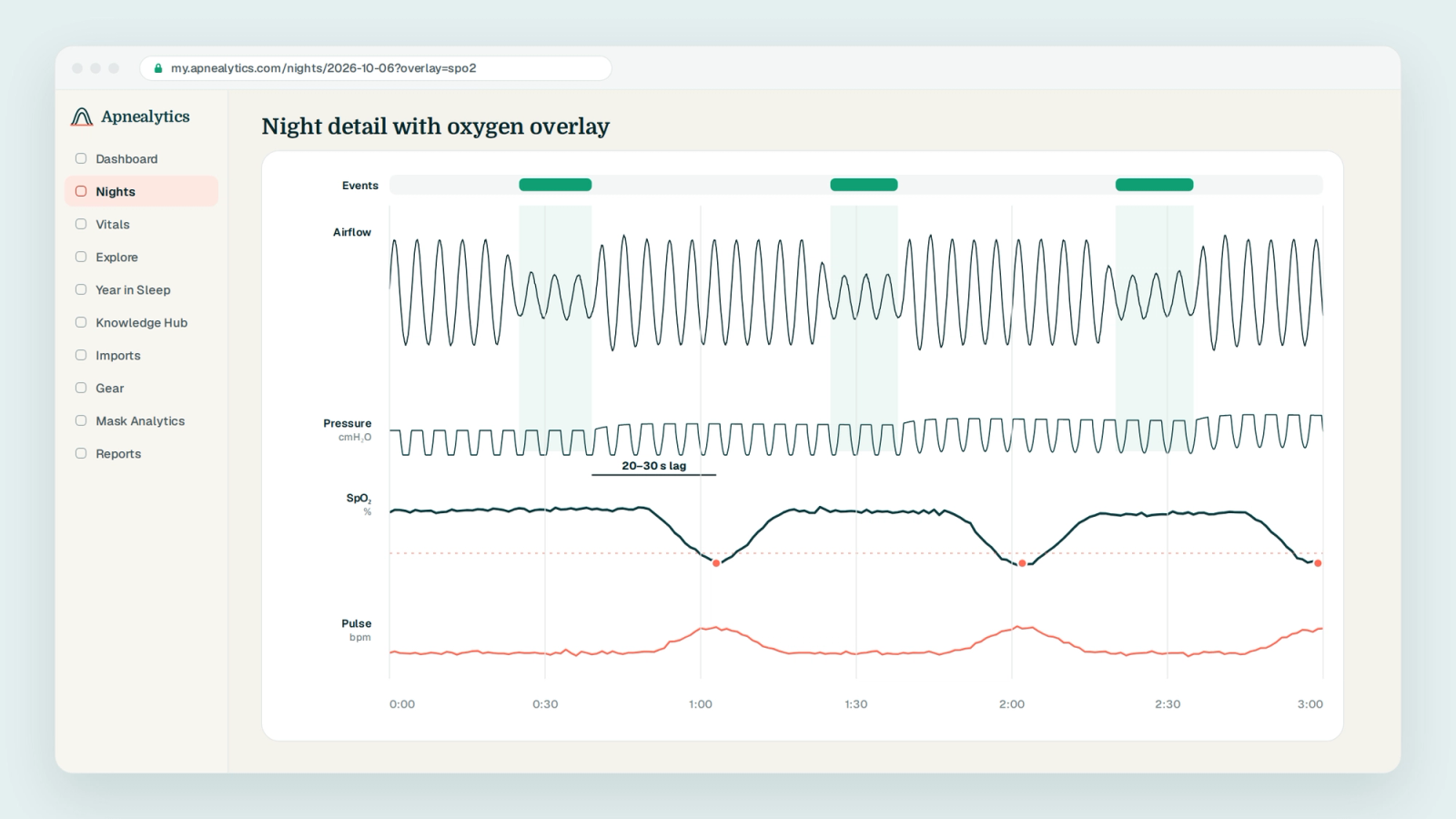
When your airway closes or your breathing pauses, oxygen stops arriving at the lungs. Your blood keeps delivering what it has to your tissues, so saturation falls. A typical obstructive apnea produces a dip of a few percentage points that bottoms out 20 to 40 seconds after the event ends, because it takes that long for blood from the lungs to reach the finger. Breathing resumes, saturation climbs back.
Repeat that thirty times an hour and you get the characteristic sawtooth pattern of untreated sleep apnea on an oximetry trace. Those repeated swings, rather than any single low reading, are thought to drive much of the cardiovascular strain associated with the condition.
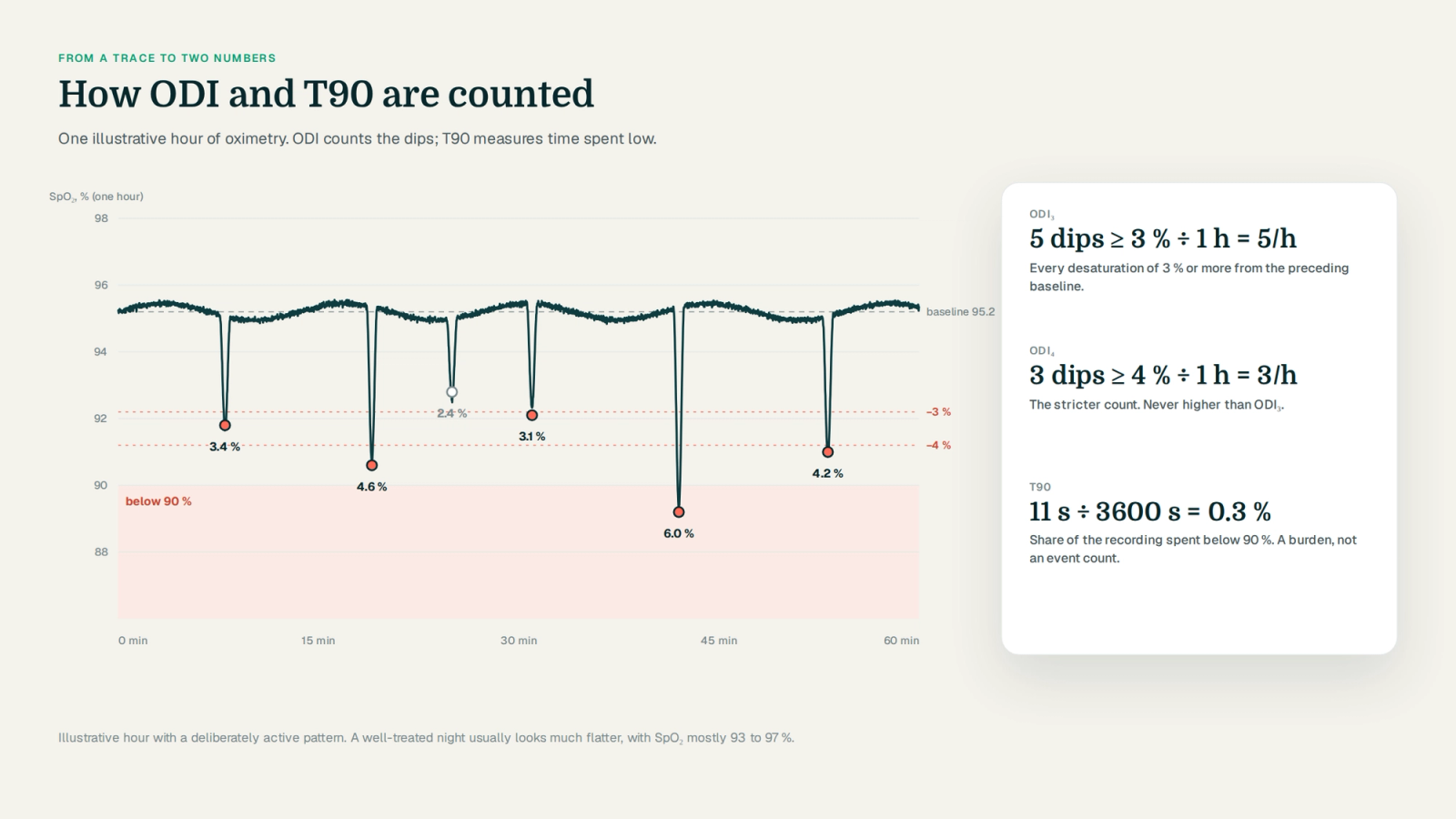
A desaturation event is a drop in SpO₂ of at least a defined amount from the preceding baseline, followed by a recovery. The two thresholds in use are 3 percent and 4 percent.
A 3 percent desaturation is used in the American Academy of Sleep Medicine's recommended hypopnea rule.
A 4 percent desaturation is used in the older alternative rule and by US Medicare for coverage decisions.
See hypopnea explained for how these thresholds feed into AHI.
ODI is the number of desaturation events per hour of recording. It is to oximetry what AHI is to airflow. Because it depends on the threshold, it is written with a subscript:
ODI₃: desaturations of 3 percent or more per hour.
ODI₄: desaturations of 4 percent or more per hour.
ODI₃ is always higher than ODI₄ on the same night, because every 4 percent drop is also a 3 percent drop.
ODI and AHI are related but not identical. Not every apnea or hypopnea produces a scorable desaturation, especially in younger or leaner people, and some desaturations happen without a scorable airflow event. In untreated sleep apnea, ODI₄ is often a little lower than AHI. On CPAP, if therapy is working, both should be low.
There are no universal severity bands for ODI the way there are for AHI, but clinicians commonly read them on a similar scale: under 5 reassuring, 5 to 15 mild, 15 to 30 moderate, above 30 severe. Treat those as orientation, not diagnosis.
T90 is the percentage of the night your SpO₂ spent below 90 percent. Where ODI counts events, T90 measures burden: how long you were hypoxic, regardless of how you got there.
A healthy sleeper has a T90 near zero. Sleep apnea raises it in proportion to how many events there are and how deep they go. Lung disease, obesity hypoventilation and living at altitude can raise it even when apnea is well treated, because the baseline itself sits low. A high T90 with a low ODI is a different picture from a high T90 with a high ODI, and the combination tells your clinician something.
Some reports also give T88 (below 88 percent) and the minimum SpO₂ for the night. The minimum is the oximetry equivalent of maximum pressure: a single worst moment that is easily skewed by a loose sensor.
This is the point of overnight oximetry for a CPAP user. Your machine's AHI is an estimate from airflow. It flags hypopneas without knowing whether oxygen fell. It cannot tell you whether the handful of residual events on a good night did anything to your saturation, or whether a night with AHI 1.5 had a long stretch of low oxygen for a reason that has nothing to do with the airway.
Most people on well-controlled CPAP do not need to wear an oximeter every night. It is useful for a stretch when you are starting therapy, when something has changed, when you are tired despite a good AHI, or when your clinician asks for it. Some people simply like having the data. Either way, the oximeter and the machine are measuring different things, and seeing them together is where the value is.
Note that ResMed machines report SpO₂ only if an oximeter accessory is connected to the device; the data lands on the SD card as a SAD.edf file, which Apnealytics reads.
Consumer oximeters are good, not perfect. Things that produce false dips:
A loose or shifted sensor, especially on ring devices during position changes.
Cold fingers and poor circulation.
Movement artefact.
Nail polish on fingertip devices.
Low sampling rates on some devices, which can miss brief events or smear them.
A single dramatic low reading is far more likely to be artefact than physiology. Repeated, regular dips that line up with breathing events are not.
The oxygen overlay is a Pro feature. Import a night from a Wellue O2Ring, a Contec CMS50-family device, a ResMed SAD.edf file, or any oximeter that exports EDF or CSV. Apnealytics aligns the oximetry trace to your therapy night and draws SpO₂ and pulse rate directly beneath the airflow, pressure and leak traces in the breath-by-breath viewer.
For each night the Vitals tiles show ODI₃, ODI₄, T90, minimum SpO₂ and average SpO₂. In Trends you can chart ODI beside AHI over 30, 90 or 365 nights, so you can see whether the two agree and whether a change in therapy moved both.
On the free plan, Apple Health or Health Connect sync brings in daily SpO₂ averages and lows from a watch or ring alongside resting heart rate and HRV. Those are daily summaries rather than a per-second trace, so they cannot show individual desaturations, but they are a useful background signal.
See oximeters that work with Apnealytics for supported devices, including the Wellue O2Ring and Contec CMS50.
My AHI is low but my ODI₄ is X. Does that match what you would expect?
My T90 is high even on nights with few events. Should we look at something other than the airway?
Here is where my desaturations line up with hypopneas. Does this change how you read my residual AHI?
For a healthy adult at sea level, SpO₂ during sleep is usually 94 to 98 percent, slightly lower than awake values. Brief dips are normal. Repeated drops of 3 or 4 percent or more, or sustained time below 90 percent, are not, and are the patterns oximetry is used to detect. Baseline values are lower at altitude and in people with lung disease.
ODI is the oxygen desaturation index: the number of times per hour your blood oxygen fell by at least 3 percent (ODI₃) or 4 percent (ODI₄) from baseline and then recovered. It is the oximetry counterpart of AHI. In untreated sleep apnea the two tend to track each other; on effective CPAP both should be low.
T90 is the percentage of the night your SpO₂ spent below 90 percent. It measures how long you were hypoxic rather than how many events occurred. A healthy sleeper has a T90 near zero. Untreated apnea raises it; so can lung disease or a low baseline saturation, which is why a high T90 with a low ODI is worth discussing with your clinician.
Not by itself. A CPAP machine measures airflow and pressure. It cannot see your blood oxygen. ResMed machines can record SpO₂ if a compatible oximeter accessory is connected, and the data is saved to the SD card. Otherwise you need a separate overnight oximeter such as a fingertip or ring device, which Apnealytics can import and align to your therapy data.
Because of circulation time. When breathing pauses, the blood in your lungs stops picking up oxygen, but it takes 20 to 40 seconds for that blood to travel to your fingertip where the oximeter reads it. The dip on the SpO₂ trace therefore appears after the event flag on the airflow trace. Apnealytics shows both traces aligned so the delay is visible.
The web app is live today. iPhone and iPad are on the App Store. Android is on Google Play. Your first 30 nights are free, forever.
 DashboardSleep Score, AHI band, leak and pressure
 Trends & historyA year down to a night
 Breath-by-breath viewerAirflow, pressure, leak tracesPro
 SpO₂ overlayOximeter data on the same nightPro
 Pressure insightsP95, set range, EPR and ramp
 SD card importDrop the card folder, only new nights added
 Mask fit & gearWhich mask actually seals
 Ask your dataPlain-English questions, your own AI keyBYOK
 Year in SleepYour therapy year in one storyNew
 Compliance reportFinds the qualifying window for youPro
 Share with your doctorRead-only, revocable links
 Companion appiPhone, iPad and Android
 Privacy & securityYour data, locked to you
 ResMed AirSense 10 & 11Supported
 ResMed AirCurve 10 & 11 VAutoSupported
 ResMed S9 / LumisSupported
 Philips DreamStation 1 & 2Supported
 Fisher & Paykel SleepStyleSupported
 Löwenstein / DeVilbissPartial
 React Health Luna G3Waitlist
 Transcend MicroWaitlist
 Full face masksFit, leak signature, Mask Analytics
 Nasal masksOver-nose and cradle styles
 Nasal pillowsMinimal-contact fit tips
 Wellue O2RingSupported
 Contec CMS50 familySupported
 Apple Health / Health ConnectResting HR, HRV, SpO₂, sleepSupported
 What is AHI?The apnea-hypopnea index, explained
 What is a good AHI on CPAP?
 CPAP leak rate explained
 Pressure settings explained
 Reading CPAP waveformsAll 14 explainers
 Apnealytics vs SleepHQ
 Apnealytics vs OSCAR
 Apnealytics vs myAir
 Apnealytics vs DreamMapper
 SleepHQ vs OSCARBest CPAP apps in 2026
 How to read CPAP dataStart here: six numbers, in order
 Read your CPAP SD card
 Share data with your doctorChoosing a CPAP mask
 Travel with CPAPAll guides
 Mask finderSeven questions, a ranked mask typeYour data
 Machine finderA two-machine shortlist for your prescription
 iPhone / iPhone DuoLast night before you are out of bed. Apple Health vitals, Face ID.Live
 iPadSame universal app, side-by-side panes and full-width waveforms.Live
 AndroidPhones, tablets and foldables, with Health Connect built in.Live
 Web portalWhere your SD card goes. Every chart, report and setting.Live

