



iPhone / iPhone Duo Live
Last night before you are out of bed. Apple Health vitals, Face ID.
Download on the App Store Apnealytics
Free on every plan: unlimited imports, the full dashboard and your last 30 nights.
 Compatibility checkerWill my machine work?Type your model. You get a straight answer: supported, partial, waitlist, or why not.Check my machine
 If it writes an SD card, we probably read it. ResMed AirMini has no card, so no app can read it.
Sleep Check-up
3 of 6 checks done
Six short screeners, one picture of how you sleep. Earn a milestone for each, save results and get retake reminders.
Latest milestone: Sleepiness check done
 NEWTrack your 90-day compliance windowOpen the calculator
 13 free tools. No account needed — sign in to save results and fill answers from your own CPAP data.
Last night before you are out of bed. Apple Health vitals, Face ID.
Download on the App Store


One account on every screen. Apple Watch vitals sync through Apple Health.
A hypopnea is a partial reduction in breathing: airflow drops significantly for at least 10 seconds but does not stop. It is the "H" in AHI, and on most people's CPAP data it is the most common event type by a wide margin. This guide covers the clinical definition, how your machine approximates it, and what a hypopnea-heavy night means.
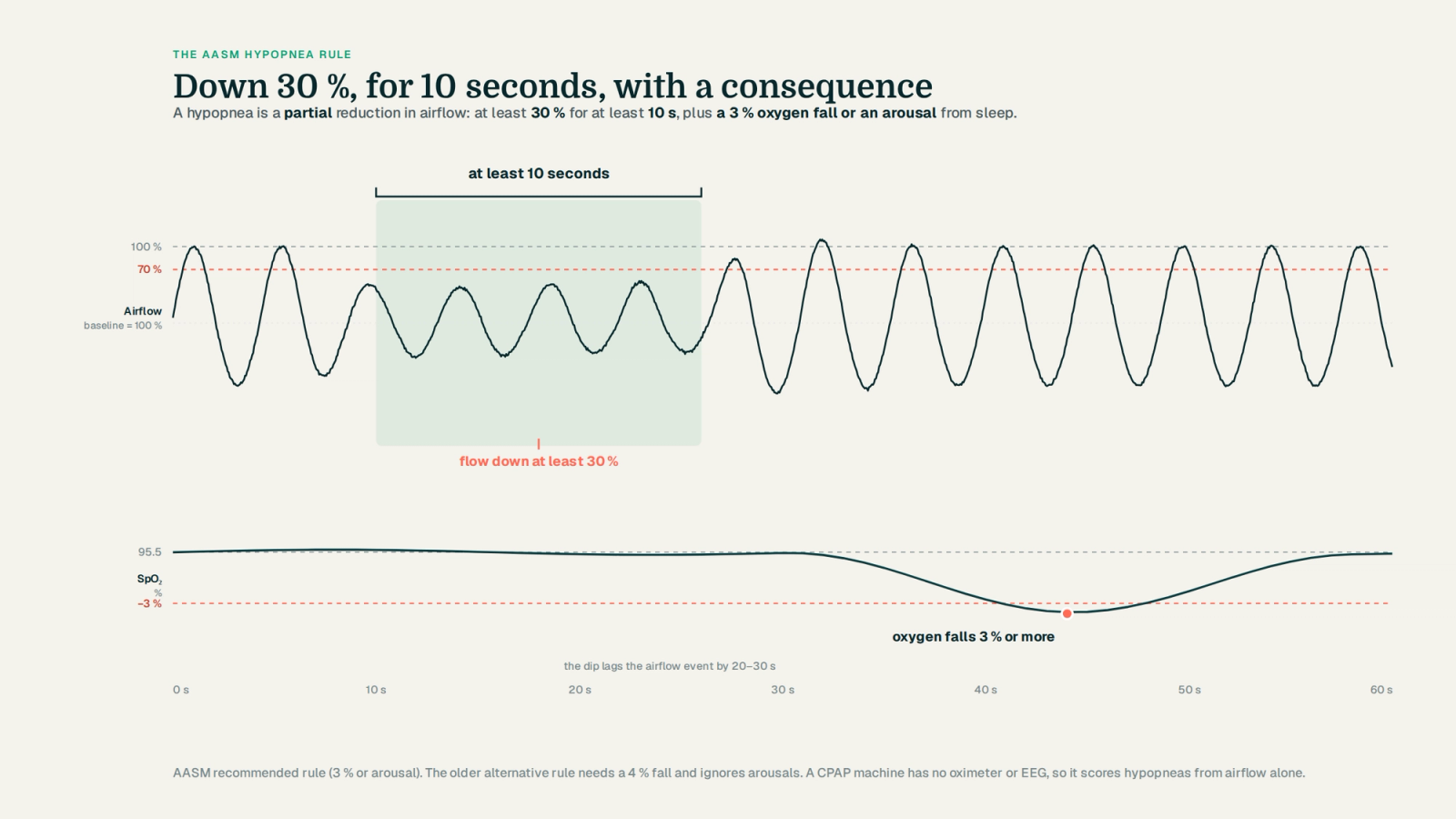
Both are breathing events of at least 10 seconds. The difference is degree.
An apnea is a near-total stop. The American Academy of Sleep Medicine (AASM) scores it when airflow drops by 90 percent or more from the pre-event baseline.
A hypopnea is a partial reduction. Airflow falls, but a meaningful amount of air still moves. Because "partial" needs a threshold, and because a small dip in breathing is only clinically interesting if it has a consequence, the hypopnea definition has a second part that the apnea definition does not.
The AASM's current scoring manual offers two definitions. Both require that airflow drop by at least 30 percent from baseline for at least 10 seconds. They differ in what else has to happen.
Recommended rule (sometimes called 1A or the "3% or arousal" rule): the airflow drop must be accompanied by either a fall in blood oxygen saturation of at least 3 percent, or an arousal from sleep seen on EEG.
Acceptable alternative rule (1B or the "4% rule"): the airflow drop must be accompanied by a fall in oxygen saturation of at least 4 percent. Arousals do not count.
The 4 percent rule is the one the US Centers for Medicare and Medicaid Services (CMS) uses for coverage decisions, which is why many US sleep labs still report it alongside or instead of the recommended rule. The same night, scored both ways, can produce noticeably different AHIs; the 3 percent-or-arousal rule catches more events and tends to give a higher number.
If you were told your diagnostic AHI, it is worth knowing which rule it used. An AHI of 12 under the 4 percent rule and an AHI of 12 under the 3 percent rule do not describe quite the same severity.
A hypopnea can be obstructive, where the airway narrows and effort continues or increases, or central, where effort itself decreases. The AASM manual describes criteria for telling them apart, based on snoring, flattening of the flow curve and paradoxical chest-abdomen movement, but scoring hypopnea type is optional and many labs do not do it. Your CPAP does not do it either; it reports hypopneas as a single category.
Here is the problem. The clinical definition of a hypopnea requires an oxygen measurement or an EEG. Your CPAP machine has neither. It has a flow sensor.
Manufacturers therefore use a flow-only definition. ResMed scores a hypopnea when airflow falls by a defined percentage for at least 10 seconds. There is no desaturation check and no arousal check, because the machine cannot perform them.
Two consequences follow.
Machine hypopneas and lab hypopneas are related but not identical. Some machine-scored hypopneas would not qualify in a lab because oxygen never dipped and sleep was not disturbed. Some lab hypopneas would not register on the machine because the flow reduction was under its threshold even though oxygen fell. Most of the time they agree well enough for trends to be meaningful, but the numbers are not interchangeable.
The machine's threshold is stricter than 30 percent. Because it cannot use oxygen or arousal to confirm an event, it demands a larger flow reduction before scoring one. Breaths that fall 30 to 50 percent are not counted at all, though they may show up as flow limitation.
Look at the event composition on a typical CPAP night and hypopneas are usually the largest slice, often more than half of all events. This makes sense. Pressure is good at preventing complete collapse. What slips through is partial narrowing: a pressure slightly too low for a moment, a position change, a REM period where the airway is extra relaxed. Those produce reductions, not stops.
A residual AHI made mostly of hypopneas is the expected pattern for well-treated obstructive apnea. It is generally a less concerning picture than the same AHI made of obstructive apneas, and a quite different one from an AHI made of central events. See central vs obstructive apnea on CPAP.
Pressure. The most common cause of rising hypopneas is a maximum pressure the machine keeps bumping against, or a minimum that lets the airway narrow before the algorithm responds. Pressure settings are clinical; see CPAP pressure settings explained.
Leak. Reduced delivered pressure from leak lets partial obstruction return. Leak also distorts the flow signal, which can inflate or deflate the hypopnea count. See CPAP leak rate explained.
EPR. The exhale pressure drop lowers pressure for part of each breath, and some people see more hypopneas at higher EPR levels. See EPR and Flex explained.
Position, alcohol, congestion. The usual suspects.
Wake breathing. Irregular breathing while awake with the mask on can be scored as hypopneas. Long periods awake in bed tend to add a few.
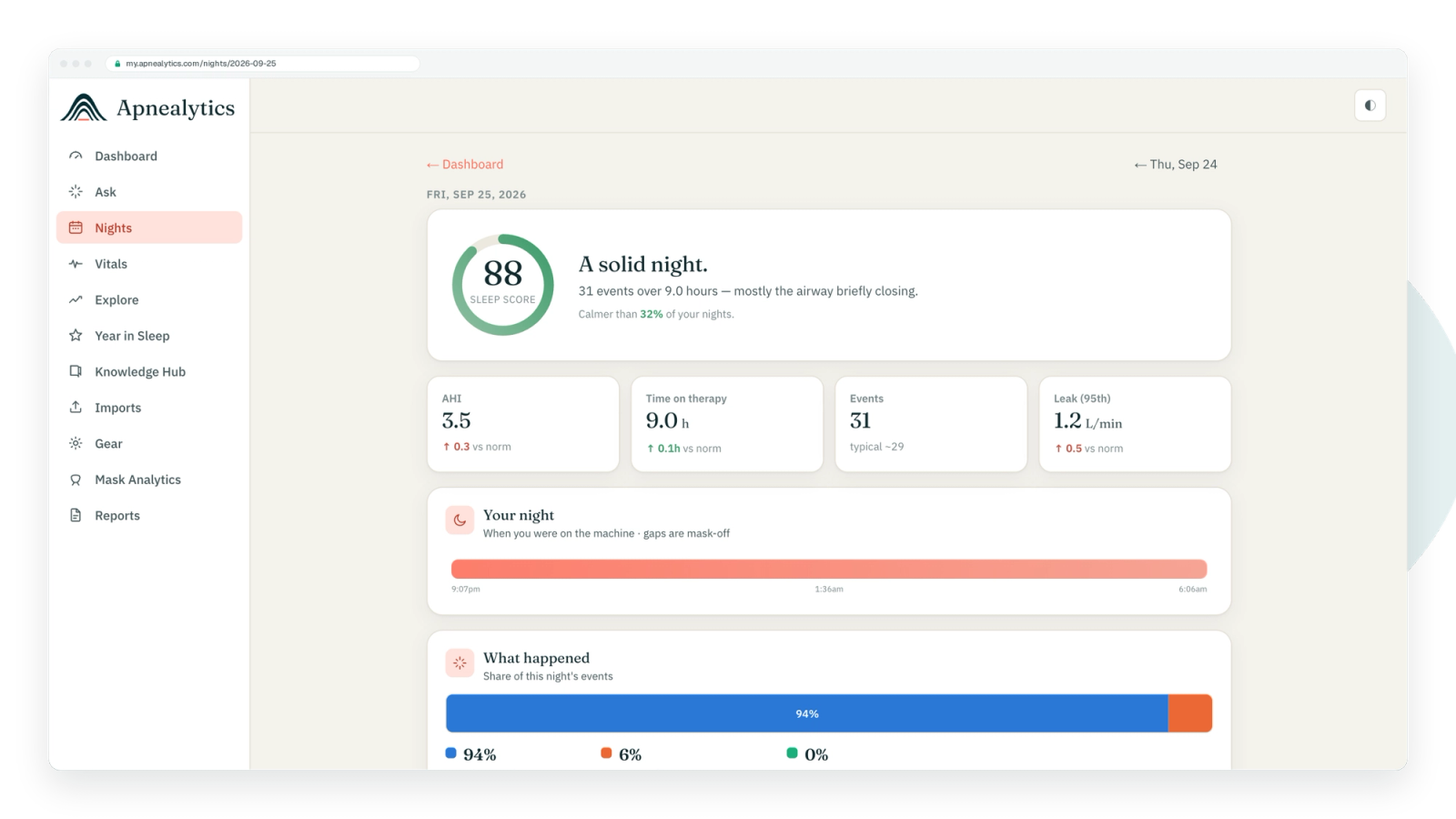
The dashboard shows last-night AHI with its band and, beneath it, the event composition ring with hypopneas as their own segment. The night detail page lists the hypopnea count next to obstructive, central and unclassified apneas.
Trends lets you chart hypopneas on their own over 30, 90 or 365 nights and overlay pressure P95 and leak P95. Hypopneas that climb in step with pressure hugging the maximum tell one story; hypopneas that climb with leak tell another.
Pro users can open the night in the breath-by-breath viewer, where each hypopnea is a labelled flag on the airflow trace. The shape is distinctive: breaths shrink over several cycles, hold at a reduced amplitude, then recover, often with a larger breath at the end. It is a useful thing to see once; after that the number on the dashboard means something concrete.
If you also wear an oximeter, the oxygen overlay puts SpO₂ beneath the flow trace. Seeing whether your machine-scored hypopneas line up with 3 or 4 percent desaturations is the closest a home setup gets to the lab definition.
Useful questions:
My residual events are mostly hypopneas. Is that the pattern you would expect?
My hypopneas rose when my pressure started hitting the maximum. Is the range worth reviewing?
Which hypopnea rule was my sleep study scored with?
An apnea is a near-complete stop in airflow, a drop of 90 percent or more for at least 10 seconds. A hypopnea is a partial reduction, a drop of at least 30 percent for at least 10 seconds that is accompanied by an oxygen desaturation or an arousal. Both count equally in the AHI. On CPAP, hypopneas are usually the more common of the two.
The AASM scoring manual's recommended rule scores a hypopnea when airflow drops at least 30 percent for at least 10 seconds with either a 3 percent oxygen desaturation or an arousal. An acceptable alternative requires a 4 percent desaturation and ignores arousals. US Medicare uses the 4 percent rule, so many US labs report that one.
From airflow alone. The machine cannot measure oxygen or detect arousals, so it scores a hypopnea when flow drops by a manufacturer-defined percentage for at least 10 seconds. This is an approximation of the clinical definition: it agrees reasonably well with lab scoring for trend purposes, but the individual event counts are not interchangeable with a sleep study.
Because pressure is good at preventing complete airway collapse but less good at preventing brief partial narrowing. What remains on well-treated therapy is mostly partial reductions rather than full stops. A residual AHI dominated by hypopneas is the typical pattern for controlled obstructive sleep apnea and is usually less concerning than the same number of full apneas.
A small number of hypopneas on therapy is normal and expected. The concern is the total and the trend: a residual AHI consistently above 5, or rising, is worth discussing with your clinician whatever the event mix. Reading hypopneas alongside leak and pressure usually points to the cause, most often a mask problem or a pressure range worth reviewing.
The web app is live today. iPhone and iPad are on the App Store. Android is on Google Play. Your first 30 nights are free, forever.
 DashboardSleep Score, AHI band, leak and pressure
 Trends & historyA year down to a night
 Breath-by-breath viewerAirflow, pressure, leak tracesPro
 SpO₂ overlayOximeter data on the same nightPro
 Pressure insightsP95, set range, EPR and ramp
 SD card importDrop the card folder, only new nights added
 Mask fit & gearWhich mask actually seals
 Ask your dataPlain-English questions, your own AI keyBYOK
 Year in SleepYour therapy year in one storyNew
 Compliance reportFinds the qualifying window for youPro
 Share with your doctorRead-only, revocable links
 Companion appiPhone, iPad and Android
 Privacy & securityYour data, locked to you
 ResMed AirSense 10 & 11Supported
 ResMed AirCurve 10 & 11 VAutoSupported
 ResMed S9 / LumisSupported
 Philips DreamStation 1 & 2Supported
 Fisher & Paykel SleepStyleSupported
 Löwenstein / DeVilbissPartial
 React Health Luna G3Waitlist
 Transcend MicroWaitlist
 Full face masksFit, leak signature, Mask Analytics
 Nasal masksOver-nose and cradle styles
 Nasal pillowsMinimal-contact fit tips
 Wellue O2RingSupported
 Contec CMS50 familySupported
 Apple Health / Health ConnectResting HR, HRV, SpO₂, sleepSupported
 What is AHI?The apnea-hypopnea index, explained
 What is a good AHI on CPAP?
 CPAP leak rate explained
 Pressure settings explained
 Reading CPAP waveformsAll 14 explainers
 Apnealytics vs SleepHQ
 Apnealytics vs OSCAR
 Apnealytics vs myAir
 Apnealytics vs DreamMapper
 SleepHQ vs OSCARBest CPAP apps in 2026
 How to read CPAP dataStart here: six numbers, in order
 Read your CPAP SD card
 Share data with your doctorChoosing a CPAP mask
 Travel with CPAPAll guides
 Mask finderSeven questions, a ranked mask typeYour data
 Machine finderA two-machine shortlist for your prescription
 iPhone / iPhone DuoLast night before you are out of bed. Apple Health vitals, Face ID.Live
 iPadSame universal app, side-by-side panes and full-width waveforms.Live
 AndroidPhones, tablets and foldables, with Health Connect built in.Live
 Web portalWhere your SD card goes. Every chart, report and setting.Live

