



iPhone / iPhone Duo Live
Last night before you are out of bed. Apple Health vitals, Face ID.
Download on the App Store Apnealytics
Free on every plan: unlimited imports, the full dashboard and your last 30 nights.
 Compatibility checkerWill my machine work?Type your model. You get a straight answer: supported, partial, waitlist, or why not.Check my machine
 If it writes an SD card, we probably read it. ResMed AirMini has no card, so no app can read it.
Sleep Check-up
3 of 6 checks done
Six short screeners, one picture of how you sleep. Earn a milestone for each, save results and get retake reminders.
Latest milestone: Sleepiness check done
 NEWTrack your 90-day compliance windowOpen the calculator
 13 free tools. No account needed — sign in to save results and fill answers from your own CPAP data.
Last night before you are out of bed. Apple Health vitals, Face ID.
Download on the App Store


One account on every screen. Apple Watch vitals sync through Apple Health.
EPR is ResMed's expiratory pressure relief: a small, deliberate drop in CPAP pressure each time you breathe out, so exhaling feels easier. Flex is Philips' family of similar features. Both are comfort settings, but because they change the pressure at your airway, they can also change your numbers.
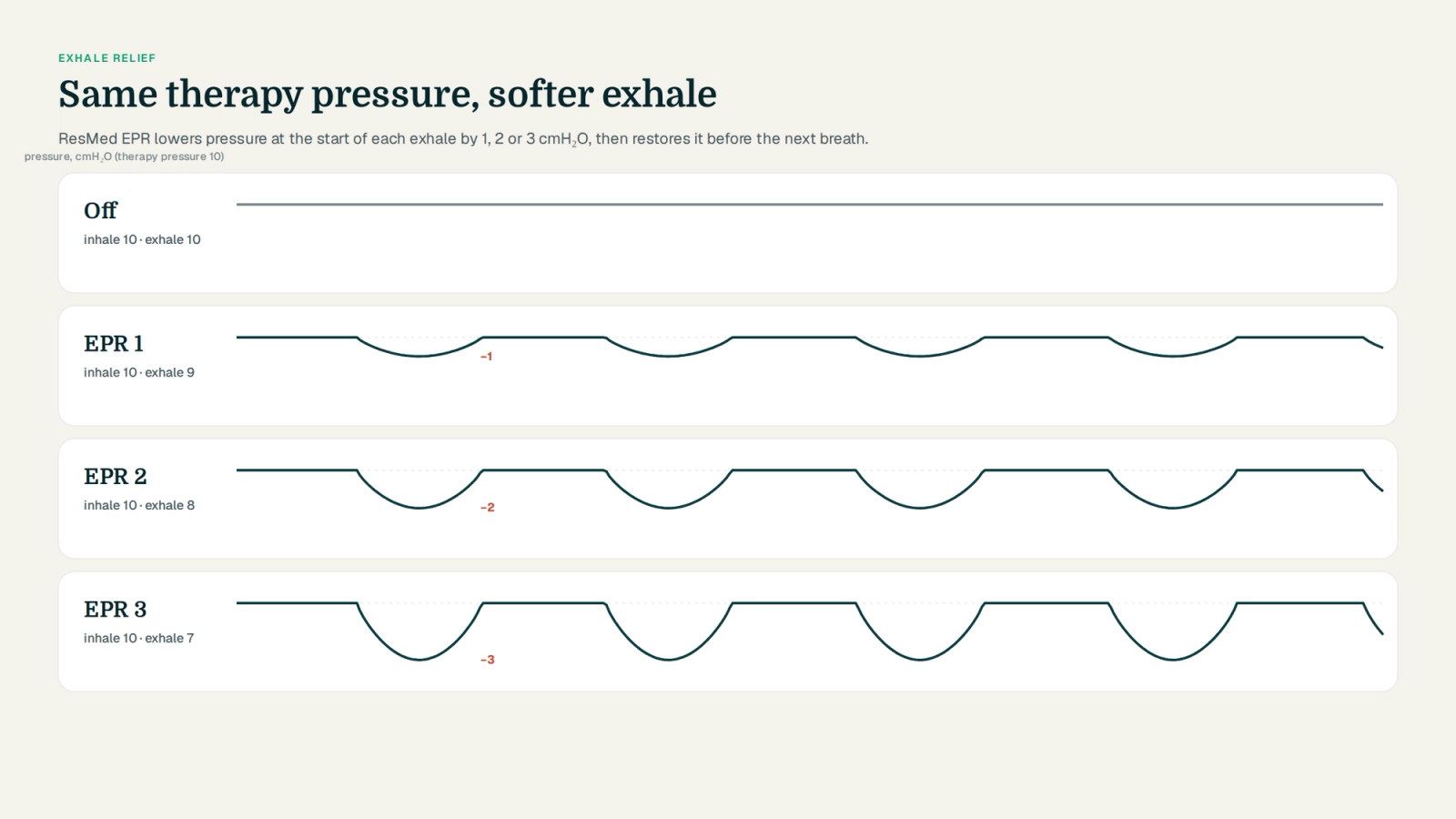
Breathing out against pressure is the thing most new CPAP users dislike. Inhaling with the machine's help feels natural; exhaling into a steady 12 cmH₂O feels like blowing up a balloon all night. Many people who abandon therapy early do it in the first weeks, and exhale discomfort is a leading reason.
Exhale relief lowers the pressure at the start of each exhale, then restores it before the next inhale. The airway is held open when it most needs holding, at the end of exhale and the start of inhale, while the effort of breathing out is reduced.
EPR stands for expiratory pressure relief. It has four settings: Off, 1, 2 and 3. The number is the drop in cmH₂O on exhale. With a therapy pressure of 10 and EPR 3, you inhale at 10 and exhale at 7.
Two further options control when it applies:
Full time: EPR works all night.
Ramp only: EPR works during the ramp period and switches off once therapy pressure is reached.
A detail that matters: EPR cannot take the exhale pressure below the machine's minimum of 4 cmH₂O. If your minimum pressure is set to 5 and EPR is 3, the actual relief at the bottom of your range is only 1 cmH₂O. Some clinicians raise the minimum pressure when enabling EPR for this reason.
EPR is available on the AirSense 10 and 11 in CPAP and AutoSet modes. On AirCurve bilevel machines the equivalent concept is pressure support, which is a therapy setting rather than a comfort one.
Philips uses several Flex variants depending on machine and mode:
C-Flex reduces pressure at the start of exhale in fixed CPAP mode, by a level of 1 to 3. Unlike EPR, the level is not a fixed cmH₂O drop; the amount of relief scales with how hard you exhale.
C-Flex+ adds a softer transition from inhale to exhale.
A-Flex is the equivalent in auto mode, smoothing both the inhale-to-exhale and exhale-to-inhale transitions.
Bi-Flex is the bilevel version.
P-Flex is a newer variant on some DreamStation 2 models.
Because Flex adjusts proportionally to flow rather than by a fixed amount, a Philips user and a ResMed user with "level 2" are not getting the same thing. Apnealytics reads Philips DreamStation 1 and 2 as well, and shows the Flex level where EPR appears for ResMed cards.
Mostly, but not entirely. Three things can change when EPR is on.
Effective pressure drops. For part of each breath you are at a lower pressure than your setting. For most people the airway stays open because it is most vulnerable at the end of exhale, when pressure is already climbing back. For some people, particularly at higher EPR levels, residual events rise a little. Studies on the question are mixed; the honest summary is that the effect is small on average and varies between individuals.
Flow limitation can appear or worsen. Flow limitation, the flattening of the inspiratory flow curve, is sensitive to small pressure changes. Some people see more flow limitation at the start of inhale with EPR on, because the pressure is still recovering from the exhale dip. See flow limitation explained.
Leak can change. Lower average pressure can reduce leak for people whose mask lets go at higher pressures. Conversely, some people find the pressure swing itself disturbs the seal. Watch your leak P95 after any EPR change.
Because EPR interacts with your therapy pressure, it is listed in the clinical settings on ResMed machines. It is a setting to discuss with your clinician rather than flip casually.
Some experienced users find that lowering or turning off EPR improves their AHI or reduces flow limitation, and prefer to adapt to the exhale feel. Others find EPR 3 is what makes therapy tolerable, and a slightly higher residual is a trade they accept. Neither choice is wrong, and both should involve the person who prescribed your therapy. What matters is that you can see the effect of the change rather than guess at it.
Your ResMed machine writes the EPR level to the SD card with each night's settings. Apnealytics reads it and shows it on the dashboard pressure tile beside your P95 and set range.
More useful is what happens when it changes. The "What changed?" panel in Trends marks the date EPR moved from one level to another, so you can compare AHI, flow limitation, leak and usage in the 30 nights before and after. Period-over-period comparison does the arithmetic for you.
On Pro, the pressure trace in the breath-by-breath viewer makes EPR visible breath by breath: the pressure line drops by your EPR amount on each exhale and recovers before the next inhale. If the dips look larger or smaller than your setting, the minimum-pressure floor may be clipping it. Put the airflow trace beside it and you can see whether the start of each inhale is clean or flattened.
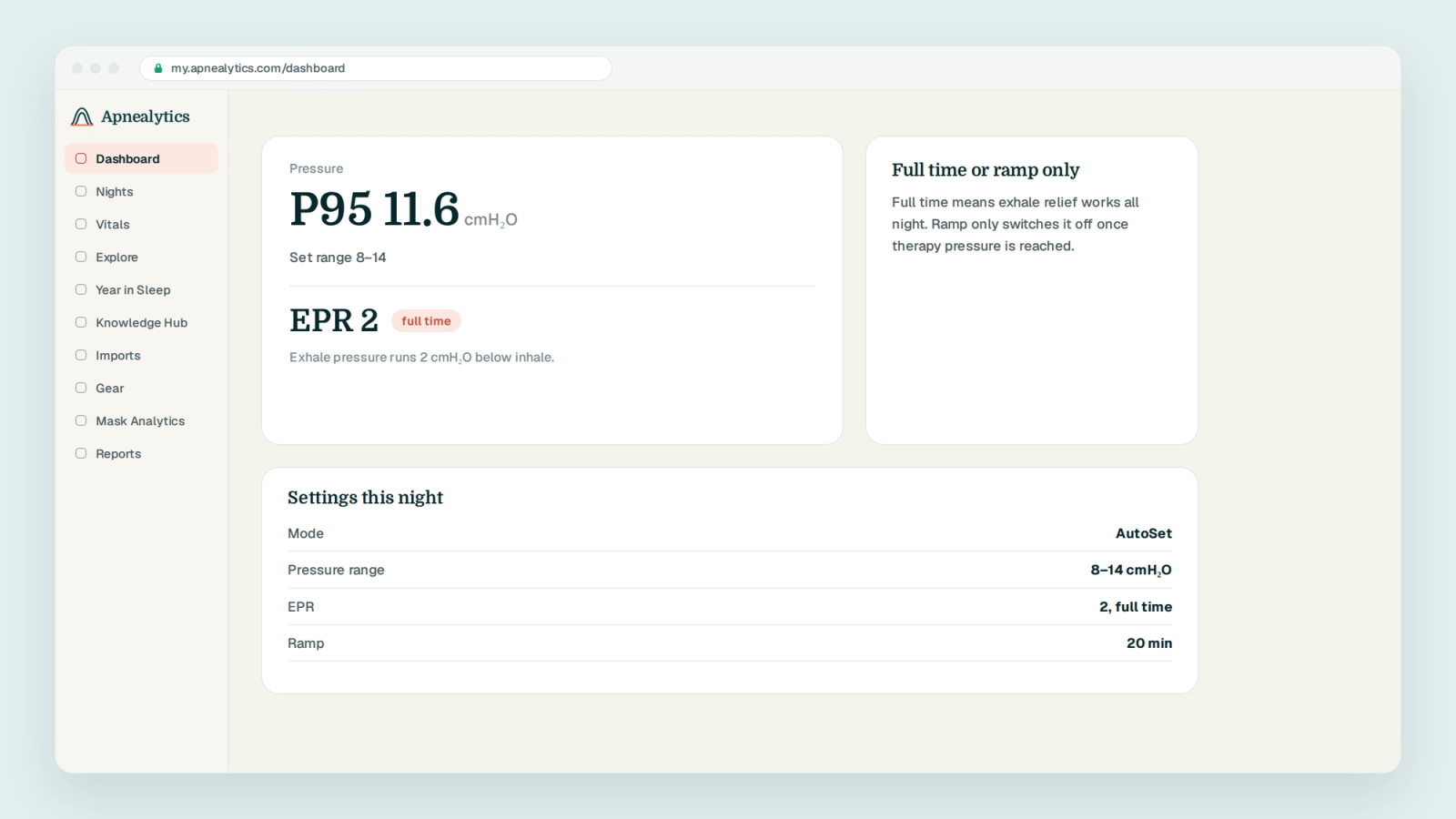
Would you expect my EPR level to be affecting my residual AHI?
My flow limitation looks higher at the start of each breath. Could EPR be contributing?
If I turn EPR down for comfort reasons, should my minimum pressure change?
EPR, expiratory pressure relief, lowers the pressure by 1, 2 or 3 cmH₂O each time you exhale and restores it for the next inhale. It makes breathing out feel easier. It can be set to work all night or only during ramp. Because it changes the pressure at your airway for part of each breath, it is listed as a clinical setting.
That is a conversation with your clinician. Higher levels feel more comfortable to most people but can slightly increase residual events or flow limitation in some. Many people do well on EPR 2 or 3; others find turning it down improves their numbers. The right level is the one that keeps you using therapy with an AHI you and your clinician are happy with.
It can, a little, for some people. Lowering pressure on exhale means part of each breath is at a pressure below your setting, and in some people that lets a few more events through or increases flow limitation. For many users there is no measurable effect. Comparing your AHI trend before and after an EPR change is the only way to know for you.
EPR is ResMed's feature and drops pressure by a fixed 1, 2 or 3 cmH₂O on exhale. C-Flex, A-Flex and the other Flex variants are Philips features that reduce exhale pressure in proportion to how hard you breathe out, so the relief varies breath to breath. Level 2 on one brand is not the same as level 2 on the other.
ResMed machines cannot deliver exhale pressure below 4 cmH₂O. If your minimum pressure is 5 and EPR is 3, the machine can only drop to 4, giving 1 cmH₂O of actual relief while you are at the bottom of your range. As pressure rises through the night, the full EPR amount becomes available. Your clinician may adjust the minimum to account for this.
The web app is live today. iPhone and iPad are on the App Store. Android is on Google Play. Your first 30 nights are free, forever.
 DashboardSleep Score, AHI band, leak and pressure
 Trends & historyA year down to a night
 Breath-by-breath viewerAirflow, pressure, leak tracesPro
 SpO₂ overlayOximeter data on the same nightPro
 Pressure insightsP95, set range, EPR and ramp
 SD card importDrop the card folder, only new nights added
 Mask fit & gearWhich mask actually seals
 Ask your dataPlain-English questions, your own AI keyBYOK
 Year in SleepYour therapy year in one storyNew
 Compliance reportFinds the qualifying window for youPro
 Share with your doctorRead-only, revocable links
 Companion appiPhone, iPad and Android
 Privacy & securityYour data, locked to you
 ResMed AirSense 10 & 11Supported
 ResMed AirCurve 10 & 11 VAutoSupported
 ResMed S9 / LumisSupported
 Philips DreamStation 1 & 2Supported
 Fisher & Paykel SleepStyleSupported
 Löwenstein / DeVilbissPartial
 React Health Luna G3Waitlist
 Transcend MicroWaitlist
 Full face masksFit, leak signature, Mask Analytics
 Nasal masksOver-nose and cradle styles
 Nasal pillowsMinimal-contact fit tips
 Wellue O2RingSupported
 Contec CMS50 familySupported
 Apple Health / Health ConnectResting HR, HRV, SpO₂, sleepSupported
 What is AHI?The apnea-hypopnea index, explained
 What is a good AHI on CPAP?
 CPAP leak rate explained
 Pressure settings explained
 Reading CPAP waveformsAll 14 explainers
 Apnealytics vs SleepHQ
 Apnealytics vs OSCAR
 Apnealytics vs myAir
 Apnealytics vs DreamMapper
 SleepHQ vs OSCARBest CPAP apps in 2026
 How to read CPAP dataStart here: six numbers, in order
 Read your CPAP SD card
 Share data with your doctorChoosing a CPAP mask
 Travel with CPAPAll guides
 Mask finderSeven questions, a ranked mask typeYour data
 Machine finderA two-machine shortlist for your prescription
 iPhone / iPhone DuoLast night before you are out of bed. Apple Health vitals, Face ID.Live
 iPadSame universal app, side-by-side panes and full-width waveforms.Live
 AndroidPhones, tablets and foldables, with Health Connect built in.Live
 Web portalWhere your SD card goes. Every chart, report and setting.Live

