



iPhone / iPhone Duo Live
Last night before you are out of bed. Apple Health vitals, Face ID.
Download on the App Store Apnealytics
Free on every plan: unlimited imports, the full dashboard and your last 30 nights.
 Compatibility checkerWill my machine work?Type your model. You get a straight answer: supported, partial, waitlist, or why not.Check my machine
 If it writes an SD card, we probably read it. ResMed AirMini has no card, so no app can read it.
Sleep Check-up
3 of 6 checks done
Six short screeners, one picture of how you sleep. Earn a milestone for each, save results and get retake reminders.
Latest milestone: Sleepiness check done
 NEWTrack your 90-day compliance windowOpen the calculator
 13 free tools. No account needed — sign in to save results and fill answers from your own CPAP data.
Last night before you are out of bed. Apple Health vitals, Face ID.
Download on the App Store


One account on every screen. Apple Watch vitals sync through Apple Health.
Flow limitation is a breath where air is still moving, but the airway is narrowed enough that the flow stops rising the way it should. On a waveform it looks like a breath with the top chopped off. It does not count toward your AHI, yet it is one of the main signals an auto CPAP uses to decide when to raise pressure, and it can leave you tired even when your AHI is low.
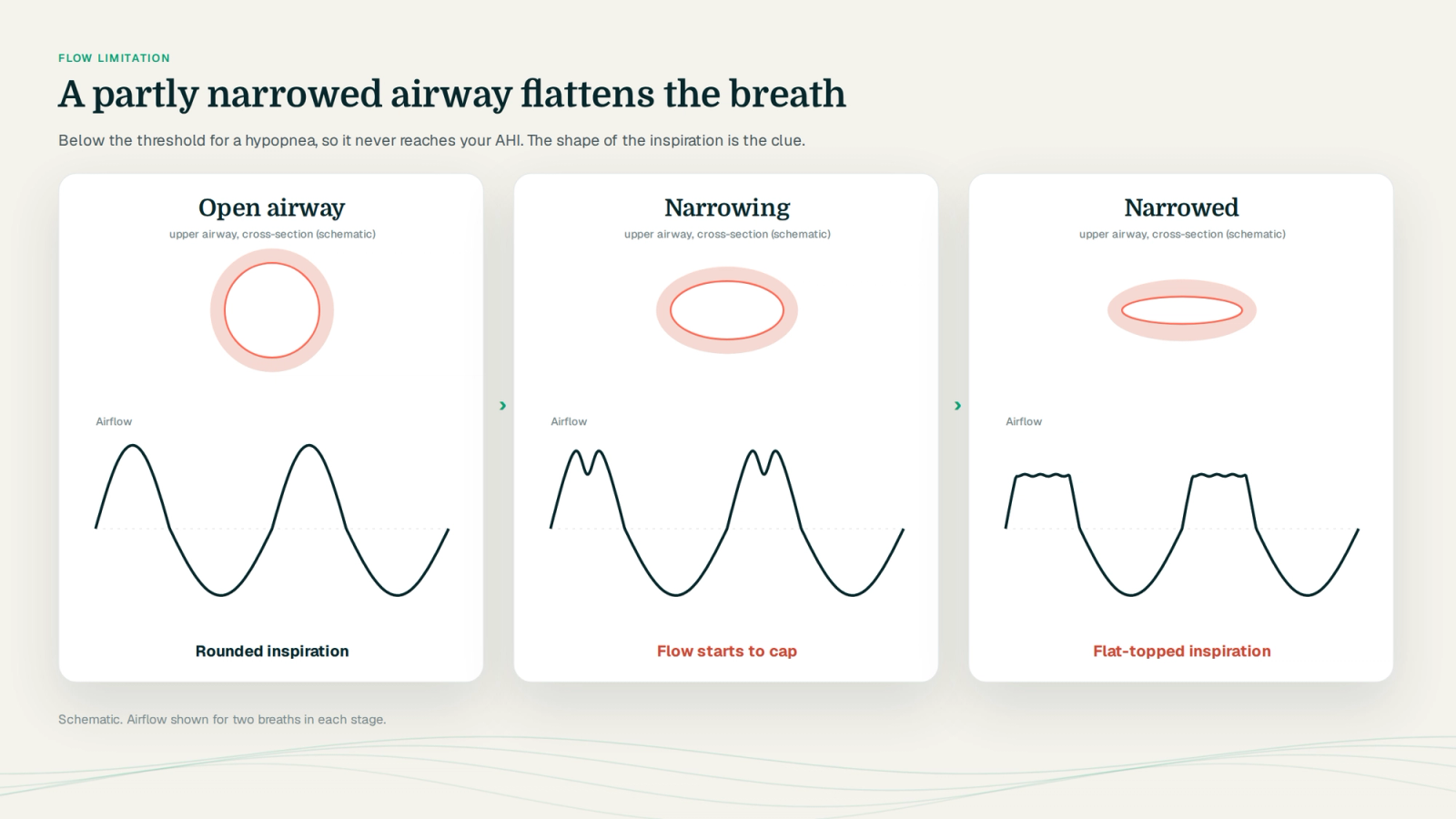
Picture the airflow trace from your CPAP: a wave that rises as you inhale and falls as you exhale. A normal inhale is rounded, a bit like the top half of a sine wave. Flow builds smoothly, peaks around the middle of the breath, and eases off.
That rounded shape happens because the airway is open and offers steady resistance. The harder you pull, the more air comes in.
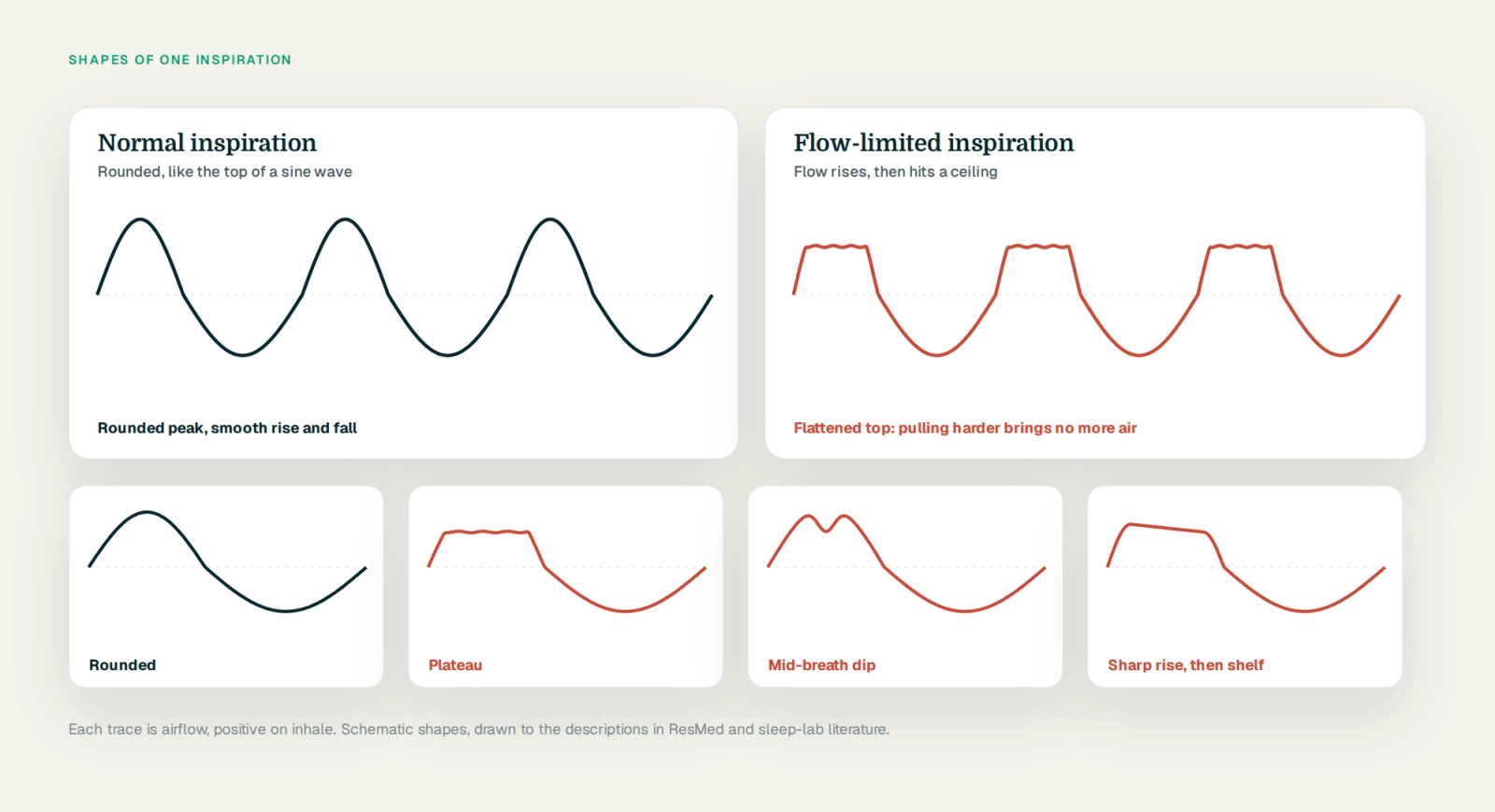
When the upper airway is partially narrowed, something different happens. As you pull harder, the soft tissue is drawn inward and the airway narrows further. Flow rises at first, then hits a ceiling: pulling harder no longer brings in more air. The top of the inspiratory wave flattens into a plateau. In more pronounced cases it develops a dip in the middle or a sharp rise followed by a flat shelf.
That flattening is flow limitation. The breath is still a breath, so there is no apnea and often no hypopnea. But it is a breath taken through a straw, and the effort it costs can lighten your sleep or wake you briefly without you ever knowing.
The apnea-hypopnea index counts events that cross defined thresholds: airflow down 90 percent for an apnea, down a set percentage for a hypopnea. Flow limitation sits below those thresholds. A night full of flow-limited breathing can score an AHI of 1.
But flow limitation is associated with increased breathing effort, and increased effort is associated with arousals, the brief shifts toward wakefulness that fragment sleep. In the sleep-medicine literature, runs of flow-limited breaths that end in an arousal are called respiratory effort-related arousals, or RERAs, and they are counted in a broader index called the RDI (respiratory disturbance index). Your CPAP cannot see arousals, so it cannot score RERAs. It can, however, see the flattened breaths.
This is one of the explanations when someone has a residual AHI under 2 and still feels unrefreshed. It is not the only explanation, and it is a conversation for your clinician, but it is one worth having with the waveforms in hand.
ResMed's AutoSet algorithm analyses the shape of each inspiratory flow curve and derives a flow limitation measure, reported on the SD card as a per-breath or per-interval index. The flatter the top of the breath, the higher the value.
The algorithm responds to three things when deciding to raise pressure: flow limitation, snoring and obstructive apnea. Flow limitation is the earliest and gentlest of the three, so in practice it drives much of the pressure movement on an auto machine during a typical night. When the machine sees a run of flattened breaths it nudges pressure up; when the breaths round out again it lets pressure drift down.
The AutoSet for Her mode uses a variant that responds more readily to flow limitation and raises pressure in smaller steps, on the basis that women with sleep apnea tend to have more flow limitation and fewer frank apneas.
This is why your pressure P95 can sit well above your minimum on a night with very few events. The machine was not chasing apneas; it was chasing flow limitation.
A small amount of flow limitation on most nights is normal and does not need action. The patterns that tend to prompt a clinical conversation are:
Flow limitation that stays elevated most of the night while pressure sits at or near the minimum. The machine may be slow to respond, or the floor may be low.
Flow limitation rising with every EPR increase.
Clusters of flattened breaths followed by a sigh or a large recovery breath, which is what an arousal can look like on the flow trace.
Flow limitation that tracks your trigger journal: wine, late meals, pollen season.
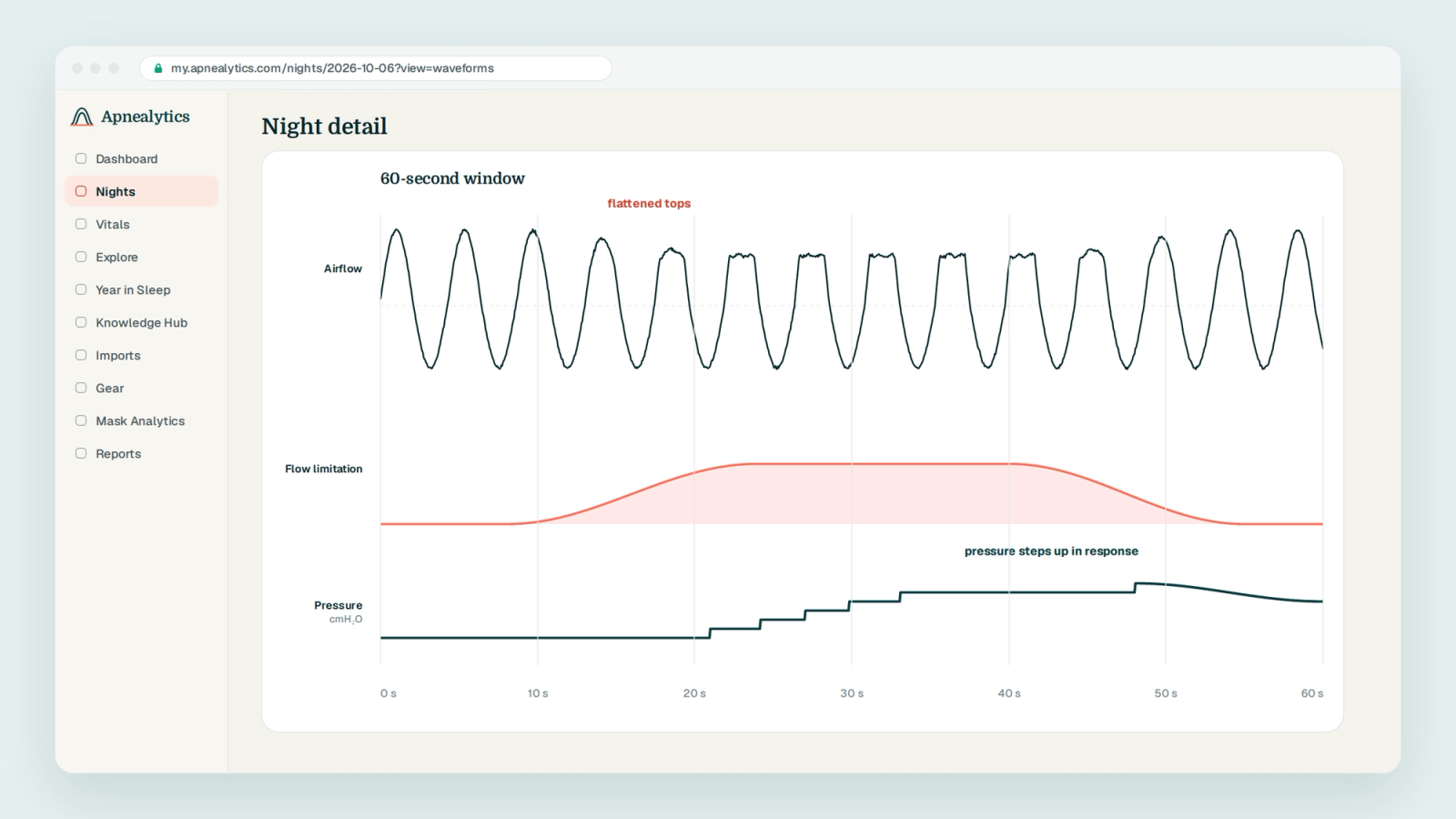
Flow limitation is a Pro feature in Apnealytics because it lives in the high-resolution data. The per-night breath-by-breath viewer shows the airflow trace with a crosshair and zoom, so you can step through individual breaths and see their shape. Where the SD card provides a flow limitation channel, it is drawn as a strip below the airflow so you can see the machine's own assessment line up with the flattened breaths.
Put the pressure trace beside it and the AutoSet logic becomes visible: flow limitation climbs, pressure follows a few breaths later, breaths round out, pressure eases. If pressure does not follow, you are probably looking at the ceiling of your range, or at central-looking events the machine has chosen not to chase.
The pressure insights page in Trends is where the nightly picture lives: pressure P95 inside the set range, with "What changed?" markers on settings changes so you can see whether a change in EPR or minimum pressure moved your flow limitation.
Nothing on your own. Flow limitation is a reason to talk to your clinician with specific evidence: a few screenshots of flattened breaths, the nights they appeared on, and your AHI, leak and pressure for context. The usual clinical responses, a higher minimum pressure, a change in EPR, a nasal review, are theirs to make.
What you can do yourself is notice. People who learn to recognise the flattened breath shape stop being puzzled by tired mornings with a perfect AHI, and start having a more productive conversation about why.
Flow limitation is a breath where the airway is partially narrowed, so airflow stops increasing even as you inhale harder. On the airflow waveform the top of the inhale flattens into a plateau instead of a rounded peak. It does not count as an apnea or hypopnea, but ResMed auto machines use it as a primary signal for raising pressure.
No. AHI counts apneas and hypopneas, which require airflow to drop by defined amounts for at least 10 seconds. Flow-limited breaths move too much air to qualify. In a sleep lab, flow limitation that ends in an arousal is scored as a RERA and counted in the RDI, but a CPAP machine cannot see arousals, so it reports flow limitation separately.
It can contribute. Flow-limited breathing requires more effort, and increased breathing effort is associated with brief arousals that fragment sleep without producing scorable events. If your AHI is low and you still wake unrefreshed, flow limitation is one of several things worth reviewing with your clinician, along with usage hours, leak and other sleep factors.
The AutoSet algorithm analyses the shape of each inspiratory flow curve and raises pressure when it detects a run of flattened breaths, then gradually lowers it when breathing normalises. Along with snoring and obstructive apneas, flow limitation is one of the three triggers for pressure increase, and in practice drives much of the pressure movement on a typical night.
It can increase it for some people. EPR lowers pressure on exhale, so each inhale begins from a lower pressure, and in some users the start of the breath shows more flattening as a result. Many people see no difference. Comparing your flow limitation and pressure data before and after an EPR change, with your clinician, is the way to find out whether it affects you.
The web app is live today. iPhone and iPad are on the App Store. Android is on Google Play. Your first 30 nights are free, forever.
 DashboardSleep Score, AHI band, leak and pressure
 Trends & historyA year down to a night
 Breath-by-breath viewerAirflow, pressure, leak tracesPro
 SpO₂ overlayOximeter data on the same nightPro
 Pressure insightsP95, set range, EPR and ramp
 SD card importDrop the card folder, only new nights added
 Mask fit & gearWhich mask actually seals
 Ask your dataPlain-English questions, your own AI keyBYOK
 Year in SleepYour therapy year in one storyNew
 Compliance reportFinds the qualifying window for youPro
 Share with your doctorRead-only, revocable links
 Companion appiPhone, iPad and Android
 Privacy & securityYour data, locked to you
 ResMed AirSense 10 & 11Supported
 ResMed AirCurve 10 & 11 VAutoSupported
 ResMed S9 / LumisSupported
 Philips DreamStation 1 & 2Supported
 Fisher & Paykel SleepStyleSupported
 Löwenstein / DeVilbissPartial
 React Health Luna G3Waitlist
 Transcend MicroWaitlist
 Full face masksFit, leak signature, Mask Analytics
 Nasal masksOver-nose and cradle styles
 Nasal pillowsMinimal-contact fit tips
 Wellue O2RingSupported
 Contec CMS50 familySupported
 Apple Health / Health ConnectResting HR, HRV, SpO₂, sleepSupported
 What is AHI?The apnea-hypopnea index, explained
 What is a good AHI on CPAP?
 CPAP leak rate explained
 Pressure settings explained
 Reading CPAP waveformsAll 14 explainers
 Apnealytics vs SleepHQ
 Apnealytics vs OSCAR
 Apnealytics vs myAir
 Apnealytics vs DreamMapper
 SleepHQ vs OSCARBest CPAP apps in 2026
 How to read CPAP dataStart here: six numbers, in order
 Read your CPAP SD card
 Share data with your doctorChoosing a CPAP mask
 Travel with CPAPAll guides
 Mask finderSeven questions, a ranked mask typeYour data
 Machine finderA two-machine shortlist for your prescription
 iPhone / iPhone DuoLast night before you are out of bed. Apple Health vitals, Face ID.Live
 iPadSame universal app, side-by-side panes and full-width waveforms.Live
 AndroidPhones, tablets and foldables, with Health Connect built in.Live
 Web portalWhere your SD card goes. Every chart, report and setting.Live

