



iPhone / iPhone Duo Live
Last night before you are out of bed. Apple Health vitals, Face ID.
Download on the App Store Apnealytics
Free on every plan: unlimited imports, the full dashboard and your last 30 nights.
 Compatibility checkerWill my machine work?Type your model. You get a straight answer: supported, partial, waitlist, or why not.Check my machine
 If it writes an SD card, we probably read it. ResMed AirMini has no card, so no app can read it.
Sleep Check-up
3 of 6 checks done
Six short screeners, one picture of how you sleep. Earn a milestone for each, save results and get retake reminders.
Latest milestone: Sleepiness check done
 NEWTrack your 90-day compliance windowOpen the calculator
 13 free tools. No account needed — sign in to save results and fill answers from your own CPAP data.
Last night before you are out of bed. Apple Health vitals, Face ID.
Download on the App Store


One account on every screen. Apple Watch vitals sync through Apple Health.
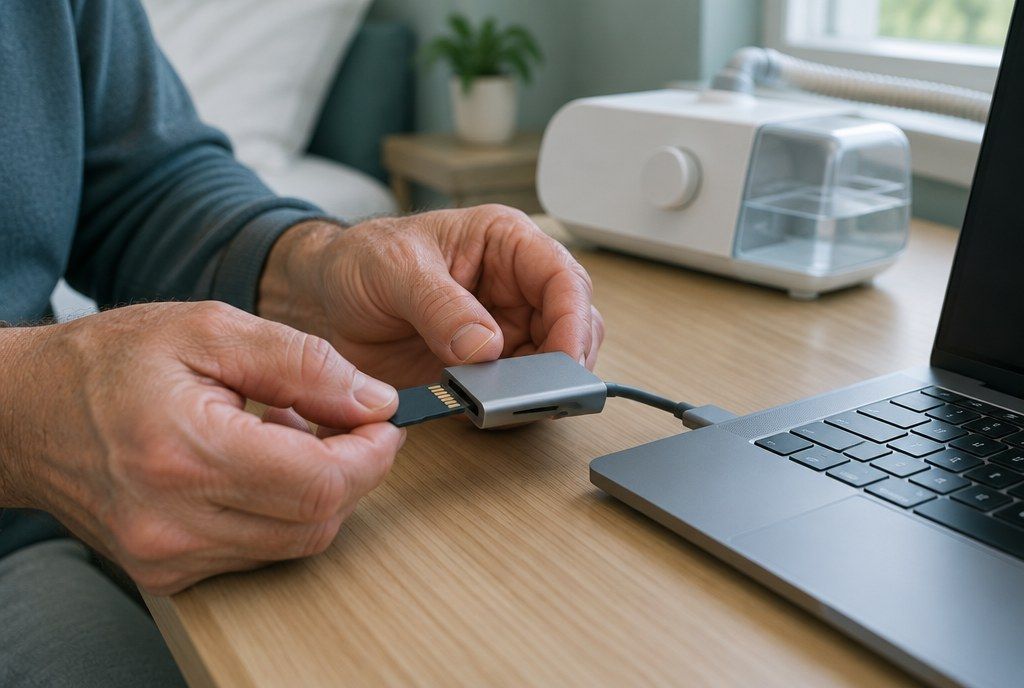
Any standard SD card reader works for a ResMed CPAP card. The card is an ordinary full-size SD card, so a laptop's built-in slot or a basic USB reader costing a few dollars is all you need. There is nothing special to buy.
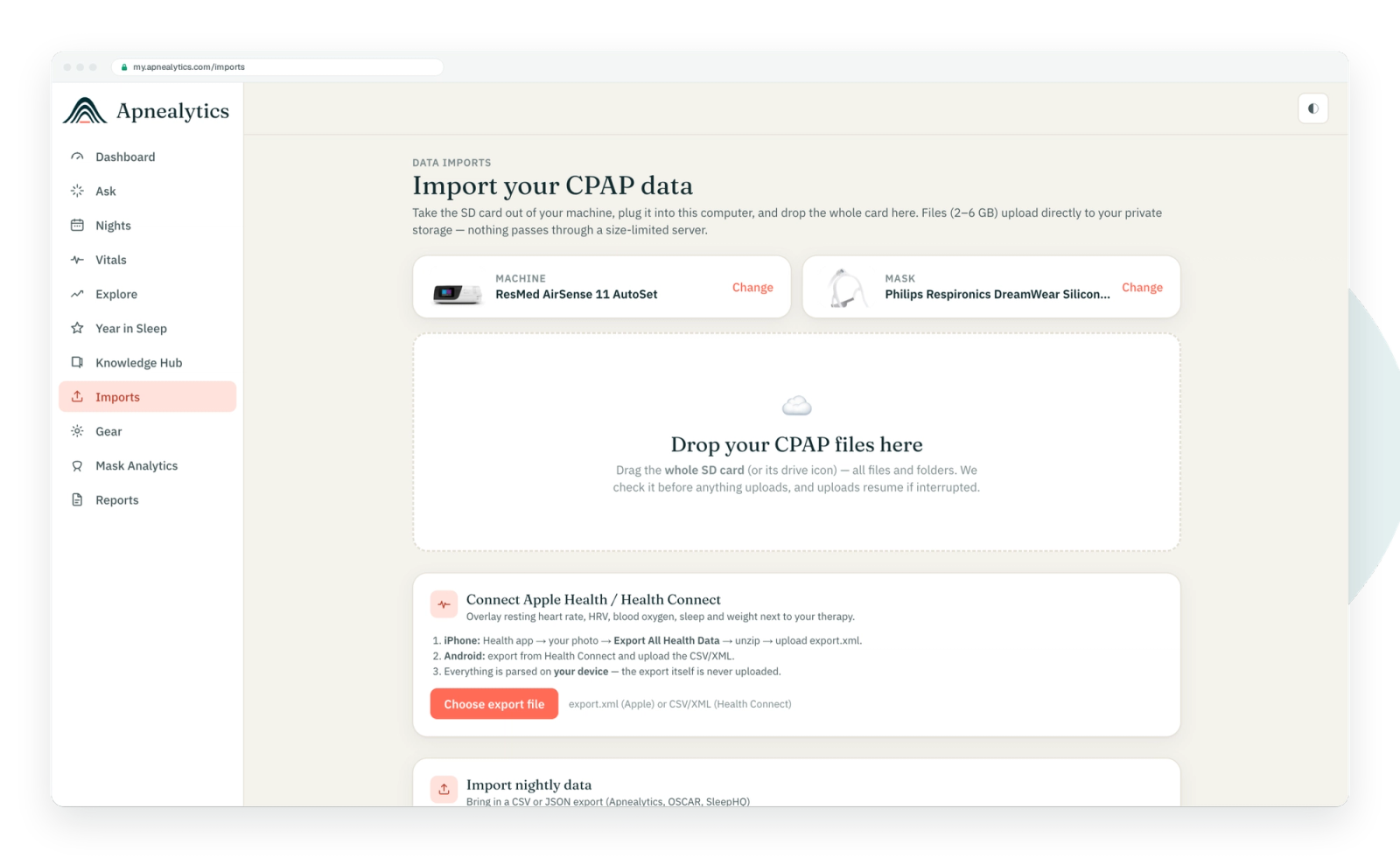
ResMed machines use a full-size SD card, not microSD. Most readers accept both; make sure yours has the larger slot. If you only have a microSD reader, it will not fit.
A reader with both plugs, or a small adapter, saves a return trip.
If your laptop has an SD slot, use it. Nothing else is needed.
Card files are large (2 to 6 GB on a well-used card) but your internet connection is the bottleneck, not the reader. Any USB 2.0 or faster reader is fine.
A reader with both plugs, or a small adapter, saves a return trip.
If your laptop has an SD slot, use it. Nothing else is needed.
Card files are large (2 to 6 GB on a well-used card) but your internet connection is the bottleneck, not the reader. Any USB 2.0 or faster reader is fine.
Any brand-name USB SD reader. We do not sell or recommend specific products, and we do not take affiliate commissions.
Phone-only readers marketed for Lightning or USB-C phones. Card import is on the web portal, so the reader needs to be on a computer.
Readers that mount the card read-only by default. Harmless for upload, but confusing if you later need to fix the write-lock issue.
Cheap no-name readers that drop the connection partway. The uploader resumes, but it is slower than it needs to be.
While the card is out, look at the long edge. The small slider should be away from LOCK. Apnealytics only reads from the card, so the position does not affect upload, but a locked card back in the machine means nothing is recorded tonight.
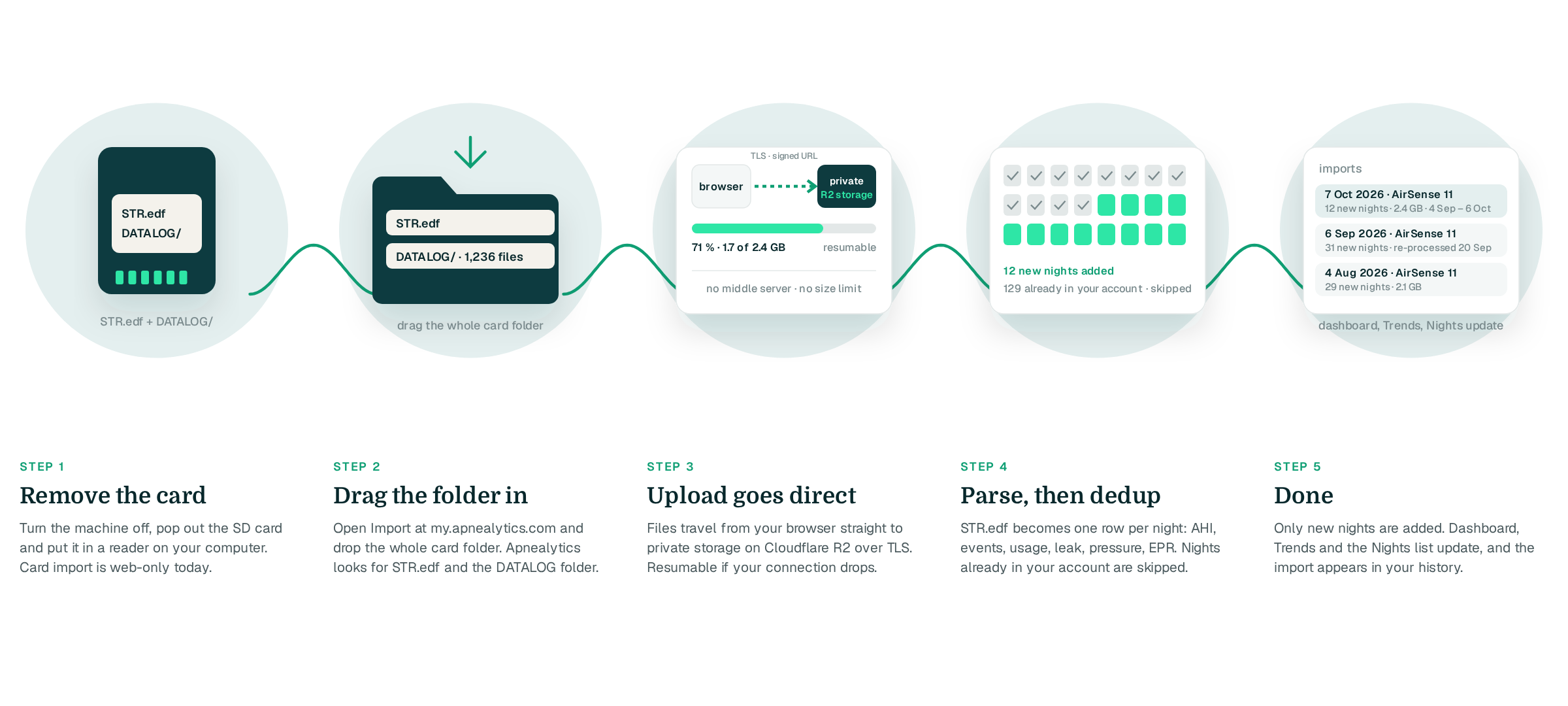
All work. Open my.apnealytics.com in Chrome, Edge, Safari or Firefox, choose Import and pick the card's folder. Do not open or edit the files on the card; just upload the folder.
Carry the card in the reader, not loose in a pocket. Put it back in the machine as soon as the upload finishes. If you lose it, your machine records nothing until you replace it.
No. ResMed cards are standard full-size SD cards. A laptop's built-in slot or any USB SD reader works. Check that it has the full-size slot (not only microSD) and the right plug, USB-C or USB-A, for your computer.
Yes. Use the built-in slot on Macs that have one, or a USB-C SD reader. Open my.apnealytics.com in Safari or Chrome, go to Import and select the card's folder. Do not let macOS "repair" or reformat the card if prompted; eject and reinsert instead.
Not for Apnealytics today. Card import is web-only because the files are large and need a resumable folder upload. Use a computer. The iPhone and Android apps show everything after the upload and import CSV and JSON exports.
A standard full-size SD card. Capacity requirements come from ResMed. If you replace the card, upload the old one first so you keep its nights.
Write to info@apnealytics.com with what you tried and we will get back to you within a day.
 DashboardSleep Score, AHI band, leak and pressure
 Trends & historyA year down to a night
 Breath-by-breath viewerAirflow, pressure, leak tracesPro
 SpO₂ overlayOximeter data on the same nightPro
 Pressure insightsP95, set range, EPR and ramp
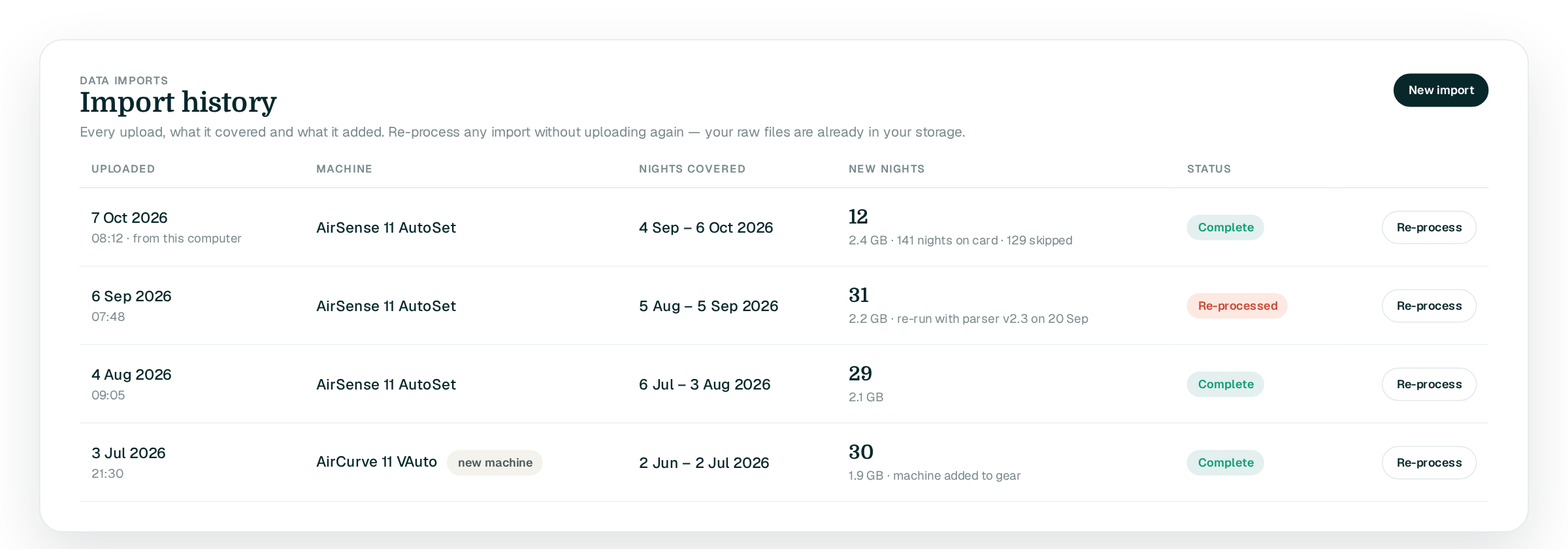
 SD card importDrop the card folder, only new nights added
 Mask fit & gearWhich mask actually seals
 Ask your dataPlain-English questions, your own AI keyBYOK
 Year in SleepYour therapy year in one storyNew
 Compliance reportFinds the qualifying window for youPro
 Share with your doctorRead-only, revocable links
 Companion appiPhone, iPad and Android
 Privacy & securityYour data, locked to you
 ResMed AirSense 10 & 11Supported
 ResMed AirCurve 10 & 11 VAutoSupported
 ResMed S9 / LumisSupported
 Philips DreamStation 1 & 2Supported
 Fisher & Paykel SleepStyleSupported
 Löwenstein / DeVilbissPartial
 React Health Luna G3Waitlist
 Transcend MicroWaitlist
 Full face masksFit, leak signature, Mask Analytics
 Nasal masksOver-nose and cradle styles
 Nasal pillowsMinimal-contact fit tips
 Wellue O2RingSupported
 Contec CMS50 familySupported
 Apple Health / Health ConnectResting HR, HRV, SpO₂, sleepSupported
 What is AHI?The apnea-hypopnea index, explained
 What is a good AHI on CPAP?
 CPAP leak rate explained
 Pressure settings explained
 Reading CPAP waveformsAll 14 explainers
 Apnealytics vs SleepHQ
 Apnealytics vs OSCAR
 Apnealytics vs myAir
 Apnealytics vs DreamMapper
 SleepHQ vs OSCARBest CPAP apps in 2026
 How to read CPAP dataStart here: six numbers, in order
 Read your CPAP SD card
 Share data with your doctorChoosing a CPAP mask
 Travel with CPAPAll guides
 Mask finderSeven questions, a ranked mask typeYour data
 Machine finderA two-machine shortlist for your prescription
 iPhone / iPhone DuoLast night before you are out of bed. Apple Health vitals, Face ID.Live
 iPadSame universal app, side-by-side panes and full-width waveforms.Live
 AndroidPhones, tablets and foldables, with Health Connect built in.Live
 Web portalWhere your SD card goes. Every chart, report and setting.Live

