


iPhone / iPhone Duo Live
Last night before you are out of bed. Apple Health vitals, Face ID.
Download on the App Store Apnealytics™
Free on every plan: unlimited imports, the full dashboard and your last 30 nights.
 Compatibility checkerWill my machine work?Type your model. You get a straight answer: supported, waitlist, or why not.Check my machine
If it writes an SD card, we probably read it. ResMed AirMini has no card, so no app can read it.
Sleep Check-up
3 of 6 checks done
Six short screeners, one picture of how you sleep. Earn a milestone for each, save results and get retake reminders.
Latest milestone: Sleepiness check done
 NEWTrack your 90-day compliance windowOpen the calculator
13 free tools. No account needed — sign in to save results and fill answers from your own CPAP data.
Last night before you are out of bed. Apple Health vitals, Face ID.
Download on the App StoreOne account on every screen. Apple Watch vitals sync through Apple Health.
How a CPAP machine works, CPAP vs APAP vs BiPAP vs ASV, the features worth comparing, prescription and insurance basics, and what your machine records.
Part ofHow to Read CPAP Data
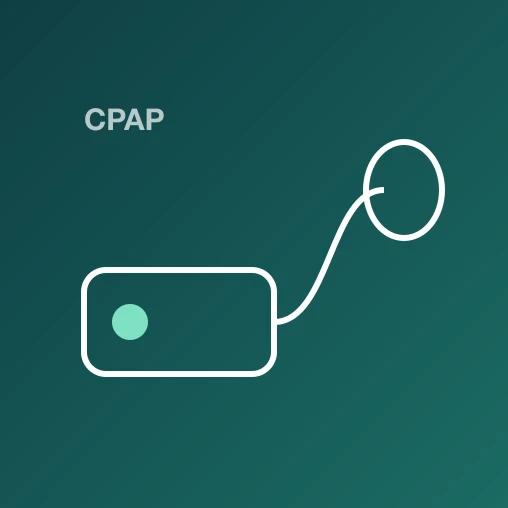
A CPAP machine, hose and mask: pressurised air acts as a splint that keeps the airway open.
A sleep apnea machine is a positive airway pressure (PAP) device. It blows gently pressurized air through a tube and mask to keep your airway open while you sleep [2][3]. Most people with obstructive sleep apnea use a CPAP or auto-adjusting CPAP (APAP), and in the US these machines need a prescription [1][8][9].
Your clinician picks the machine type and pressure. Your choices are mostly about comfort: humidification, noise, size, data, and above all the mask.
Below: how the machines work, the main types, the specs worth comparing, and what your machine records.
A CPAP machine takes in room air, filters it, and pressurizes it. It then sends that air through a hose into your mask [3]. The steady pressure acts like an air splint. It stops the tongue, uvula, and soft palate from collapsing into the airway during sleep [3].
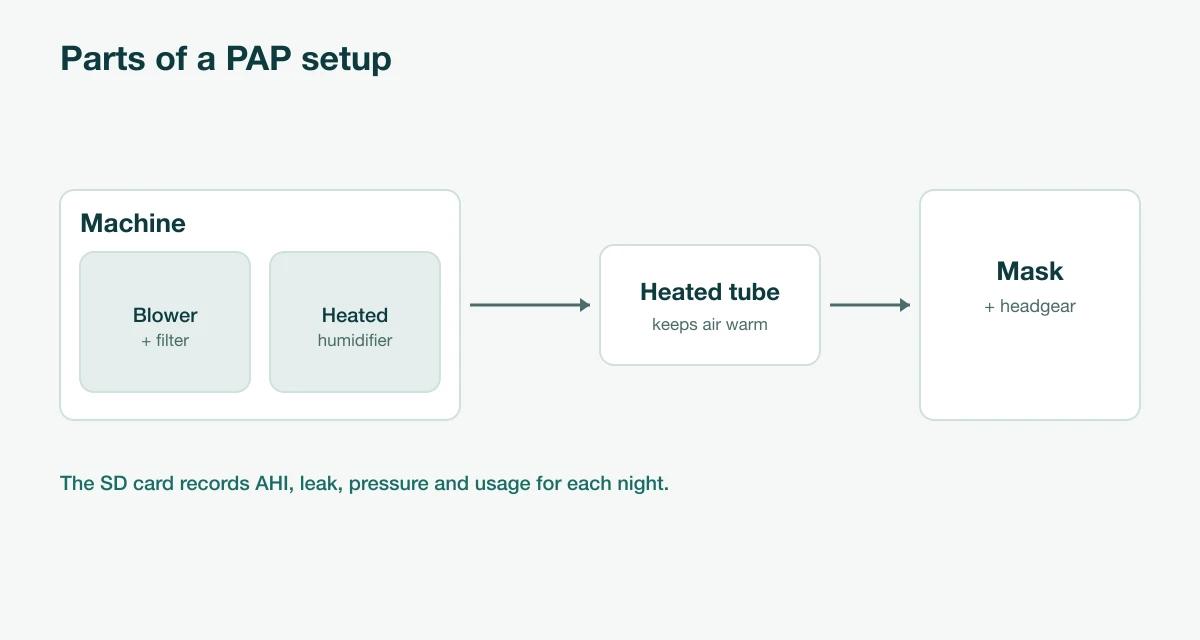
The basic parts are simple [2][3]:
Pressure is measured in centimeters of water (cm H2O). The four machines we compare below all run between 4 and 20 cm H2O [9][11][12][14]. Your clinician sets your pressure or pressure range. Never change it yourself. Our guide to CPAP pressure settings explains what the numbers mean.
There are four main types. They differ in how they deliver pressure, which decides who each is for.
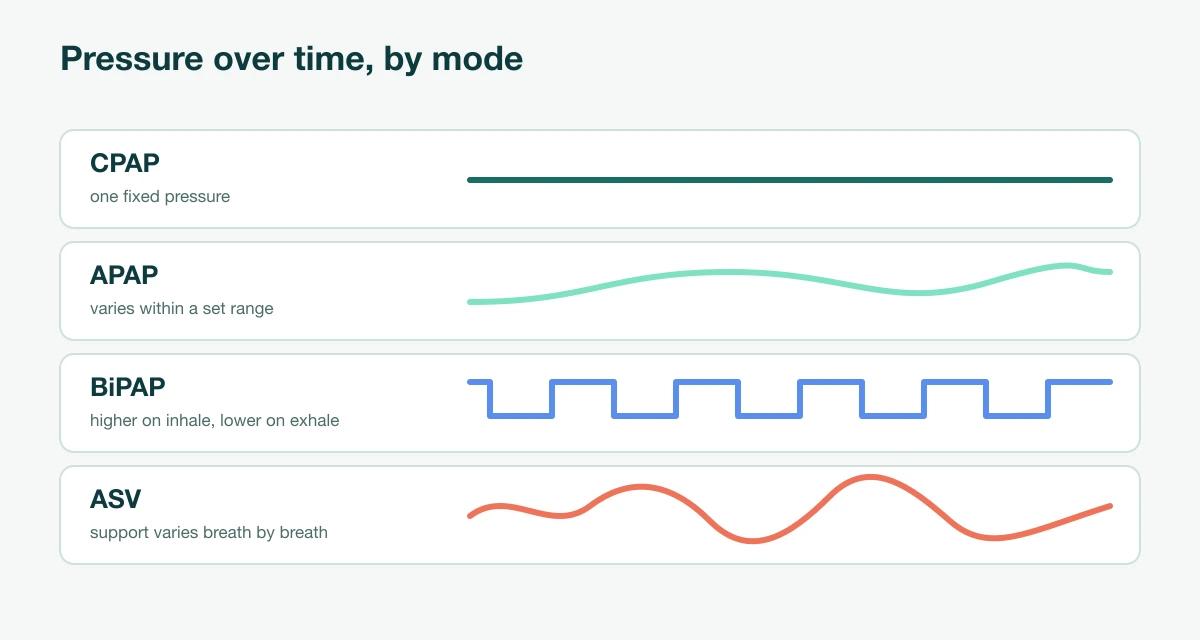
| Type | How pressure works | Typically prescribed for |
|---|---|---|
| CPAP (fixed) | One steady pressure, breathing in and out [4] | Obstructive sleep apnea (OSA) [1] |
| APAP / Auto CPAP | Adjusts automatically within a range your clinician sets [3] | OSA; also used to start therapy at home [1] |
| BiPAP / Bilevel | A higher pressure when you breathe in (IPAP) and a lower one when you breathe out (EPAP) [4] | People who need two pressures, such as some with COPD, heart failure, high carbon dioxide, or central apnea [4] |
| ASV (adaptive servo-ventilation) | Senses your breathing and adds support when it detects pauses or slow breathing [5] | Central sleep apnea or "complex" sleep apnea [5] |
For most adults with OSA, the choice is between fixed CPAP and APAP. The American Academy of Sleep Medicine (AASM) 2019 guideline recommends either CPAP or APAP for ongoing treatment of OSA [1].
The same guideline recommends starting therapy with either APAP at home or an in-lab titration study, for adults with no major other conditions [1].
The AASM suggests CPAP or APAP over bilevel (BPAP) for routine OSA treatment [1]. Bilevel is usually saved for specific needs. Those include trouble breathing out against pressure, or conditions where carbon dioxide builds up in the blood [4].
ASV machines are made for central sleep apnea, where the brain does not send the signal to breathe [5]. ASV is not right for everyone. The AASM recommends against ASV for central sleep apnea linked to heart failure when the ejection fraction is 45% or lower, with moderate or severe central apnea [6]. This is a decision for your sleep and heart specialists.
If you are still unsure where you fit, start with our overview of sleep apnea treatment and talk to your clinician.
Within a given type, most machines do the same core job. The day-to-day differences are comfort and convenience.
Dry mouth, a stuffy nose, and nosebleeds are common CPAP side effects. Cleveland Clinic and NHLBI tie these mainly to dry air [2][3]. A heated humidifier helps [3][7]. A heated tube keeps the air warm on the way to your mask and cuts down on condensation, which F&P says its ThermoSmart tube is designed to reduce [14].
Check whether the humidifier is built in or a separate tub, how much water it holds, and whether it has an automatic mode. For example, the AirSense 11 offers manual levels or an automatic Climate Control mode, and the auto mode needs ResMed's heated tube [10].
Ramp starts you at a low pressure and slowly rises to your prescribed setting as you fall asleep [7]. Some machines detect sleep onset and only raise pressure after you drift off. ResMed calls this AutoRamp [10]. Philips's Ramp Plus lets you choose the starting pressure [12].
Exhale relief lowers pressure a little each time you breathe out. ResMed calls it EPR, Philips calls it Flex, and F&P calls it Expiratory Relief [10][12][14]. It is not the same as bilevel therapy.
Mayo Clinic notes that most new CPAP machines are almost silent [7]. Machines in our table are rated between about 27 and 29 dBA [9][11][14]. If your machine gets louder, Mayo Clinic suggests checking that the air filter is clean and not blocked [7].
Most current machines store therapy data and send it by cellular modem or Bluetooth to an app or your care team. Some also use an SD card or USB stick [9][12][14]. More on why this matters below.
Home machines with humidifiers weigh about 1 to 1.7 kg [9][12][14]. Travel CPAP machines are much smaller. The ResMed AirMini weighs 300 g and uses waterless humidification instead of a water tub [11]. Our guide to travelling with CPAP and your data covers the data trade-off.
This table uses only manufacturer-published figures. It is not a ranking. The right machine depends on your prescription, mask, insurance, and supplier. Sound figures come from slightly different test setups, so ignore small gaps.
| Machine | Type | Pressure range | Size and weight | Sound level | Humidification | Data and connectivity |
|---|---|---|---|---|---|---|
| ResMed AirSense 11 (AutoSet and fixed CPAP models) | APAP or CPAP [10] | 4–20 cm H2O [9] | 94.5 × 259.4 × 138.5 mm; 1,130 g with humidifier tub [9] | 27 dBA ± 2 with tub, CPAP mode [9] | Integrated heated humidifier; auto mode with heated tube [10] | SD card, cellular, Bluetooth to myAir app [9][10] |
| Philips DreamStation 2 Auto CPAP Advanced | APAP or CPAP [12] | 4–20 cm H2O [12] | 256.8 × 158.5 × 84.8 mm; 1,040 g without power supply [12] | Not published on spec sheet | Integrated 325 ml humidifier; optional heated tube [12] | Cell modem, Bluetooth, DreamMapper app [12] |
| Fisher & Paykel SleepStyle | Auto or fixed CPAP [15] | 4–20 cm H2O [14] | 144 × 177 × 183 mm; 1.7 kg [14] | 28.0 ± 1.5 dBA [14] | Integrated 380 ml humidifier; ThermoSmart heated tube [14] | InfoUSB data stick, Bluetooth, cellular on some models [14][15] |
| ResMed AirMini (travel) | APAP or CPAP [11] | 4–20 cm H2O [11] | 133 × 84 × 52 mm; 300 g [11] | 29 dBA ± 2, CPAP mode [11] | Waterless HumidX [11] | Bluetooth to AirMini app [11] |
US availability notes: Philips Respironics has paused sales of new CPAP and BiPAP machines in the US under a consent decree with the US government. It can still service existing devices and sell masks, parts, and supplies [13]. Fisher & Paykel says it no longer sells the SleepStyle in the US [15]. Both remain in wide use.
Want help narrowing the field? Our machine finder walks you through the questions to bring to your clinician or supplier.
Often, yes. Mayo Clinic lists the wrong mask size or style as the first common CPAP problem. It also says a leaky mask can dry out your nose and that mouth breathers may do better with a full-face mask or chin strap [7].
Masks come in three main styles: nasal pillows, nasal masks, and full-face masks. Most masks work with most machines. Our Mask Finder and our guide to choosing a CPAP mask can help you shortlist options to try.
Yes, in the United States. CPAP machines are prescription medical devices. The FDA's device database lists the ResMed AirSense 11 as "Prescription Use (Rx): Yes" [8]. Both ResMed and Philips state that US federal law restricts these devices to sale by or on the order of a physician [9][12].
In practice, the path usually looks like this:
NHLBI notes that insurance typically works with a medical device company to supply the machine, mask, and tube [2].
Prices vary too widely for one number. Cost depends on the model, buying versus renting, your insurance, your supplier, and ongoing supplies like masks, cushions, filters, and tubing.
Medicare's rules are a useful reference point:
That adherence rule is one big reason your machine's usage data matters. Our guide to CPAP usage hours and adherence explains how it is counted.
Modern machines are data loggers. Depending on the model, they record usage hours, mask leak, pressure, and breathing events. Some store detailed flow waveforms too [12][14]. F&P says its InfoUSB stick can hold up to 5 years of summary data on the SleepStyle [14].
The most useful numbers are:
Your care team often reviews this data. NHLBI notes your provider may check your machine's data card to confirm use and effectiveness [2]. The AASM also suggests telemonitoring-guided support during the early weeks of therapy [1].
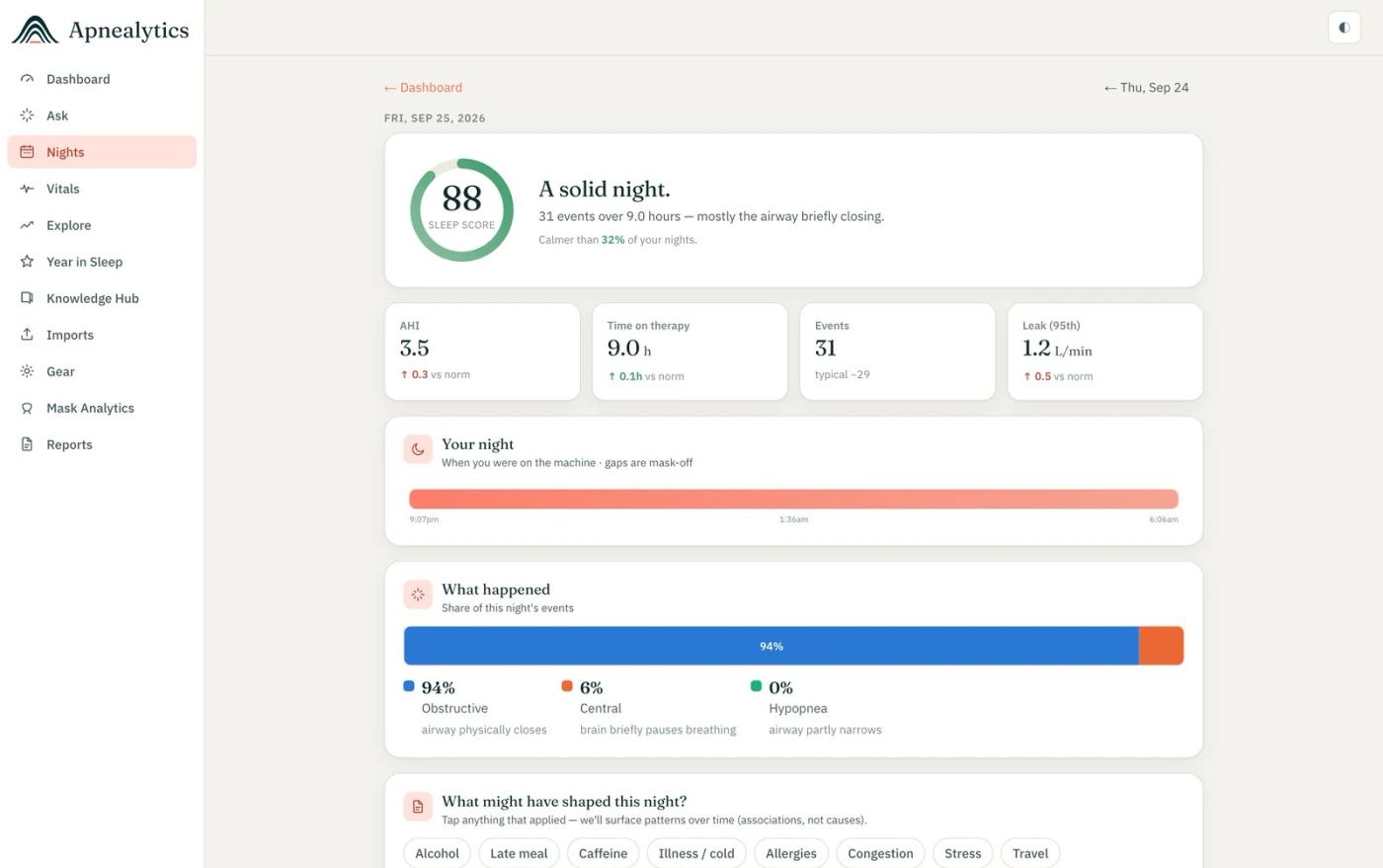
You can look at it yourself, too. Apnealytics reads the SD card from ResMed machines today, and turns the files into nightly charts of AHI, usage, leak, and pressure. Philips DreamStation 1, Fisher & Paykel SleepStyle and the Luna G3 are in testing (usage, adherence and pressure setting for DreamStation 1), the DreamStation 2 and some other machines are on a waitlist, and the ResMed AirMini has no SD card and syncs over Bluetooth only, so Apnealytics cannot read AirMini data. See which machines work for the current list. Apnealytics is a tracking tool, not a diagnostic device. Bring questions about your numbers to your clinician.
Follow your machine's user guide first. As an example, ResMed's AirSense 11 guide says to [9]:
Cleveland Clinic and NHLBI recommend cleaning the mask and tube every day [2][3]. The FDA says most CPAP accessories can be cleaned with mild soap and water [19]. It also warns that there are no FDA-cleared devices for cleaning, disinfecting, or sanitizing CPAP machines. That includes ozone and UV gadgets sold for this purpose [19].
There is no single best sleep apnea machine for everyone. The best one is the type your clinician prescribes, paired with a mask that seals well, that you actually use every night. Compare humidification, ramp and exhale relief, noise, size, and data access.
If you are already on therapy, tracking your nightly AHI, leak, and usage is the simplest way to see whether your setup is working. Apnealytics can read your ResMed machine's data card and show those trends in one place. Start free on the pricing page, and keep your clinician in the loop on anything that looks off.
The most common sleep apnea machine is called a CPAP machine, short for continuous positive airway pressure. Related machines include APAP (auto CPAP), BiPAP or bilevel, and ASV. All of them are positive airway pressure (PAP) devices. They push pressurized air through a mask to keep your airway open during sleep. Your clinician decides which type fits your diagnosis.
Not in the United States. CPAP and related machines are prescription medical devices, and federal law restricts their sale to the order of a physician. You will usually need a sleep test and a diagnosis first. A clinician then prescribes the machine type and pressure. A medical equipment supplier, often working with your insurance, provides it.
CPAP delivers one fixed pressure all night. APAP adjusts pressure automatically within a range your clinician sets. BiPAP uses two pressures: a higher one when you breathe in and a lower one when you breathe out. For most adults with obstructive sleep apnea, AASM guidance favors CPAP or APAP over bilevel for routine treatment.
Most modern machines are quiet. Manufacturer figures for current models are roughly 27 to 29 decibels, about the level of a soft whisper. Louder noise often comes from a mask leak or a blocked air filter, not the machine itself. Check your mask fit and filter first, then contact your supplier if the noise continues.
Yes, if you meet its criteria. Medicare may cover a 12-week CPAP trial for obstructive sleep apnea. It then requires proof that you use the machine at least 4 hours a night on 70% of nights in a 30-day period. Medicare rents the machine for 13 months, after which you own it. You pay 20% coinsurance after the Part B deductible.
There is no single best travel CPAP. Mini machines such as the ResMed AirMini weigh about 300 grams and use waterless humidification. Smaller size brings trade-offs, such as different humidification and fewer data options. Ask your clinician whether a travel machine suits your prescription, and check mask compatibility first.
It depends on the model and how well you care for it. Warranties vary; Philips lists 2 years for DreamStation 2. Insurance plans set their own replacement schedules, and Medicare transfers ownership to you after 13 months of rental. Replace filters, tubing, and mask parts on the schedule in your user guide.
Not medical advice. Apnealytics is a tracking and coaching tool, not a diagnostic device. Machine-estimated numbers are not a clinical diagnosis; talk to your clinician about your therapy.
Written by
Founder of Apnealytics. A CPAP user who builds software, not a sleep physician.
More from the teamKeep reading
Home test vs in-lab sleep study, what a test night is like, what AHI, REI and RDI mean, what it costs and what happens next.
Oral appliances, Inspire and Genio implants, nasal EPAP, positional and tongue devices: what each does, who it suits, FDA status and evidence.
Small habits that get most people over the usage line, plus how to track it without stress.
Upload your SD card and see your nights in plain English. Free to start.
 DashboardSleep Score, AHI band, leak and pressure
 Trends & historyA year down to a night
 Breath-by-breath viewerAirflow, pressure, leak tracesPro
 SpO₂ overlayOximeter data on the same nightPro
 Pressure insightsP95, set range, EPR and ramp
 SD card importDrop the card folder, only new nights added
 Mask fit & gearWhich mask actually seals
 Ask your dataPlain-English questions, your own AI keyBYOK
 Year in SleepYour therapy year in one storyNew
 Compliance reportFinds the qualifying window for youPro
 Share with your doctorRead-only, revocable links
 Companion appiPhone, iPad and Android
 Privacy & securityYour data, locked to you
 ResMed AirSense 10 & 11Supported
 ResMed AirCurve 10 & 11 VAutoSupported
 ResMed S9 / LumisSupported
 Philips DreamStation 1In testing
 Fisher & Paykel SleepStyleIn testing
 Löwenstein / DeVilbissWaitlist
 React Health Luna G3In testing
 Transcend MicroWaitlist
 Full face masksFit, leak signature, Mask Analytics
 Nasal masksOver-nose and cradle styles
 Nasal pillowsMinimal-contact fit tips
 Wellue O2RingSupported
 Contec CMS50 familySupported
 Apple Health / Health ConnectResting HR, HRV, SpO₂, sleepSupported
 Mask finderSeven questions, a ranked mask typeYour data
 Machine finderA two-machine shortlist for your prescription
 What is AHI?The apnea-hypopnea index, explained
 What is a good AHI on CPAP?
 CPAP leak rate explained
 Pressure settings explained
 Reading CPAP waveformsAll 17 explainers
 Apnealytics vs SleepHQ
 Apnealytics vs OSCAR
 Apnealytics vs myAir
 Apnealytics vs DreamMapper
 SleepHQ vs OSCARBest CPAP apps in 2026
 How to read CPAP dataStart here: six numbers, in order
 Read your CPAP SD card
 Share data with your doctorChoosing a CPAP mask
 Travel with CPAPAll 11 guides
 iPhone / iPhone DuoLast night before you are out of bed. Apple Health vitals, Face ID.Live
 iPadSame universal app, side-by-side panes and full-width waveforms.Live
 AndroidPhones, tablets and foldables, with Health Connect built in.Live
 Web portalWhere your SD card goes. Every chart, report and setting.Live


