


iPhone / iPhone Duo Live
Last night before you are out of bed. Apple Health vitals, Face ID.
Download on the App Store Apnealytics™
Free on every plan: unlimited imports, the full dashboard and your last 30 nights.
 Compatibility checkerWill my machine work?Type your model. You get a straight answer: supported, waitlist, or why not.Check my machine
If it writes an SD card, we probably read it. ResMed AirMini has no card, so no app can read it.
Sleep Check-up
3 of 6 checks done
Six short screeners, one picture of how you sleep. Earn a milestone for each, save results and get retake reminders.
Latest milestone: Sleepiness check done
 NEWTrack your 90-day compliance windowOpen the calculator
13 free tools. No account needed — sign in to save results and fill answers from your own CPAP data.
Last night before you are out of bed. Apple Health vitals, Face ID.
Download on the App StoreOne account on every screen. Apple Watch vitals sync through Apple Health.
Home test vs in-lab sleep study, what a test night is like, what AHI, REI and RDI mean, what it costs and what happens next.
A home test or an in-lab study: both end in one number, events per hour, that a clinician reads with your symptoms.
A sleep apnea test is an overnight recording of your breathing and blood oxygen while you sleep. It is done either at home with a small portable kit (a home sleep apnea test, or HSAT) or in a sleep lab with a full sleep study called polysomnography (PSG). Either way, a clinician has to order and interpret it. An online quiz or a smartwatch alert can tell you to get tested, but it cannot diagnose sleep apnea [1].
Testing is simpler than many people expect, and many adults can do it in their own bed. Here's each step, how home and lab tests compare, and how to read your results.
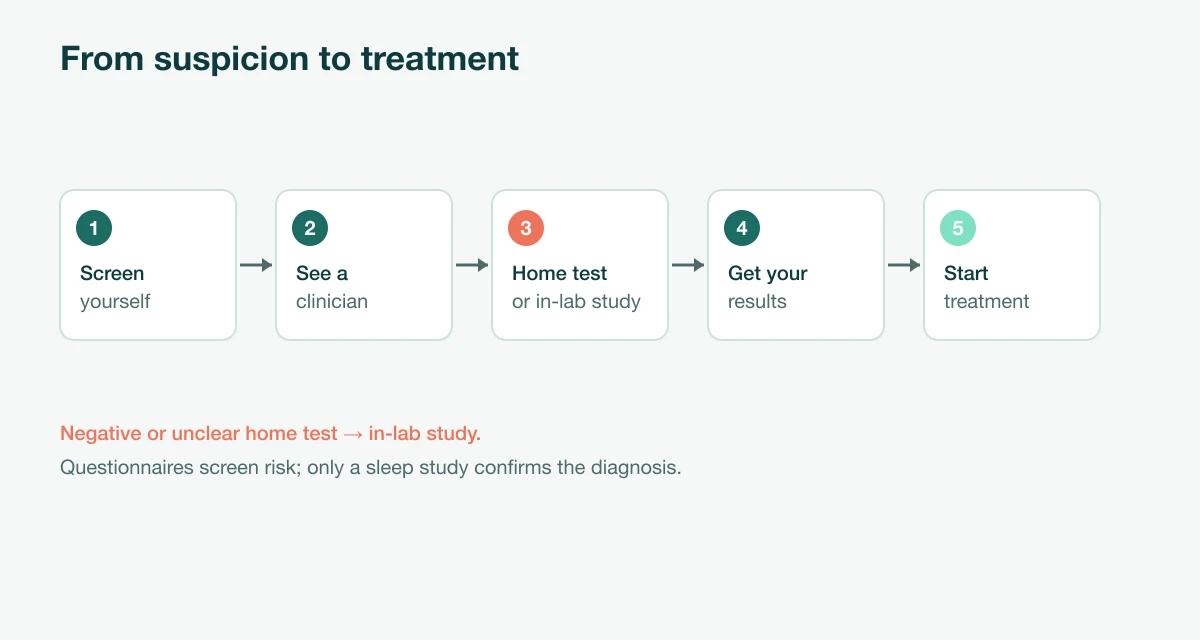
Most people follow the same five steps:
Not sure your symptoms are worth checking? Start with our guide to sleep apnea symptoms.
No. The American Academy of Sleep Medicine (AASM) gives a strong recommendation that questionnaires, clinical tools and prediction algorithms should not be used to diagnose obstructive sleep apnea (OSA) in adults without an actual sleep test [1]. These tools are for screening, which means sorting people by risk.
Screeners still help you decide whether to book an appointment. Try ours free:
A high score is a reason to get tested. A low score doesn't rule sleep apnea out if you still have symptoms.
Neither is better for everyone. A home test is built to confirm likely obstructive sleep apnea. An in-lab study measures much more, including your actual sleep [1][3][4].
| Home sleep apnea test (HSAT) | In-lab polysomnography (PSG) | |
|---|---|---|
| Where | Your own bed | A sleep lab or hospital sleep center |
| What it measures | Breathing (airflow or nasal pressure), breathing effort (chest/belly belts), blood oxygen, pulse; some devices add heart rate or other signals [1][4][6] | Brain waves (EEG), eye movements, muscle activity, heart rhythm (ECG), airflow, breathing effort, blood oxygen, plus synced video and audio [3] |
| Measures actual sleep? | No. It usually counts events per hour of recording time, not sleep time [1] | Yes. It stages your sleep, so events are counted per hour of real sleep [1][3] |
| Can it detect central sleep apnea? | No, a home test cannot diagnose central sleep apnea [5] | Yes |
| Supervision | None overnight. Higher risk of a failed recording [1] | A technologist monitors the night [3] |
| Best suited to | Adults with no major other health problems and a high likelihood of moderate-to-severe OSA [1][6] | People with other medical conditions, suspected other sleep disorders, or a negative or unclear home test [1][6] |
| Main limitation | Can underestimate severity and miss milder cases [1][4] | Less natural setting; you may sleep worse than usual [3] |
The AASM recommends in-lab polysomnography rather than a home test for adults with any of these [1]:
It's also a poor fit if your risk is low, another sleep disorder is suspected, or setting up the kit would be physically hard [6].
A home test is less sensitive than a lab study. It can't tell when you're awake, so time lying awake still counts, which can push your number down. It also misses events that cause a brief brain arousal without much oxygen drop [1].
A Cleveland Clinic sleep specialist says at-home tests "underestimate how severe your obstructive sleep apnea is." Roughly 7–8% also fail for technical reasons, like a sensor slipping off [4].
So the AASM is clear: if a single home test is negative, inconclusive or technically inadequate, the next step is an in-lab polysomnogram, not a second home test [1].
A home sleep apnea test is usually a single night [1][4]. Your clinic either hands you the kit or ships it to your door with instructions and a help line [4][6].
A typical kit has a small nasal tube for airflow, a fingertip oxygen sensor and stretchy chest and belly belts, all wired to a small recorder [4]. The AASM also accepts finger-based devices that measure blood-vessel tone (peripheral arterial tonometry) with oximetry and a movement sensor [1].
Here's how the night usually goes:
An in-lab study feels like a night in a plain hotel room. You change into sleepwear, a technologist attaches sensors, then checks them by asking you to move your eyes, mouth and legs [3].
The sensors are painless. Scalp, eye and chin sensors track your sleep stages, while belts, a nasal sensor and a finger clip track breathing and oxygen (see the table above) [3].
Do you need to sleep all night? No. Most people sleep worse than usual in a lab, and that rarely spoils the results. A night generally counts if you sleep two hours or more [3].
The first part of the night is for diagnosis. If sleep apnea shows up clearly, you're fitted with a positive airway pressure (PAP) mask for the rest of the night [2]. When appropriate, the AASM suggests this over a full diagnostic night [1].
Cleveland Clinic recommends avoiding caffeine and alcohol for at least 8 hours beforehand and skipping naps. Shower, but skip lotions and hair products, which stop scalp sensors sticking. Remove nail polish or fake nails, which can interfere with the finger sensor. Keep taking your usual medicines unless told otherwise [3].
Not in the diagnostic sense. Some watches can now flag possible sleep apnea, but these are notifications, not tests.
Apple Watch. In September 2024, the FDA cleared Apple's Sleep Apnea Notification Feature. It looks for "patterns of breathing disturbances suggestive of moderate-to-severe sleep apnea" over 30-day windows, in adults 18+ without a diagnosis. It "is not intended to diagnose, treat, or aid in the management of sleep apnea" [7].
In Apple's validation study, the feature flagged 66.3% of people with moderate-to-severe sleep apnea and stayed silent for 98.5% of people with normal-to-mild results [7]. So false alarms are rare, but it misses about a third of moderate-to-severe cases. As the FDA labeling says, "The absence of a notification is not intended to indicate the absence of sleep apnea" [7].
Samsung Galaxy Watch. In February 2024, Samsung announced FDA De Novo authorization for a feature that looks for signs of moderate-to-severe OSA. It is for adults 22 and older without a diagnosis, and it is not meant to help clinicians diagnose [8].
If your watch alerts you, treat it like a high screener score and book an appointment. Apple's alert includes a PDF of past data to share with your clinician [13]. If it never alerts you but you have symptoms, still get checked.
Your report centers on one number: breathing events per hour.
The AHI is the average number of apneas (full pauses) and hypopneas (partial drops in breathing) per hour of sleep [5]. Adult severity is usually grouped like this [5]:
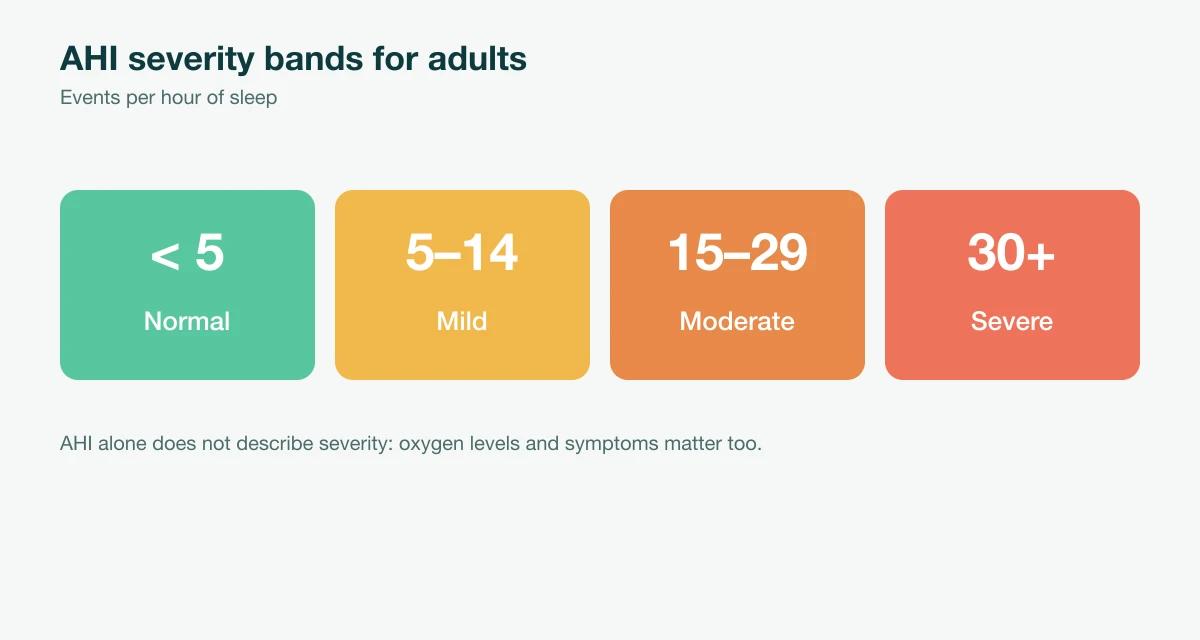
| AHI (events per hour) | Category |
|---|---|
| Under 5 | Normal range |
| 5–14 | Mild sleep apnea |
| 15–29 | Moderate sleep apnea |
| 30 or more | Severe sleep apnea |
Scoring rules matter. The AASM's recommended rule counts a hypopnea when reduced airflow comes with a 3% oxygen drop or a brief arousal; an alternative rule requires a 4% drop. The same night can give quite different AHIs under each rule [1]. For more, see what AHI means.
On a home test, you may see REI instead of AHI. REI uses total recording time rather than sleep time, because the device can't tell when you're asleep [1]. That's one reason home results can run lower.
The RDI adds a third event type to the AHI: respiratory effort-related arousals (RERAs). These are subtle breathing struggles that wake your brain briefly without a full apnea or hypopnea [1]. Your RDI is therefore equal to or higher than your AHI.
The oxygen desaturation index (ODI) counts how often per hour your blood oxygen drops by a set amount. Reports may also show your lowest oxygen level. Our guide to SpO₂, ODI and T90 explains these.
Events are either obstructive (the airway collapses while you keep trying to breathe) or central (the brain briefly stops signaling you to breathe). This changes treatment, and a home test can't diagnose central sleep apnea [5].
Your sleep physician reads these numbers alongside your symptoms and health. A number alone isn't a diagnosis.
Prices vary too widely to quote one figure. Cost depends on:
Ask your clinic and insurer about out-of-pocket cost first. For later CPAP coverage, Medicare requires an AHI or RDI of 15 or more (at least 30 events), or 5–14 (at least 10 events) plus a documented condition such as excessive sleepiness or high blood pressure [10].
You'll meet your clinician to choose a treatment [2][6]. Positive airway pressure (PAP) is the most studied and most often recommended therapy. Other options include oral appliances, weight loss and, in selected cases, surgery [2]. Our guide to sleep apnea treatment compares them.
If you start CPAP, the first months matter. Medicare covers an initial 12-week trial, then needs an in-person follow-up showing the therapy is helping [12]. See CPAP usage hours and adherence.
This is where tracking your own data helps. Your CPAP machine records nightly AHI, hours of use, leak and pressure. Apnealytics reads that data from the SD card of supported ResMed machines and turns it into clear nightly and long-term charts. It doesn't diagnose or change your therapy, but it makes trends easier to spot and discuss with your care team. Next reads: what a good AHI on CPAP looks like and our overview of sleep apnea machines.
If your test was negative but you still snore loudly, stop breathing at night or feel exhausted, go back to your clinician. The AASM suggests a second in-lab study can be considered when suspicion stays high [1]. Untreated sleep apnea carries real health risks, covered in is sleep apnea dangerous?
A home sleep apnea test is usually one night in your own bed, and the AASM looks for at least 4 hours of usable data [1]. An in-lab study is also usually one night, and a night generally counts if you sleep two hours or more [3]. Scoring and results can take a few days to a few weeks, depending on the clinic [3][6].
They are accurate enough to confirm obstructive sleep apnea in the right people: adults with a high likelihood of moderate-to-severe OSA and no major other conditions [1]. But they are less sensitive than a lab study and can underestimate severity [1][4]. If a home test is negative or unclear and you still have symptoms, the AASM recommends an in-lab study next [1].
You can screen yourself with tools like STOP-Bang or a smartwatch notification, but you can't diagnose yourself. The AASM advises against diagnosing OSA from questionnaires or prediction tools alone [1]. A clinician needs to order and interpret a proper sleep test, and insurers generally require that before covering treatment.
Usually, if a clinician orders it for symptoms of sleep apnea. Medicare Part B covers Type I through IV sleep tests when you have signs and symptoms, with Type I covered only in a sleep lab [11]. You typically pay 20% after the deductible [11]. Private plans vary and often need prior authorization, so check with your insurer first.
Yes, especially a home test. It can miss mild cases or underestimate severity, since it counts time awake as if you were asleep [1][4]. Around 7–8% of home tests fail for technical reasons [4]. That's why a negative or inconclusive home test should be followed by an in-lab study if symptoms persist [1].
A home test measures breathing, breathing effort, blood oxygen and pulse [4][6]. An in-lab polysomnogram adds brain waves, eye movements, muscle activity, heart rhythm and video, so it can stage your sleep and detect other sleep disorders [3]. Both report an events-per-hour number, such as AHI or REI [1].
No. Apple's FDA-cleared feature looks for breathing patterns "suggestive of moderate-to-severe sleep apnea" and sends a notification, but it is "not intended to diagnose" [7]. In testing, it caught about two-thirds of moderate-to-severe cases [7]. An alert means see a clinician. No alert doesn't mean you're in the clear.
Not medical advice. Apnealytics is a tracking and coaching tool, not a diagnostic device. Machine-estimated numbers are not a clinical diagnosis; talk to your clinician about your therapy.
Written by
Founder of Apnealytics. A CPAP user who builds software, not a sleep physician.
More from the teamKeep reading
Check five things in order: usage, leak, AHI, event mix and pressure. Then read each number by brand, with a worked night, a 90-day trend and 27 primary sources.
CPAP, oral appliances, Zepbound, Inspire, surgery and home steps compared: who each suits, how strong the evidence is, and how to tell it is working.
One night is weather; thirty nights is climate. How to read the trend line.
Upload your SD card and see your nights in plain English. Free to start.
 DashboardSleep Score, AHI band, leak and pressure
 Trends & historyA year down to a night
 Breath-by-breath viewerAirflow, pressure, leak tracesPro
 SpO₂ overlayOximeter data on the same nightPro
 Pressure insightsP95, set range, EPR and ramp
 SD card importDrop the card folder, only new nights added
 Mask fit & gearWhich mask actually seals
 Ask your dataPlain-English questions, your own AI keyBYOK
 Year in SleepYour therapy year in one storyNew
 Compliance reportFinds the qualifying window for youPro
 Share with your doctorRead-only, revocable links
 Companion appiPhone, iPad and Android
 Privacy & securityYour data, locked to you
 ResMed AirSense 10 & 11Supported
 ResMed AirCurve 10 & 11 VAutoSupported
 ResMed S9 / LumisSupported
 Philips DreamStation 1In testing
 Fisher & Paykel SleepStyleIn testing
 Löwenstein / DeVilbissWaitlist
 React Health Luna G3In testing
 Transcend MicroWaitlist
 Full face masksFit, leak signature, Mask Analytics
 Nasal masksOver-nose and cradle styles
 Nasal pillowsMinimal-contact fit tips
 Wellue O2RingSupported
 Contec CMS50 familySupported
 Apple Health / Health ConnectResting HR, HRV, SpO₂, sleepSupported
 Mask finderSeven questions, a ranked mask typeYour data
 Machine finderA two-machine shortlist for your prescription
 What is AHI?The apnea-hypopnea index, explained
 What is a good AHI on CPAP?
 CPAP leak rate explained
 Pressure settings explained
 Reading CPAP waveformsAll 17 explainers
 Apnealytics vs SleepHQ
 Apnealytics vs OSCAR
 Apnealytics vs myAir
 Apnealytics vs DreamMapper
 SleepHQ vs OSCARBest CPAP apps in 2026
 How to read CPAP dataStart here: six numbers, in order
 Read your CPAP SD card
 Share data with your doctorChoosing a CPAP mask
 Travel with CPAPAll 11 guides
 iPhone / iPhone DuoLast night before you are out of bed. Apple Health vitals, Face ID.Live
 iPadSame universal app, side-by-side panes and full-width waveforms.Live
 AndroidPhones, tablets and foldables, with Health Connect built in.Live
 Web portalWhere your SD card goes. Every chart, report and setting.Live


