


iPhone / iPhone Duo Live
Last night before you are out of bed. Apple Health vitals, Face ID.
Download on the App Store Apnealytics™
Free on every plan: unlimited imports, the full dashboard and your last 30 nights.
 Compatibility checkerWill my machine work?Type your model. You get a straight answer: supported, waitlist, or why not.Check my machine
If it writes an SD card, we probably read it. ResMed AirMini has no card, so no app can read it.
Sleep Check-up
3 of 6 checks done
Six short screeners, one picture of how you sleep. Earn a milestone for each, save results and get retake reminders.
Latest milestone: Sleepiness check done
 NEWTrack your 90-day compliance windowOpen the calculator
13 free tools. No account needed — sign in to save results and fill answers from your own CPAP data.
Last night before you are out of bed. Apple Health vitals, Face ID.
Download on the App StoreOne account on every screen. Apple Watch vitals sync through Apple Health.
Rarely in a single night, but untreated severe sleep apnea raises heart, stroke and crash risk. What the large studies found, and what treatment does and does not prove.
Repeated drops in oxygen and broken sleep, night after night, are what strain the heart and blood vessels.
Yes, sleep apnea can contribute to death, but usually not the way people fear. A single pause in breathing almost never stops someone breathing for good, because the brain senses the pause and briefly wakes you to reopen the airway [15]. The real danger of untreated sleep apnea, especially severe sleep apnea, is years of strain on the heart and blood vessels, plus sleepiness-related accidents [1][2][12].
So sleep apnea is serious, but it is not a death sentence. Risk depends on how severe it is, your other health conditions, and whether it is treated. Below is what large, long-running studies actually found, and what treatment does and does not yet prove.
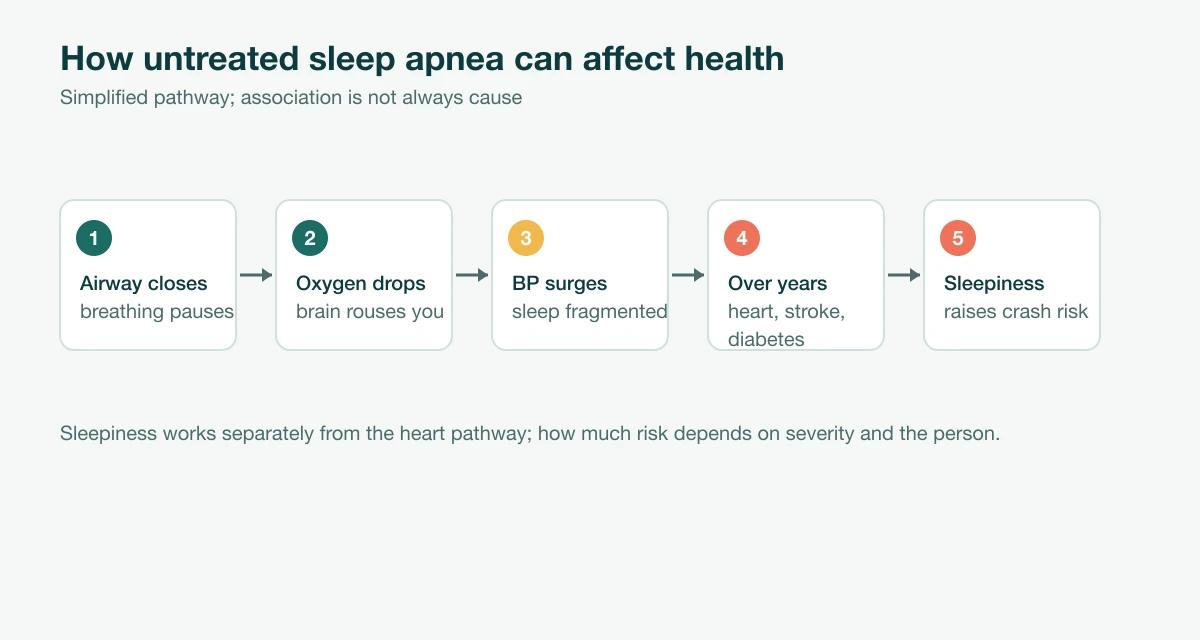
In obstructive sleep apnea (OSA), the throat narrows or closes during sleep. Oxygen in the blood falls and carbon dioxide builds up [15]. The brain notices and briefly rouses you so the airway reopens. This can repeat more than five times an hour, all night [15].
What harms you is the repetition. The American Heart Association describes the result as intermittent low oxygen, nervous-system swings and broken sleep [11]. Over time, those stresses are linked to high blood pressure, heart rhythm problems, heart failure and stroke [11]. The NHLBI states plainly that untreated sleep apnea raises the risk of stroke, heart attack and other serious problems [23].
So how does sleep apnea kill? The evidence points to three main pathways:
A fourth risk involves surgery, sedatives and opioid painkillers, which make breathing harder [14][15].
Not sure you have sleep apnea? Start with our guide to sleep apnea symptoms or the STOP-Bang screening interpreter. Only a sleep apnea test can confirm it.
Two community studies give the clearest picture. Both used overnight sleep studies, then followed people for years.
Researchers followed 1,522 adults for 18 years [1]. They grouped people by apnea-hypopnea index (AHI), breathing events per hour: 5, 15 and 30 marked mild, moderate and severe [1]. (New to AHI? See what AHI means.)
People with severe sleep apnea had about three times the risk of dying from any cause, compared with people without it (adjusted hazard ratio 3.0) [1]. When the researchers removed the 126 people who had used CPAP, the risk rose to 3.8 times. The risk of cardiovascular death was 5.2 times higher in that untreated group [1].
Results held after adjusting for age, sex and body weight, and did not change after accounting for daytime sleepiness [1]. Not feeling sleepy did not mean being protected.
This larger study followed 6,441 adults aged 40 and older for 8.2 years on average [2]. The picture was more nuanced:
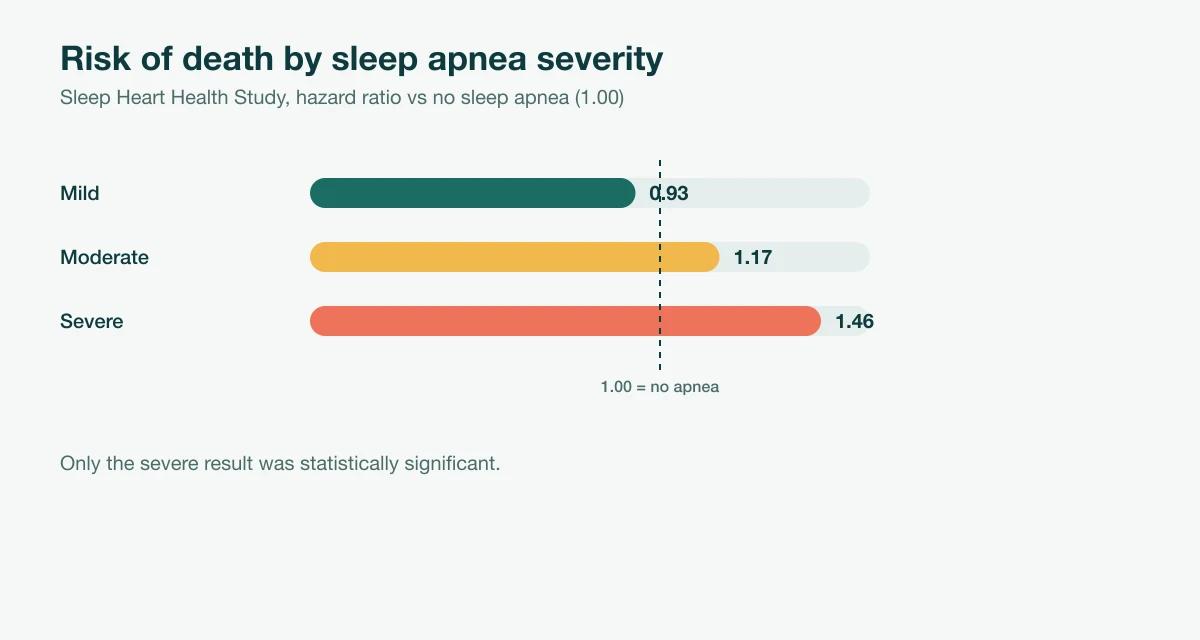
The risk was clearest in men aged 40 to 70 with severe sleep apnea, whose risk of death was roughly doubled (2.09) [2]. Notably, the drops in blood oxygen during sleep predicted death, while broken sleep alone did not [2].
What this means for you: severity matters. The clearest mortality signal is in severe, untreated sleep apnea [1][2]. Evidence that mild sleep apnea raises the risk of death is weak [2]. Mild cases can still affect sleep and daytime function, so they are worth discussing with a clinician.
The AHA estimates that about 34% of middle-aged men and 17% of middle-aged women meet the criteria for OSA [11]. In people with high blood pressure, heart failure, atrial fibrillation or stroke, it is found in 40% to 80% [11].
In the Wisconsin cohort, people with an AHI of 15 or more at the start were 2.89 times as likely to have high blood pressure four years later [5]. The risk rose step by step with AHI, which suggests a dose-response link [5].
In a Mayo Clinic study of 3,542 adults, OSA was linked to about twice the risk of new atrial fibrillation (hazard ratio 2.18) [6]. Under age 65, deeper nighttime oxygen drops independently predicted it [6].
A Yale study of 1,022 people found OSA nearly doubled the combined risk of stroke or death (hazard ratio 1.97), even after adjusting for blood pressure, AFib and diabetes [7]. More severe sleep apnea carried more risk [7].
In the Sleep Heart Health Study, men with an AHI of 30 or more were 58% more likely to develop heart failure than men with an AHI under 5 [8]. Men aged 40 to 70 with severe OSA were 68% more likely to develop coronary heart disease [8]. These links were not seen in women, and the authors called the coronary finding "equivocal" [8].
In a 13-year study of 1,453 adults, severe OSA was linked to a 71% higher risk of developing diabetes, even after accounting for body weight and waist size [9]. Across 16 cohort studies, OSA carried a 40% higher risk of type 2 diabetes [10].
In the general population, sudden cardiac death peaks from 6 a.m. to noon and is least common from midnight to 6 a.m. [3]. A Mayo Clinic team reviewed 112 people who had a sleep study and later died suddenly of cardiac causes [3]. Among those with OSA, 46% died between midnight and 6 a.m. That compared with 21% of those without OSA and 16% of the general population [3]. The higher the AHI, the higher the risk of a nighttime sudden death [3].
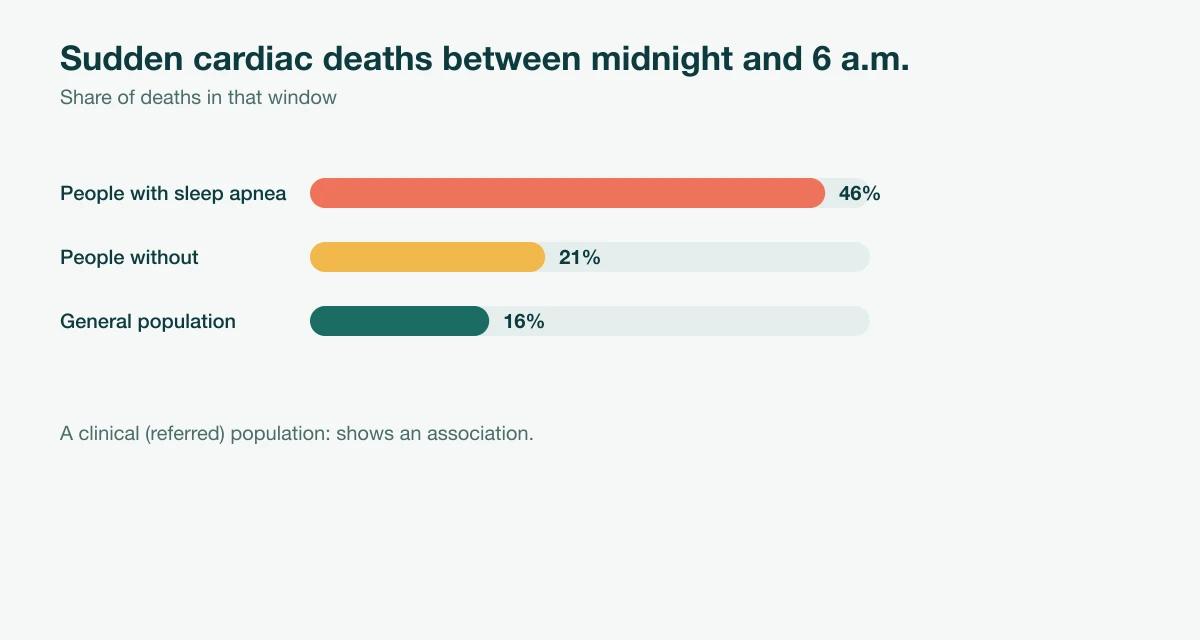
A follow-up study tracked 10,701 adults for up to 15 years [4]. Sudden cardiac death, fatal or resuscitated, occurred at 0.27% a year [4]. Key sleep-related predictors were an AHI above 20, a mean oxygen saturation under 93% (nearly triple the risk) and a lowest reading under 78% (more than double) [4].
Keep this in perspective. Sudden death at night is uncommon, even with OSA [4]. These studies show associations; they do not prove apneas caused each death. But they are a good reason to take low oxygen seriously. Our guide to SpO₂, ODI and T90 explains those measures.
| Risk | What the evidence shows | Source |
|---|---|---|
| Death from any cause | Severe: about 3x risk over 18 years (3.8x without CPAP). | Wisconsin Sleep Cohort [1] |
| Death from any cause, by severity | Severe: 1.46x. Moderate: 1.17x (not significant). Mild: no increase. | Sleep Heart Health Study [2] |
| Cardiovascular death | Severe, never on CPAP: 5.2x risk. | Wisconsin Sleep Cohort [1] |
| Sudden cardiac death at night | 46% occurred midnight–6 a.m. with OSA, vs 16% in the general population. | Gami et al., NEJM 2005 [3] |
| Sudden cardiac death overall | Predicted by AHI over 20 (1.6x) and low nighttime oxygen (up to 2.9x). | Gami et al., JACC 2013 [4] |
| High blood pressure | AHI 15+: 2.89x odds of hypertension 4 years later. | Peppard et al., NEJM 2000 [5] |
| Atrial fibrillation | OSA linked to about 2x risk of new AFib. | Gami et al., JACC 2007 [6] |
| Stroke or death | About 2x risk, independent of blood pressure. | Yaggi et al., NEJM 2005 [7] |
| Heart failure | Men with AHI 30+: 58% higher risk. | Gottlieb et al., Circulation 2010 [8] |
| Type 2 diabetes | 40% higher risk across 16 cohorts; 71% with severe OSA in one. | Qie et al. 2020 [10]; Nagayoshi et al. 2016 [9] |
| Car crashes | Roughly 1.2 to 4.9x crash risk. | Tregear et al. 2009 [12] |
Yes. Drowsy driving is one of the most direct ways untreated sleep apnea can kill, and it endangers others too. A systematic review found a clearly higher crash risk with OSA. The crash-rate ratio likely falls between 1.21 and 4.89 [12]. Higher BMI, higher AHI, lower oxygen and possibly daytime sleepiness predicted crashes [12]. Mayo Clinic notes that sleepiness from OSA raises the risk of potentially fatal work and motor vehicle accidents [15].
The good news: treatment helps here. In a meta-analysis of nine observational studies, crash risk fell by about 72% after people started CPAP [13]. Daytime sleepiness improved after a single night, and simulated driving improved within 2 to 7 days [13].
The NHLBI's advice is simple: do not drive if you feel tired or sleepy [17]. Not sure how sleepy you are? Try the Epworth Sleepiness Scale interpreter.
It can be. OSA is linked to a higher risk of complications around surgery [14]. By 2015, the Joint Commission had received 61 serious perioperative event reports involving patients with known or suspected OSA [14].
Several things make breathing harder:
What to do:
Risk is highest when several of these overlap:
Children are a separate case. Untreated sleep apnea in children can affect learning, behavior and growth, and can be linked to high blood pressure and heart problems [24]. It is often caused by large tonsils or adenoids, so talk with your child's pediatrician [24].
Treatment clearly helps some outcomes. For others, the evidence is still mixed.
Observational data are encouraging. In a 10-year Spanish study, men with untreated severe OSA had more fatal and non-fatal cardiovascular events, while CPAP-treated men had rates similar to healthy men [18]. But people who stick with CPAP may differ in other ways.
Randomized trials are less clear. The SAVE trial randomized 2,717 adults with moderate-to-severe OSA and existing heart or brain blood-vessel disease [19]. CPAP did not reduce cardiovascular events over 3.7 years (hazard ratio 1.10) [19]. One key caveat: average CPAP use was only 3.3 hours a night [19].
Adherence appears to be the missing piece. A 2023 JAMA analysis pooled 4,186 people from three trials (SAVE, ISAACC and RICCADSA) [20]. Overall, CPAP did not change the risk of repeat cardiovascular events (hazard ratio 1.01) [20]. But in an on-treatment analysis, people who used CPAP at least 4 hours a night had about 31% lower risk (hazard ratio 0.69) [20].
That on-treatment finding is weaker evidence than a direct trial result. Still, the message is consistent: CPAP only works during the hours you use it.
The AASM recommends PAP for adults with OSA and excessive sleepiness, and suggests it with high blood pressure [22]. It also advises follow-up that checks objective usage and efficacy data [22]. See our sleep apnea treatment guide for options.
If benefit depends on use, your real numbers matter. Two are worth watching:
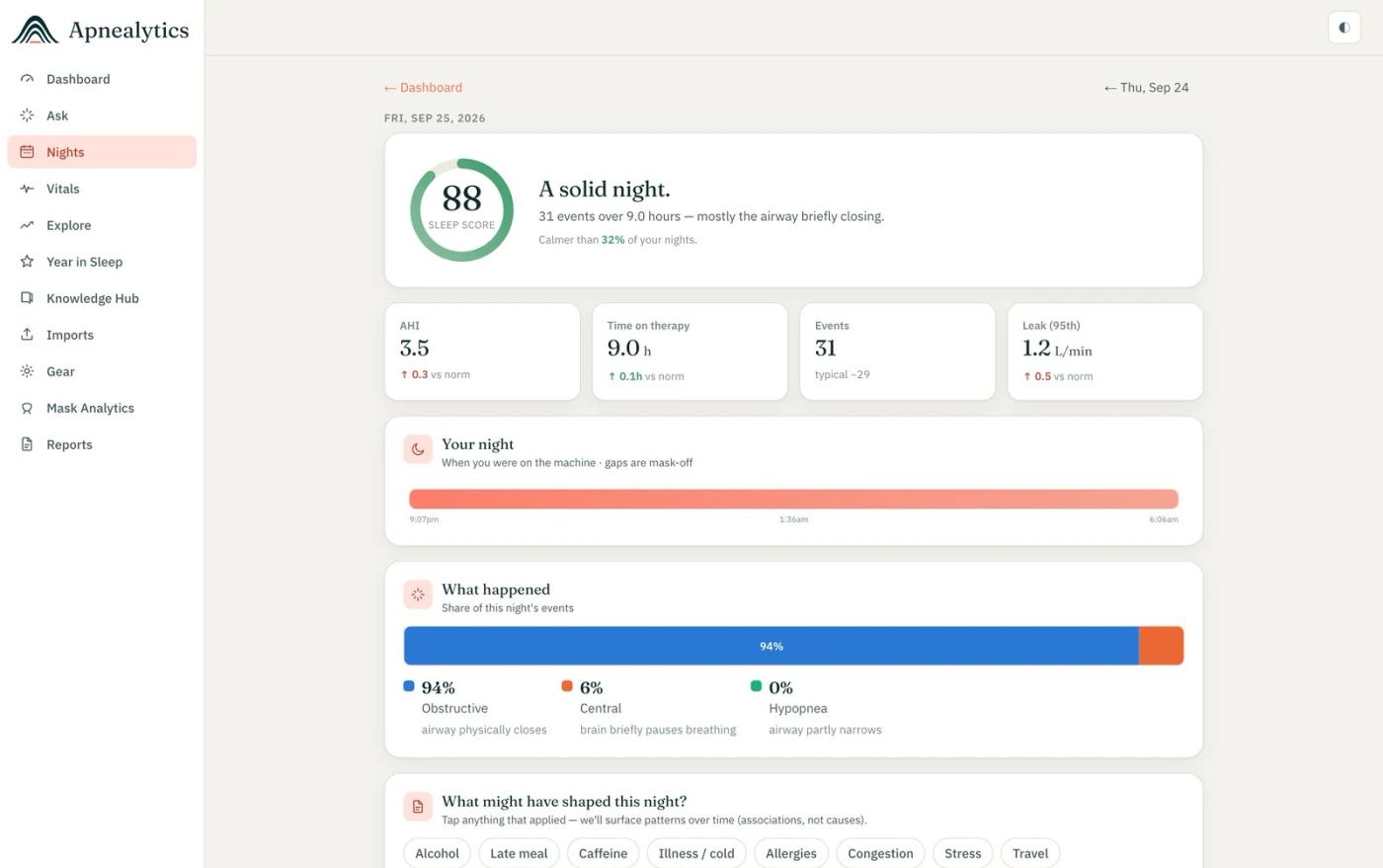
Apnealytics reads the data card from supported ResMed machines and shows usage, AHI, leak and pressure night by night. It is a tracking tool, not a diagnostic device, and you should never change your pressure yourself. But clear trends make it easier to spot problems early and share your CPAP data with your doctor.
Most sleep apnea symptoms need a doctor's visit, not an ambulance. But some signs are urgent.
Call 911 right away for signs of a heart attack or stroke [25][26]:
See a clinician soon if you notice:
Untreated severe sleep apnea is linked to a higher risk of death, mostly through heart disease, stroke and accidents [1][2][12]. Mild sleep apnea was not linked to higher mortality in the largest community study [2]. Treatment improves sleepiness, driving safety and blood pressure [13][19][21]. Its effect on heart attacks and deaths is still debated, but using it 4+ hours a night appears key [20].
It is uncommon, but people with OSA have more sudden cardiac deaths at night. In one study, 46% of such deaths in people with OSA happened between midnight and 6 a.m., versus 16% in the general population [3]. Low nighttime oxygen was a strong predictor [4]. The brain usually wakes you to end each apnea [15].
Mild sleep apnea was not linked to a higher risk of death in the Sleep Heart Health Study, which followed 6,441 adults for about eight years [2]. That said, mild sleep apnea can still affect sleep and daytime function, and the evidence for it is less studied than for severe cases. A clinician can help you decide whether treatment is worthwhile, especially if you feel sleepy or have heart disease.
Treatment lowers some risks but not all. CPAP reduces sleepiness and crash risk and modestly lowers blood pressure [13][21]. Trials have not consistently shown fewer heart attacks or strokes. In a pooled analysis, though, people using CPAP 4+ hours a night had about 31% fewer repeat cardiovascular events [20].
We could not find a trustworthy official yearly count, so we do not quote one. Researchers instead measure extra risk. For example, severe untreated sleep apnea was linked to about three times the risk of death over 18 years in the Wisconsin Sleep Cohort [1].
Studies show the clearest danger at an AHI of 30 or more, the severe range [1][2]. Risk also rises with deeper nighttime oxygen drops [4]. Danger is not only about the number, though. Sleepiness behind the wheel is a serious risk in its own right, so never drive drowsy [17]. Talk to your clinician about your own results.
Not medical advice. Apnealytics is a tracking and coaching tool, not a diagnostic device. Machine-estimated numbers are not a clinical diagnosis; talk to your clinician about your therapy.
Written by
Founder of Apnealytics. A CPAP user who builds software, not a sleep physician.
More from the teamKeep reading
How a CPAP machine works, CPAP vs APAP vs BiPAP vs ASV, the features worth comparing, prescription and insurance basics, and what your machine records.
Oral appliances, Inspire and Genio implants, nasal EPAP, positional and tongue devices: what each does, who it suits, FDA status and evidence.
Check five things in order: usage, leak, AHI, event mix and pressure. Then read each number by brand, with a worked night, a 90-day trend and 27 primary sources.
Upload your SD card and see your nights in plain English. Free to start.
 DashboardSleep Score, AHI band, leak and pressure
 Trends & historyA year down to a night
 Breath-by-breath viewerAirflow, pressure, leak tracesPro
 SpO₂ overlayOximeter data on the same nightPro
 Pressure insightsP95, set range, EPR and ramp
 SD card importDrop the card folder, only new nights added
 Mask fit & gearWhich mask actually seals
 Ask your dataPlain-English questions, your own AI keyBYOK
 Year in SleepYour therapy year in one storyNew
 Compliance reportFinds the qualifying window for youPro
 Share with your doctorRead-only, revocable links
 Companion appiPhone, iPad and Android
 Privacy & securityYour data, locked to you
 ResMed AirSense 10 & 11Supported
 ResMed AirCurve 10 & 11 VAutoSupported
 ResMed S9 / LumisSupported
 Philips DreamStation 1In testing
 Fisher & Paykel SleepStyleIn testing
 Löwenstein / DeVilbissWaitlist
 React Health Luna G3In testing
 Transcend MicroWaitlist
 Full face masksFit, leak signature, Mask Analytics
 Nasal masksOver-nose and cradle styles
 Nasal pillowsMinimal-contact fit tips
 Wellue O2RingSupported
 Contec CMS50 familySupported
 Apple Health / Health ConnectResting HR, HRV, SpO₂, sleepSupported
 Mask finderSeven questions, a ranked mask typeYour data
 Machine finderA two-machine shortlist for your prescription
 What is AHI?The apnea-hypopnea index, explained
 What is a good AHI on CPAP?
 CPAP leak rate explained
 Pressure settings explained
 Reading CPAP waveformsAll 17 explainers
 Apnealytics vs SleepHQ
 Apnealytics vs OSCAR
 Apnealytics vs myAir
 Apnealytics vs DreamMapper
 SleepHQ vs OSCARBest CPAP apps in 2026
 How to read CPAP dataStart here: six numbers, in order
 Read your CPAP SD card
 Share data with your doctorChoosing a CPAP mask
 Travel with CPAPAll 11 guides
 iPhone / iPhone DuoLast night before you are out of bed. Apple Health vitals, Face ID.Live
 iPadSame universal app, side-by-side panes and full-width waveforms.Live
 AndroidPhones, tablets and foldables, with Health Connect built in.Live
 Web portalWhere your SD card goes. Every chart, report and setting.Live


