


iPhone / iPhone Duo Live
Last night before you are out of bed. Apple Health vitals, Face ID.
Download on the App Store Apnealytics™
Free on every plan: unlimited imports, the full dashboard and your last 30 nights.
 Compatibility checkerWill my machine work?Type your model. You get a straight answer: supported, waitlist, or why not.Check my machine
If it writes an SD card, we probably read it. ResMed AirMini has no card, so no app can read it.
Sleep Check-up
3 of 6 checks done
Six short screeners, one picture of how you sleep. Earn a milestone for each, save results and get retake reminders.
Latest milestone: Sleepiness check done
 NEWTrack your 90-day compliance windowOpen the calculator
13 free tools. No account needed — sign in to save results and fill answers from your own CPAP data.
Last night before you are out of bed. Apple Health vitals, Face ID.
Download on the App StoreOne account on every screen. Apple Watch vitals sync through Apple Health.
Oral appliances, Inspire and Genio implants, nasal EPAP, positional and tongue devices: what each does, who it suits, FDA status and evidence.
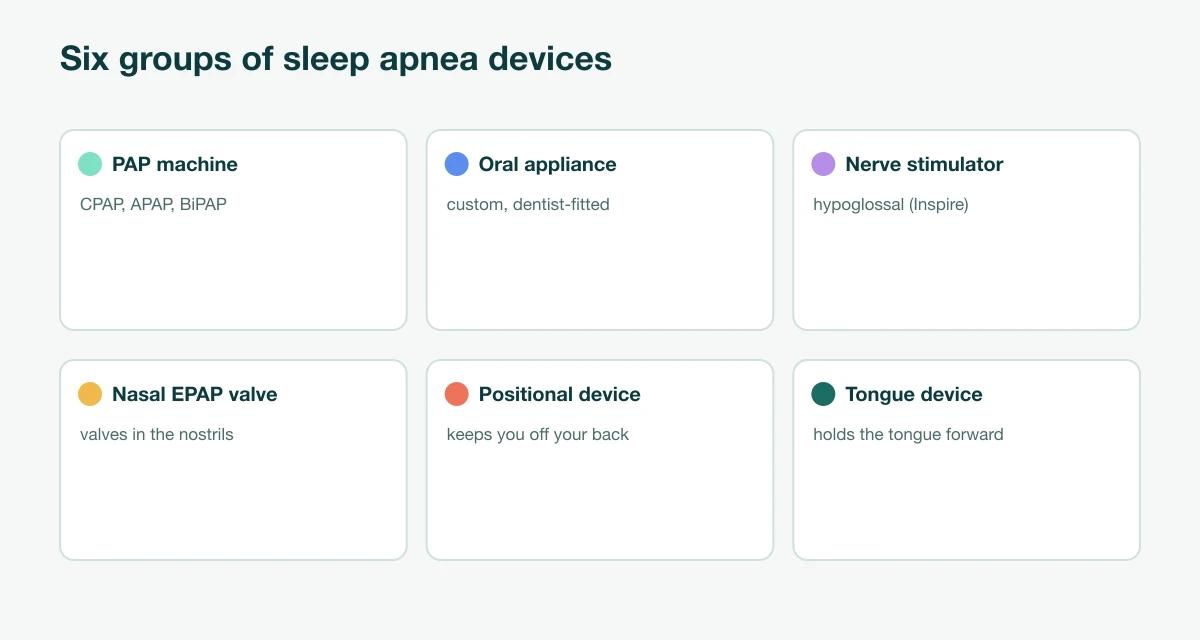
Six groups of devices: PAP, oral appliances, nerve stimulators, nasal EPAP, positional devices and tongue devices.
Sleep apnea devices fall into six main groups: positive airway pressure (PAP) machines like CPAP, custom oral appliances fitted by a dentist, implanted nerve stimulators such as Inspire, nasal EPAP valves, positional devices, and tongue devices. PAP is the most studied option and the usual starting point. For people who can't tolerate CPAP, sleep specialists recommend a custom oral appliance over no treatment at all [1][2].
Which device is right depends on how severe your sleep apnea is, the shape of your airway, your teeth, and what you will actually use every night. Almost every device that treats sleep apnea needs a diagnosis first, and most need a prescription.
Each row is covered in more detail below.
| Device | How it works | Best for | Evidence | Prescription needed (US)? |
|---|---|---|---|---|
| CPAP / APAP machine | Pressurized air through a mask holds the airway open | Most adults with obstructive sleep apnea (OSA), any severity | Strongest; AASM strong recommendation [1] | Yes |
| Custom oral appliance (mandibular advancement device) | Moves the lower jaw forward to open the airway | Mild to moderate OSA, or CPAP intolerance [2][3] | Good; AASM "standard" recommendation over no therapy for CPAP-intolerant adults [2] | Yes, prescribed by a physician and fitted by a dentist [2] |
| Hypoglossal nerve stimulator (Inspire, Genio) | Implant stimulates the nerve that moves the tongue forward | Moderate to severe OSA when PAP fails [3][7] | FDA-approved (PMA); STAR trial showed large AHI drops [9] | Yes, plus surgery |
| Nasal EPAP (e.g., Bongo Rx) | One-way valve adds resistance when you breathe out | Mild to moderate OSA in some adults [13] | FDA-cleared; more limited | Yes, for OSA-labeled products [13] |
| Positional device | Vibrates or blocks you from sleeping on your back | Apnea that is much worse on your back | Meta-analysis: AHI fell about 43% from baseline [15] | Varies by product |
| Tongue retaining device | Holds the tongue forward with suction | Selected cases; ask a dental sleep specialist | Limited [4][6] | Yes, when sold to treat OSA |
| Daytime tongue stimulator (eXciteOSA) | Trains tongue muscles while awake | Snoring and mild OSA (AHI under 15) in adults [11] | FDA De Novo authorization, 2021 [11] | Check with your clinician |
| Smart watch / ring / tracker | Screens for signs of apnea | Flagging possible risk only | Not a treatment [16] | No |
Yes. Positive airway pressure is the most established treatment. The American Academy of Sleep Medicine (AASM) strongly recommends PAP over no therapy for adults with OSA and excessive sleepiness [1]. It recommends either fixed-pressure CPAP or auto-adjusting APAP for ongoing treatment [1].
Mayo Clinic describes CPAP as delivering "just enough air pressure to a mask to keep the upper airway passages open" [3]. BPAP (bilevel) uses one pressure for breathing in and another for breathing out [3].
Mask fit, leaks and dryness are common, fixable reasons people struggle. Our guide to sleep apnea machines compares models, and choosing a CPAP mask covers fit.
The best-supported alternative is a custom oral appliance. For moderate to severe OSA in people who truly can't use PAP, hypoglossal nerve stimulation is the main implant option [3][7].
Nasal EPAP and positional devices can help selected people with milder or position-dependent apnea. Tongue devices are niche options.
No alternative should replace CPAP without a conversation with your sleep physician. A device that cuts snoring can still leave dangerous breathing pauses untreated. See our overview of sleep apnea treatment for non-device options, too.
An oral appliance looks like a sports mouth guard or orthodontic retainer. The common type is a mandibular advancement device (MAD). It clips onto your upper and lower teeth and holds your lower jaw slightly forward. That pulls the tongue and soft tissues forward and keeps the airway more open.
Federal rules classify these as Class II devices, a group that also includes tongue retaining devices [4].
Mayo Clinic says oral appliances are an option for some people with mild or moderate sleep apnea. They can also suit some people with severe apnea who can't use CPAP [3].
The 2015 joint AASM and American Academy of Dental Sleep Medicine (AADSM) guideline makes these key points [2]:
They lower AHI, but usually less than CPAP does. A 2023 meta-analysis found oral appliances reduced AHI compared with baseline. It also found CPAP produced a greater AHI reduction than oral appliances overall [6].
Still, a device you wear beats one left on the nightstand. That is why the guideline backs oral appliances for adults who can't tolerate CPAP [2].
Custom, dentist-made appliances. The AASM/AADSM guideline found custom appliances "achieve a greater reduction in AHI" than non-custom ones [2]. Custom titratable devices also showed a moderate improvement in quality of life [2]. A 2025 AADSM position paper says a proper appliance should advance the jaw "in increments of 1 mm or less" and keep "a verifiable protrusive setting" [21].
Boil-and-bite and online mouth guards. Evidence for non-custom devices for OSA rests on two small trials with 42 patients and wide confidence intervals [2]. Some store-bought devices are cleared only to reduce snoring. For example, one FDA-cleared over-the-counter device is labeled "intended for use by adults (18 years or older) as an aid to reduce snoring" [5]. That is not the same as treating sleep apnea.
The safe path: get a sleep study first, then a prescription, then a fitting with a dentist trained in dental sleep medicine. Mayo Clinic advises seeing "a dentist experienced in dental sleep medicine appliances for the fitting and follow-up therapy" [3].
Most oral appliance side effects are dental, such as tooth movement or bite changes [2]. A qualified dentist can pick or modify a device for issues like metal or acrylic allergies, grinding, or unusual anatomy [2]. Regular follow-up catches problems early [2].
Inspire is a hypoglossal nerve stimulator, sometimes called upper airway stimulation. A small device is implanted in the chest. Mayo Clinic explains: "When you inhale, the device stimulates the nerve that controls the movement of the tongue" [3]. The tongue moves forward and keeps the airway open. You turn it on at bedtime with a remote.
In the STAR trial of 126 adults who had trouble with CPAP, AHI fell 68% at 12 months, from 29.3 to 9.0 events per hour [9].
FDA approved an expanded Inspire label on June 8, 2023 [7]. It covers:
The 2023 approval also raised the recommended upper limit for body mass index (BMI) from 32 to 40 [7]. The manufacturer adds that central plus mixed apneas above 25% of the total AHI is a contraindication, and that safety and effectiveness for people with a BMI over 40 "is unknown at this time" [8].
Our explainer on central vs obstructive apnea covers why central events matter.
Yes. Nyxoah's Genio system received FDA approval in August 2025 for a subset of adults with moderate to severe OSA and an AHI from 15 to 65 [10]. Like Inspire, it stimulates the hypoglossal nerve. Ask an ENT surgeon which system fits your anatomy.
Yes: nasal EPAP (expiratory positive airway pressure) valves that sit in or over the nostrils. Air flows in easily, but breathing out meets resistance. That back-pressure helps keep the airway open.
Provent is no longer sold. Its maker announced the end of manufacturing as of June 1, 2020 [14]. The last batch expired September 16, 2023 [14]. Many older articles still recommend it.
What is available now. A 2026 industry guide lists two prescription EPAP products for mild to moderate OSA in adults: Bongo Rx and ULTepap 2 [13]. FDA's database shows Bongo was cleared through 510(k) in August 2018 under the product code for intranasal expiratory resistance valves for OSA [12]. The same guide lists an over-the-counter EPAP mask cleared only for snoring [13].
EPAP needs clear nasal breathing, and results vary. A follow-up sleep test confirms whether it works for you.
They can, if your apnea is mainly positional. That means most events happen when you sleep on your back.
Positional devices include vibrating bands worn on the neck or chest that buzz when you roll onto your back. Mayo Clinic notes that "devices that vibrate when you try to sleep on your back may help" [3].
A 2023 meta-analysis in Thorax pooled 18 studies of vibrating positional devices [15]. AHI fell by about 9 events per hour, a 43% reduction from baseline. Time spent on the back fell about 70% [15]. Changes in daytime sleepiness and quality of life were minimal, based on limited data [15].
Ask your clinician whether your sleep study shows positional apnea before buying one.
A tongue retaining device (TRD) uses a soft suction bulb to hold the tongue forward. Evidence is thin: a 2023 meta-analysis could only cite a single study comparing TRDs with jaw-advancing devices [6]. Because a TRD doesn't anchor to the teeth, it is sometimes discussed for people who can't wear a MAD. Ask a dental sleep specialist.
eXciteOSA is worn while awake, not during sleep. FDA granted it De Novo authorization on February 5, 2021 [11]. Its label describes "a removable tongue muscle stimulation device that delivers neuromuscular stimulation to the tongue" to reduce "snoring and mild obstructive sleep apnea (AHI<15)" in patients 18 or older [11]. It is not indicated for moderate or severe OSA.
Not treatment devices. Some can screen for possible sleep apnea, but none treat it.
Two smartwatch features have FDA authorization:
The AASM's position is clear. Consumer sleep technology without validation and FDA clearance "cannot be utilized for the diagnosis and/or treatment of sleep disorders" [16]. It can help start a conversation with your clinician [16].
If a wearable flags you, the next step is a real sleep apnea test. You can also take the free STOP-Bang interpreter to bring to your appointment.
Chin straps, nose vents, sprays, "EMS" neck pads and boil-and-bite guards are often sold with sleep apnea language. Before you buy, check three things:
Costs vary widely by device, region and insurance. What drives cost:
Feeling better matters, but people can feel improved while still under-treated [2].
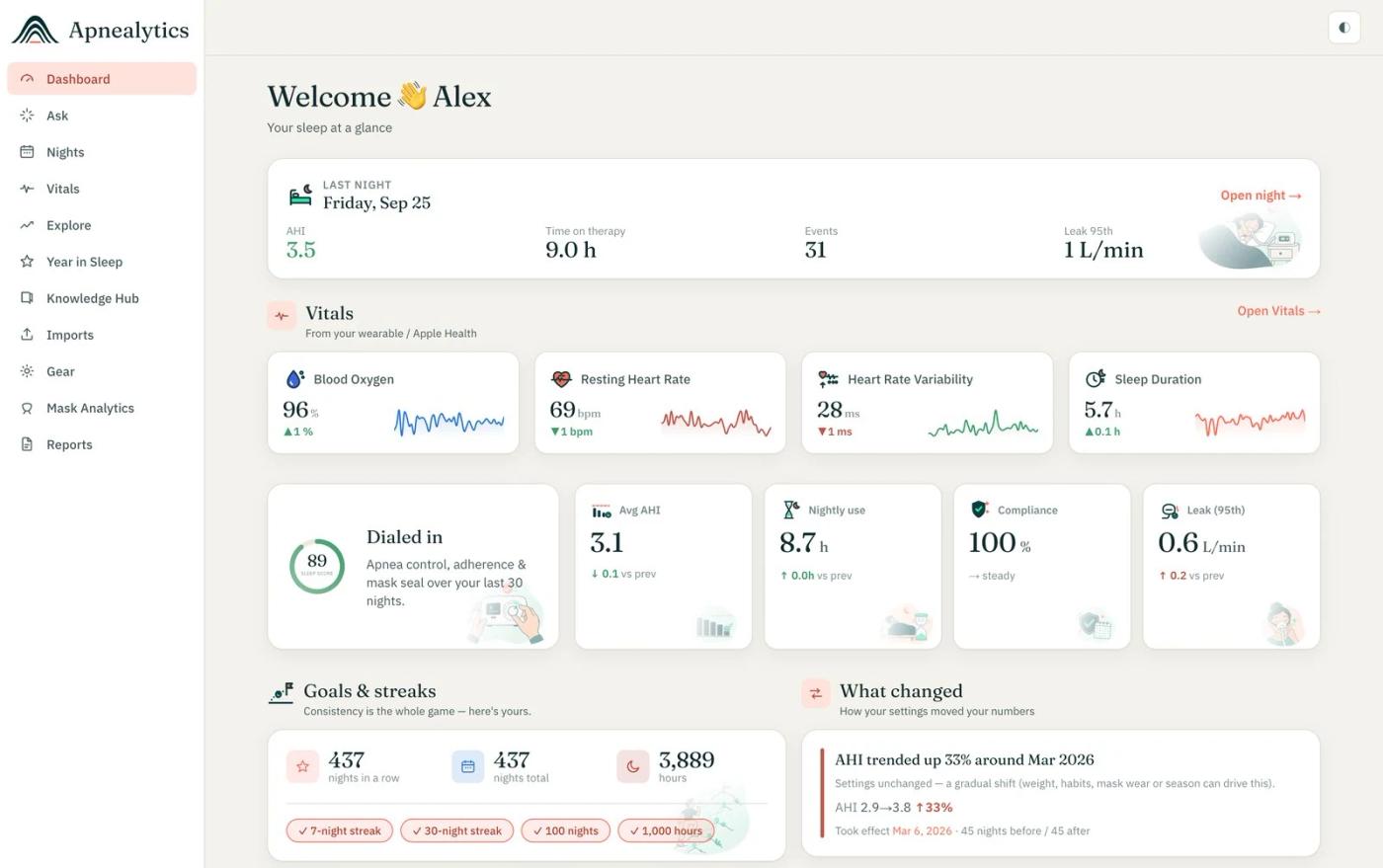
If you use a ResMed CPAP, Apnealytics reads your machine's SD card and charts residual AHI, usage hours and leak over time on one dashboard. Other machines are in testing or on a waitlist; see which machines work. It is a tracking tool, not a diagnosis. Learn what AHI means and what a good AHI on CPAP looks like.
The biggest recent changes are approvals, not gadgets:
Treat any "breakthrough" claim with caution until you can find its FDA indication and published results.
The right sleep apnea device is the one that keeps your AHI down and that you use every night. If you're on a ResMed CPAP, Apnealytics turns your SD card into clear nightly trends you can share with your care team.
For most adults, PAP (CPAP or APAP) is the most effective and best-studied option, and AASM strongly recommends it [1]. "Best" also means a device you will use nightly. If CPAP fails after real troubleshooting, a custom oral appliance or, for moderate to severe OSA, a hypoglossal nerve stimulator may fit better [2][7]. Decide with your sleep physician.
Often, yes. AASM recommends custom oral appliances rather than no treatment for adults who can't tolerate CPAP or prefer an alternative [2]. Implants, nasal EPAP and positional devices suit selected people [7][13][15]. Each still needs a diagnosis, a prescription, and follow-up testing to prove it works. Don't stop CPAP on your own.
The evidence is weak. AASM's guideline found custom appliances lower AHI more than non-custom ones, and the non-custom data came from just 42 patients [2]. Some store devices are FDA-cleared only to reduce snoring [5]. A quieter night can hide ongoing apneas, so see a sleep physician and a qualified dentist instead.
Under the current FDA label, adults 22 and older with moderate to severe OSA (AHI 15 to 100) who can't use or tolerate PAP may qualify, with a recommended BMI of 40 or lower. So may selected patients aged 18 to 21 and teens with Down syndrome [7]. You must not have complete concentric collapse at the soft palate [7]. Too many central apneas is a contraindication [8].
Yes. Oral appliances, hypoglossal nerve stimulators, nasal EPAP valves and positional devices all work without a mask or hose [2][3][13][15]. Each has a narrower group of ideal candidates than CPAP. Your AHI, airway anatomy, teeth, weight and sleep position all shape which mask-free option is realistic. A sleep specialist can review your study results with you.
No. Apple and Samsung have FDA-authorized features that flag possible signs of moderate to severe OSA [17][18]. FDA's review of the Samsung feature says it should not replace diagnosis by a qualified clinician [18]. AASM says unvalidated consumer devices can't diagnose or treat sleep disorders [16]. A flag means it's time for a proper sleep test.
No. Provent's maker ended manufacturing as of June 1, 2020, and the last units expired in September 2023 [14]. Prescription nasal EPAP alternatives such as Bongo Rx and ULTepap 2 are listed for mild to moderate OSA in adults [13]. Ask your clinician whether EPAP suits you and plan a follow-up test.
Not medical advice. Apnealytics is a tracking and coaching tool, not a diagnostic device. Machine-estimated numbers are not a clinical diagnosis; talk to your clinician about your therapy.
Written by
Founder of Apnealytics. A CPAP user who builds software, not a sleep physician.
More from the teamKeep reading
Home test vs in-lab sleep study, what a test night is like, what AHI, REI and RDI mean, what it costs and what happens next.
How a CPAP machine works, CPAP vs APAP vs BiPAP vs ASV, the features worth comparing, prescription and insurance basics, and what your machine records.
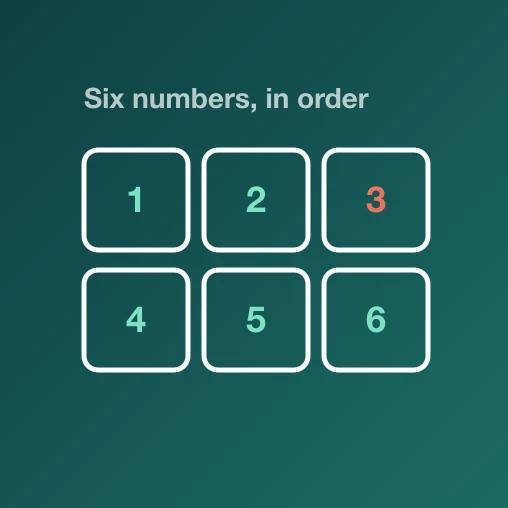
Check five things in order: usage, leak, AHI, event mix and pressure. Then read each number by brand, with a worked night, a 90-day trend and 27 primary sources.
Upload your SD card and see your nights in plain English. Free to start.
 DashboardSleep Score, AHI band, leak and pressure
 Trends & historyA year down to a night
 Breath-by-breath viewerAirflow, pressure, leak tracesPro
 SpO₂ overlayOximeter data on the same nightPro
 Pressure insightsP95, set range, EPR and ramp
 SD card importDrop the card folder, only new nights added
 Mask fit & gearWhich mask actually seals
 Ask your dataPlain-English questions, your own AI keyBYOK
 Year in SleepYour therapy year in one storyNew
 Compliance reportFinds the qualifying window for youPro
 Share with your doctorRead-only, revocable links
 Companion appiPhone, iPad and Android
 Privacy & securityYour data, locked to you
 ResMed AirSense 10 & 11Supported
 ResMed AirCurve 10 & 11 VAutoSupported
 ResMed S9 / LumisSupported
 Philips DreamStation 1In testing
 Fisher & Paykel SleepStyleIn testing
 Löwenstein / DeVilbissWaitlist
 React Health Luna G3In testing
 Transcend MicroWaitlist
 Full face masksFit, leak signature, Mask Analytics
 Nasal masksOver-nose and cradle styles
 Nasal pillowsMinimal-contact fit tips
 Wellue O2RingSupported
 Contec CMS50 familySupported
 Apple Health / Health ConnectResting HR, HRV, SpO₂, sleepSupported
 Mask finderSeven questions, a ranked mask typeYour data
 Machine finderA two-machine shortlist for your prescription
 What is AHI?The apnea-hypopnea index, explained
 What is a good AHI on CPAP?
 CPAP leak rate explained
 Pressure settings explained
 Reading CPAP waveformsAll 17 explainers
 Apnealytics vs SleepHQ
 Apnealytics vs OSCAR
 Apnealytics vs myAir
 Apnealytics vs DreamMapper
 SleepHQ vs OSCARBest CPAP apps in 2026
 How to read CPAP dataStart here: six numbers, in order
 Read your CPAP SD card
 Share data with your doctorChoosing a CPAP mask
 Travel with CPAPAll 11 guides
 iPhone / iPhone DuoLast night before you are out of bed. Apple Health vitals, Face ID.Live
 iPadSame universal app, side-by-side panes and full-width waveforms.Live
 AndroidPhones, tablets and foldables, with Health Connect built in.Live
 Web portalWhere your SD card goes. Every chart, report and setting.Live


